
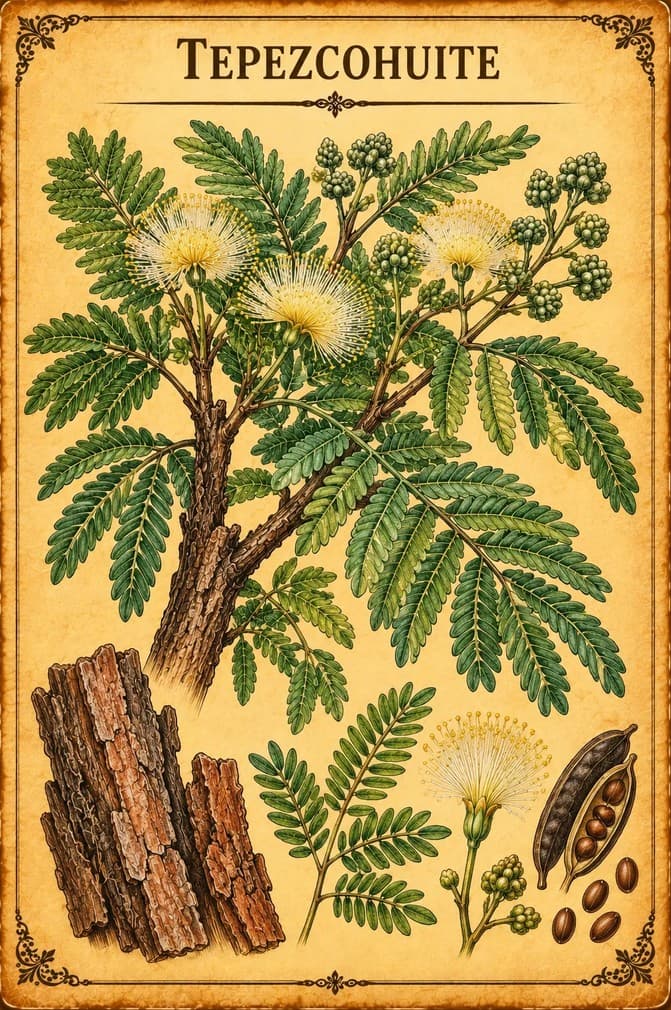
Tepezcohuite
Mimosa tenuiflora
A tree from southern Mexico to Brazil whose bark is used on wounds and burns. Two small trials of a bark gel for leg ulcers disagreed.
Safety at a glance
- Pregnancy2 notes →
- BreastfeedingNothing recorded
- MedicinesNothing recorded
- Who should avoid it1 note →
- AllergiesNothing recorded
- Toxicity3 notes →
Tap a box to read the safety notes below. “Nothing recorded” means our sources don't cover it, not that it's safe.
What is Tepezcohuite?
- Plant family
- Fabaceae, the pea and bean family
- Parts used
- The bark
- Where it grows
- Southern Mexico (Oaxaca and Chiapas) through Central America to Colombia, Venezuela and Brazil
- Genus
- Mimosa
- Species
- tenuiflora
Also called
Tepescohuite, Jurema Preta, Jurema, Calumbi
Older scientific names
Mimosa hostilis
Traditionally used for
- Wounds and burns (traditional)
- Leg ulcers (mixed trial results)
- Skin aging (unproven)
Traditionally described as
- Rich in tannins
- Contains DMT (a hallucinogen)
Health topics
Where Tepezcohuite appears in symptom search, and why. Being listed doesn't mean it's a proven treatment.
- Cuts, Wounds, Burns and Skin Ulcers
Used on wounds and burns in Mexico. Of two small trials of a bark gel for leg ulcers, one found it helped and one found no benefit.
How it's prepared
Common ways Tepezcohuite is prepared or sold. This isn't advice on how to take it; see Safety below.
- Capsule
It's also sold in capsules.[1]Study
- Powder
The powdered bark is put on skin wounds and burns.[1]Study
- Salve
The bark is made into ointments, and it's sold in creams, shampoos and soaps.[1]Study
- Tea / Infusion
In southern Mexico, the bark is made into a tea that's used on skin wounds and burns.[1]Study
Safety
Who should avoid it
Its safety isn't known for people who take medicines, have health conditions, or are breastfeeding, so it's best avoided in these cases.[2]General reference
Side effects
Few side effects have been reported when it's used on the skin. Burning, tingling or skin irritation can happen.[2]General reference
Pregnancy
Don't use tepezcohuite if you're pregnant. In a study of pregnant goats fed the fresh plant, 3 of 4 kids were born with defects such as cleft lip and eye problems.[3]Study
In pregnant rats fed feed containing 10% tepezcohuite seeds, 40 of 101 unborn young had bone defects, compared with 3 of 58 in untreated rats.[4]Study
Toxicity testing
A 2021 review of 24 studies found the plant can cause birth defects, miscarriage and death of unborn young in farm animals, especially sheep and goats. The cause may be DMT, a mind-altering compound the plant contains.[5]Review or trial
Both the stem bark and the root bark contain DMT, a strong hallucinogen.[6]Study
The bark and roots are mind-altering when swallowed, and in ceremonies they're combined with MAO inhibitors to cause short-term hallucinations. Healthline advises not taking tepezcohuite by mouth because its safety is unknown, and using it only on the skin after checking with a health professional.[2]General reference
What does the research say?
Traditional use
These are traditional uses, not proven treatments.
In southern Mexico, tepezcohuite bark is used on skin wounds and burns as a tea, powder or ointment, and the wood is used for fuel and fences. Its use on burns became widely popular in Mexico after disasters in the 1980s, when news reports spread many myths about it. Today it's sold in shampoos, creams, soaps and capsules.[1]Study
According to Healthline, the Red Cross used tepezcohuite bark powder to treat more than 5,000 people burned in the 1984 gas explosion in Mexico City. In traditional medicine it has also been used for coughs, bronchitis, vaginal infections, stomach ulcers and pain. In Brazil, the bark and root are made into a mind-altering drink for the religious ceremony called Jurema.[2]General reference
In Bahia, Brazil, where it's called jurema preta, the bark is used for coughs and to heal wounds.[7]Study
Laboratory & animal research
Lab and animal results show what might be worth studying in people. They don't show that the herb has these effects in humans.
The bark is rich in tannins (about 16% in genuine samples), which are thought to be behind its wound-healing effects. Commercial tepezcohuite powder is sometimes mixed with other plant material, so its identity can't always be trusted.[8]Study
In a lab study on human skin cells, sugar compounds (arabinogalactans) from the bark helped the cells that build skin tissue grow. A plain water extract had the opposite effect at the doses tested.[9]Study
In mice, a bark extract reduced pain responses and lowered signs of inflammation. This hasn't been tested in people.[7]Study
Technical detail: ethanolic bark extract 50–200 mg/kg; writhing, formalin and von Frey tests; sakuranetin identified as one active flavone.
Research in people
In a small trial in Mexico of people with leg ulcers caused by poor vein circulation, a gel with 5% tepezcohuite bark extract was compared with the same gel without it, along with cleaning and dressings. After 8 weeks, ulcers in the tepezcohuite group had shrunk by 92% on average, while only one person in the comparison group improved. No side effects were seen.[10]Study
A later trial in 41 people with the same kind of leg ulcers, also using compression bandages, found no difference: ulcers shrank about as much with the plain gel as with the tepezcohuite gel.[11]Study
Technical detail: mean area reduction 6.29 cm² (MTC-2G) vs 5.85 cm² (hydrogel), P = 0.815; 32 of 41 completed.
A 2017 review combined the two tepezcohuite gel trials (42 people in total) and called it a promising treatment for leg ulcers. The two trials' results differed widely, so the evidence is weak.[12]Review or trial
Technical detail: heterogeneity I² = 84%; mean Jadad score of included studies 2.5.
There are no trials of tepezcohuite for skin aging, acne or psoriasis, or for any use by mouth.[2]General reference
In short
Caused birth defects in animals; avoid in pregnancy. Don't take by mouth.
Sources
- [1] Description, distribution, anatomy, chemical composition and uses of Mimosa tenuiflora (Fabaceae-Mimosoideae) in MexicoPeer-reviewed study
- [2] What Is Tepezcohuite, and Does It Benefit Your Skin? — HealthlineGeneral reference
- [3] Mimosa tenuiflora as a cause of malformations in ruminants in the northeastern Brazilian semiarid rangelands · DOI: 10.1354/vp.44-6-928Peer-reviewed study
- [4] Teratogenicity of Mimosa tenuiflora seeds to pregnant rats · DOI: 10.1016/j.toxicon.2007.06.012Peer-reviewed study
- [5] Phytochemistry and teratogenic potential of Mimosa tenuiflora (Willd.) Poir. (Fabaceae) in ruminants: A systematic review · DOI: 10.1016/j.toxicon.2021.03.010Review or clinical trial
- [6] Extraction and Characterization of N,N-Dimethyltryptamine from Mimosa tenuiflora: A Multivariate Approach · DOI: 10.1021/acsomega.5c06560Peer-reviewed study
- [7] Antinoceptive and Anti-inflammatory Activities of the Ethanolic Extract, Fractions and Flavones Isolated from Mimosa tenuiflora (Willd.) Poir (Leguminosae) · DOI: 10.1371/journal.pone.0150839Peer-reviewed study
- [8] Pharmacognostical studies of the plant drug Mimosae tenuiflorae cortex · DOI: 10.1016/j.jep.2007.06.023Peer-reviewed study
- [9] Arabinogalactans from Mimosa tenuiflora (Willd.) Poiret bark as active principles for wound-healing properties · DOI: 10.1016/j.jep.2009.05.034Peer-reviewed study
- [10] Therapeutic effectiveness of a Mimosa tenuiflora cortex extract in venous leg ulceration treatment · DOI: 10.1016/j.jep.2006.08.032Peer-reviewed study
- [11] A randomised comparative trial on the use of a hydrogel with tepescohuite extract (Mimosa tenuiflora cortex extract-2G) in the treatment of venous leg ulcers · DOI: 10.1111/j.1742-481x.2011.00900.xPeer-reviewed study
- [12] The use of medicinal plants in venous ulcers: a systematic review with meta-analysis · DOI: 10.1111/iwj.12751Review or clinical trial
This information is educational and traditional in nature, and is not a substitute for professional medical advice. Unfamiliar word? See what these words mean.