
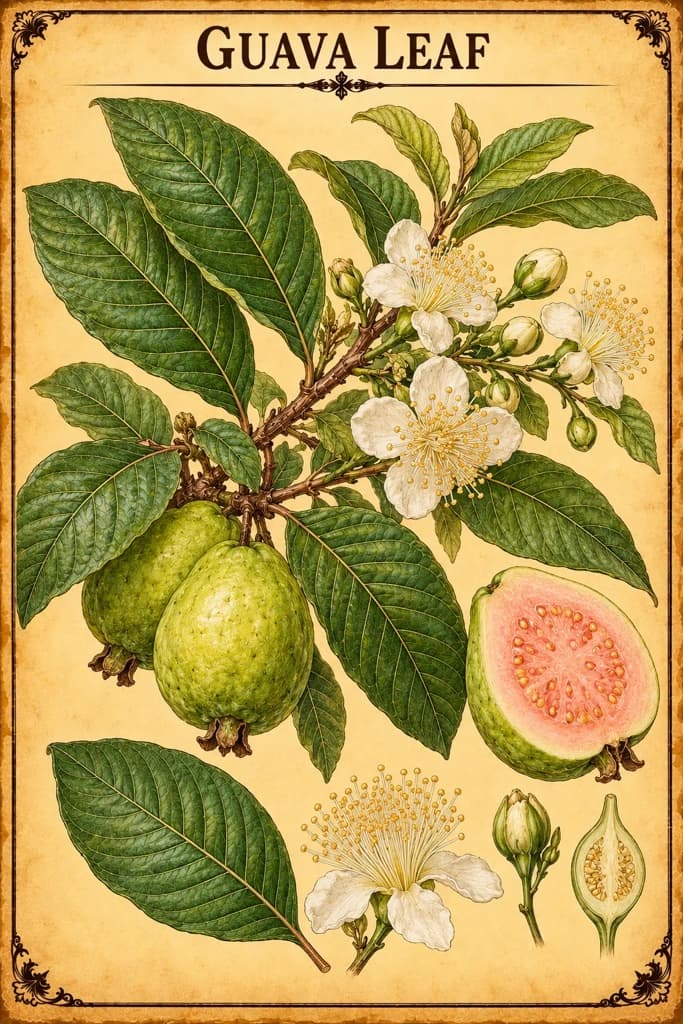
Guava Leaf
Psidium guajava
The leaves of the guava tree, widely used as a tea for diarrhea in the Caribbean, Latin America, Africa and Asia. Small trials have tested it for diarrhea, blood sugar after meals and gum inflammation.
Safety at a glance
- Pregnancy1 note →
- Breastfeeding1 note →
- Medicines1 note →
- Who should avoid it1 note →
- AllergiesNothing recorded
- ToxicityNothing recorded
Tap a box to read the safety notes below. “Nothing recorded” means our sources don't cover it, not that it's safe.
What is Guava Leaf?
- Plant family
- Myrtaceae, the myrtle family
- Parts used
- The leaves, often the young shoots and flower buds
- Where it grows
- Probably from the Brazilian Amazon; now grown in tropical and subtropical regions worldwide
- Genus
- Psidium
- Species
- guajava
Also called
Guava
Regional names
Guayaba, Goyave
Traditionally used for
- Diarrhea
- Vomiting
- Skin rashes
- Pimples
- Diabetes
- Ataque de nervios (traditional)
Traditionally described as
- Leaf tea for diarrhea
- Leaf wash for skin
Health topics
Where Guava Leaf appears in symptom search, and why. Being listed doesn't mean it's a proven treatment.
- Diarrhea
Traditional use in many countries. In one 5-day trial in 109 adults, people taking a guava leaf decoction recovered from sudden diarrhea faster than a comparison group given oral rehydration solution. Everyone knew which treatment they got.
- High Blood Sugar
Traditionally used for diabetes in East Asia. Small studies of a Japanese guava leaf tea found it lowered the rise in blood sugar after meals. The studies were reported by the tea's maker.
- Occasional Nausea
Traditional use only: in the Caribbean, a tea of the leaves or young shoots is used for vomiting. Not studied in people.
- Skin Irritation, Rashes and Itching
Traditional use only: in the Caribbean, a boiled leaf wash or bath is used for skin rashes and pimples. Not studied in people.
Traditions that use it
- African Traditional Medicine
Leaf and bark teas for diarrhea and stomachache.
- Caribbean Folk Medicine
Leaf and shoot teas for diarrhea, vomiting and ataque de nervios, and a leaf wash for skin rashes and pimples.
How it's prepared
Common ways Guava Leaf is prepared or sold. This isn't advice on how to take it; see Safety below.
- Decoction
TRAMIL's recipe for diarrhea or vomiting: 30 grams of fresh leaves (young shoots preferred) boiled for 5 minutes in 1 liter (4 cups) of water, optionally with a little salt and sugar; 1 cup 3 to 4 times a day.[1]Traditional text
- Tea / Infusion
In Japan, a guava leaf tea made from a water extract of the leaves is sold as a food for blood sugar after meals.[2]Study
Safety
Interactions with medicines
No interactions causing low blood sugar were seen when people took guava leaf tea with their diabetes medicines (insulin, sulfonylureas or biguanides such as metformin), with or without a statin for cholesterol. These were small studies reported by the tea's maker.[2]Study
Who should avoid it
TRAMIL advises against giving it to children under 3.[1]Traditional text
Side effects
Pregnancy
TRAMIL advises against using it during pregnancy.[1]Traditional text
Breastfeeding
TRAMIL advises against using it while breastfeeding.[1]Traditional text
Depends on how it's prepared
For diarrhea, use it alongside oral rehydration, not instead of it.
Get medical help right away if someone with diarrhea shows signs of dehydration:
- a dry tongue
- skin that stays tented when pinched
- passing little urine
- crying without tears
See a doctor if diarrhea lasts more than 3 days (1 day in children), if a skin problem lasts more than 5 days, or if the person gets worse. Don't keep a prepared tea for more than 24 hours, even in the fridge.[1]Traditional text
What does the research say?
Traditional use
These are traditional uses, not proven treatments.
TRAMIL, a Caribbean research program, records these traditional uses of the leaves, young shoots and flower buds:
- Diarrhea: a tea, sometimes with salt or sugar.
- Ataque de nervios (a "nervous attack"): a leaf tea.
- Skin pimples and rashes: a boiled leaf wash or bath.
- Dizziness from drunkenness, and vomiting: a tea of the leaves or shoots.
TRAMIL recognizes all of these uses, based on how widely they're used and on safety studies.[1]Traditional text
A 2024 review found guava used for diarrhea in traditional medicine in 44 countries. The leaves were the part mentioned most often, usually boiled into a tea and drunk. Leaf and bark teas have been used for diarrhea and stomachache in the Americas, Africa and Asia.[4]Study
In East Asia and other countries, guava leaf extract has traditionally been used for diabetes.[2]Study
Laboratory & animal research
Lab and animal results show what might be worth studying in people. They don't show that the herb has these effects in humans.
In lab tests, a water extract of the leaves blocked gut enzymes that break down sugars. In diabetic mice, it improved blood sugar, insulin and blood fat levels.[2]Study
Technical detail: alpha-glucosidase inhibition; improvements in hyperglycemia, hyperinsulinemia, hypoadiponectinemia, hypertriglyceridemia and hypercholesterolemia in murine models.
In lab and animal studies, about 27 compounds from guava have shown activity against diarrhea or bacteria.[4]Study
Technical detail: benzophenone glycosides, terpenes, polysaccharides, phenols and flavonoids, including quercetin and its glycosides.
In mice, a single large dose of an alcohol-based leaf extract (2,000 mg per kg of body weight) caused no poisoning or deaths. Daily doses of up to 1,000 mg per kg for 28 days caused no harmful changes in blood tests or organs.[5]Study
Technical detail: OECD 425 (acute) and OECD 407 (28-day sub-acute) guidelines; 250, 500 and 1000 mg/kg/day.
In mice and rats, powdered dried leaves didn't damage genes, and single doses of 2 g per kg of body weight caused no deaths or signs of poisoning.[1]Traditional text
Technical detail: micronucleus test in mouse bone marrow; oral LD50 in mice above 2 g/kg; no histopathological changes in rats over 14 days.
Research in people
In a 5-day trial in India, 109 adults with sudden, uncomplicated diarrhea took a guava leaf decoction (made from 6, 10 or 14 leaves) three times a day, or were given oral rehydration solution as a comparison.
The 14-leaf decoction (7.4 g of leaves) worked best: people were back to normal in about 72 hours, compared with 120 hours in the comparison group. Blood, liver and kidney tests stayed normal, and no side effects were reported. Everyone knew which treatment they got, which can bias results.[3]Study
Technical detail: randomized, open-label, parallel-group, multi-arm; Sardar variety; outcomes were stool frequency and consistency; retrospectively registered (CTRI/2016/07/007095).
Studies of a Japanese guava leaf tea (Bansoureicha) in people:
- In people with type 2 diabetes, one 200 mL serving with a meal lowered the rise in blood sugar after eating, though less than the diabetes medicine voglibose.
- In 15 men with prediabetes or mild type 2 diabetes who drank it with every meal for 12 weeks, fasting blood sugar dipped slightly and insulin levels fell. Cholesterol and triglycerides fell in those whose levels started high.
These studies were small. The review describing them was written by researchers at Yakult, which makes the tea, and one author holds patents on it.[2]Study
Technical detail: fasting blood glucose 136 to 131 mg/dL (p = 0.07; the reduction rate was significant); insulin, C-peptide and HOMA-IR significantly decreased; approved in Japan as a Food for Specified Health Uses.
In a trial in India, 60 people with gum inflammation (gingivitis) had a professional teeth cleaning, then used a mouthwash for 30 days: 0.15% guava leaf, 0.2% chlorhexidine (a standard antiseptic mouthwash) or plain water.
Gum inflammation, plaque and bacteria went down in all three groups. The guava and chlorhexidine groups improved more than the water group. The authors say longer studies are needed.[6]Study
Technical detail: randomized, placebo-controlled; gingival index, plaque index and colony-forming units measured at baseline, 30 and 90 days; no significant difference in salivary antioxidant levels.
In short
TRAMIL advises against it in pregnancy, breastfeeding and children under 3; get medical help for diarrhea with signs of dehydration.
Sources
- [1] Psidium guajava — TRAMIL (Traditional Medicine in the Islands)Traditional text
- [2] Anti-hyperglycemic and anti-hyperlipidemic effects of guava leaf extract · DOI: 10.1186/1743-7075-7-9Peer-reviewed study
- [3] A randomized open label efficacy clinical trial of oral guava leaf decoction in patients with acute infectious diarrhoea · DOI: 10.1016/j.jaim.2020.04.001Peer-reviewed study
- [4] Ethnobotany, phytochemistry, and biological activities of Psidium guajava in the treatment of diarrhea: a review · DOI: 10.3389/fphar.2024.1459066Peer-reviewed study
- [5] Acute and sub-acute toxicological studies on the ethanol leaf extract of Psidium guajava in experimental mice · DOI: 10.11604/pamj.2026.53.49.49406Peer-reviewed study
- [6] Evaluation of a mouthrinse containing guava leaf extract as part of comprehensive oral care regimen: a randomized placebo-controlled clinical trial · DOI: 10.1186/s12906-019-2745-8Peer-reviewed study
This information is educational and traditional in nature, and is not a substitute for professional medical advice. Unfamiliar word? See what these words mean.