
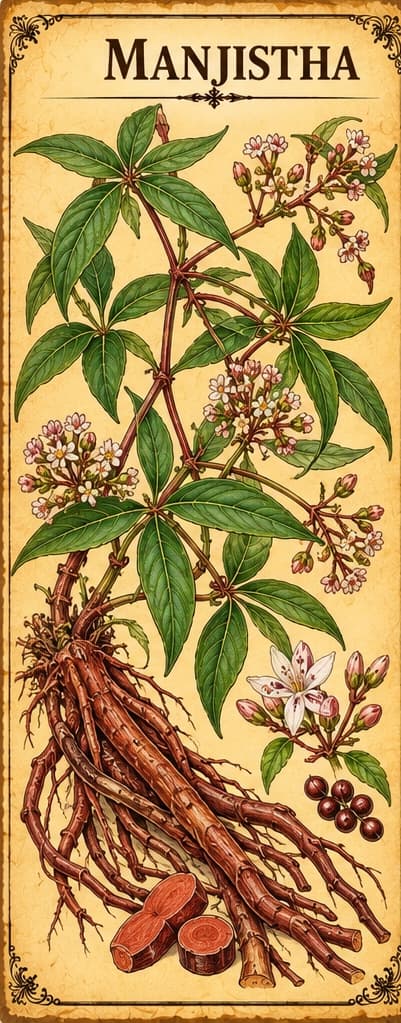
Manjistha
Rubia cordifolia
A climbing plant with long red roots, used in Chinese medicine to stop bleeding and in Ayurveda for inflammation, skin problems and menstrual pain. Most research is in labs and animals.
Safety at a glance
- PregnancyNothing recorded
- BreastfeedingNothing recorded
- MedicinesNothing recorded
- Who should avoid itNothing recorded
- AllergiesNothing recorded
- ToxicityNothing recorded
Tap a box to read the safety notes below. “Nothing recorded” means our sources don't cover it, not that it's safe.
What is Manjistha?
- Plant family
- Rubiaceae, the coffee family
- Parts used
- Mainly the root; the leafy stems are also used in China
- Where it grows
- Africa, tropical Asia including India and Malaysia, China, Japan and tropical Australia
- Genus
- Rubia
- Species
- cordifolia
Regional names
Qiancaogen, Chien-tsao
Traditional names
Manjishtha
Traditionally used for
- Bleeding
- Menstrual pain
- Rheumatism
- Skin discoloration
- Wounds
- Diarrhea (traditional)
Traditionally described as
- Stops bleeding (Chinese medicine)
- Cooling
Health topics
Where Manjistha appears in symptom search, and why. Being listed doesn't mean it's a proven treatment.
- Cuts, Wounds, Burns and Skin Ulcers
Traditional use only: used for wounds in Chinese medicine, and as a honey paste to help wounds heal in Ayurveda. Not studied in people.
- Diarrhea
Traditionally used for diarrhea in Shaanxi, China. A leafy-stem extract reduced diarrhea in mice; it hasn't been tested in people.
- Joint Discomfort
Traditional use only: used for rheumatism and arthritis in India and Korea. Not studied in people.
- Menstrual Discomfort
Traditionally used for menstrual pain in India and Korea, and in Chinese formulas for painful periods. Not tested on its own in people.
Traditions that use it
- Ayurveda
Applied to inflamed areas, ulcers and fractures, used for long-lasting inflammation, and mixed with honey for skin discoloration.
- Traditional Chinese Medicine
The root (qiancaogen) is used mainly to stop bleeding; it's listed in the Chinese Pharmacopoeia.
What does the research say?
Traditional use
These are traditional uses, not proven treatments.
In traditional Chinese medicine, the root (qiancaogen) is described as bitter and cooling. It's used mainly to stop bleeding, such as vomiting blood, heavy menstrual bleeding and nosebleeds, and for wounds, injuries and strains. It's officially listed in the Chinese Pharmacopoeia.[1]Study
Uses in other traditions:
- India: rheumatism, menstrual pain, urinary problems, fluid swelling, paralysis, missed periods and jaundice.
- Ayurveda: used to color medicinal oils, applied to inflamed areas, ulcers and fractures, and used for long-lasting inflammation. A paste with honey is put on the skin to fade brown spots and freckles and to help wounds heal.
- Korea: menstrual pain, arthritis, rheumatism, bleeding and urinary problems.
In China today, herbal prescriptions that include manjistha are used for abnormal uterine bleeding, painful periods, allergic purpura (a bleeding rash) and bleeding from the kidneys.[1]Study
In Shaanxi province, China, a water extract of the leafy stems is traditionally used for diarrhea.[2]Study
Laboratory & animal research
Lab and animal results show what might be worth studying in people. They don't show that the herb has these effects in humans.
In mice, a water extract of the leafy stems delayed and reduced diarrhea. In rats with chemically caused colitis (inflammation of the large bowel), it reduced bowel damage and inflammation.[2]Study
Technical detail: senna leaf-induced diarrhea and castor oil-induced intestinal transit, compared with loperamide; TNBS colitis with lower MDA, IL-1β and TNF-α.
More than 100 compounds have been found in the plant, mostly quinones and peptides. In lab and animal studies, it has slowed tumors, shown antioxidant activity, may have helped reduce inflammation, and slowed blood clotting. Most research is lab and animal work, few studies have looked at toxicity, and safety data in people is lacking.[1]Study
Technical detail: bicyclic peptides, anthraquinones, terpenes, polysaccharides and flavonoids; anti-platelet aggregation activity.
In short
Safety data in people is lacking; most research has been in labs and animals.
Sources
- [1] A comprehensive review of Rubia cordifolia L.: Traditional uses, phytochemistry, pharmacological activities, and clinical applications · DOI: 10.3389/fphar.2022.965390Peer-reviewed study
- [2] Anti-diarrheal and anti-inflammatory activities of aqueous extract of the aerial part of Rubia cordifolia · DOI: 10.1186/s12906-016-1527-9Peer-reviewed study
This information is educational and traditional in nature, and is not a substitute for professional medical advice. Unfamiliar word? See what these words mean.