
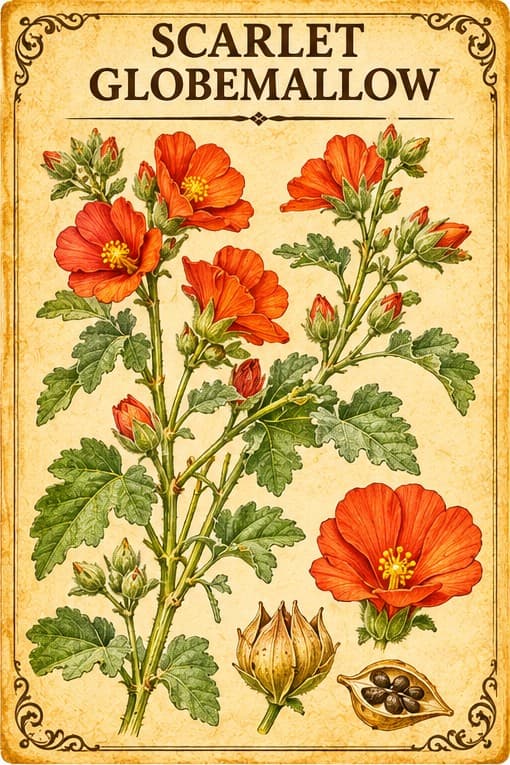
Scarlet Globemallow
Sphaeralcea coccinea
A mallow of western and central North America. Plains and Southwestern peoples chewed it into a cooling salve for sores and wounds.
Safety at a glance
- Pregnancy1 note →
- BreastfeedingNothing recorded
- MedicinesNothing recorded
- Who should avoid itNothing recorded
- AllergiesNothing recorded
- ToxicityNothing recorded
Tap a box to read the safety notes below. “Nothing recorded” means our sources don't cover it, not that it's safe.
What is Scarlet Globemallow?
- Plant family
- Malvaceae, the mallow family
- Parts used
- The whole plant, especially the deep, gummy roots
- Where it grows
- British Columbia to Manitoba, south to Arizona, New Mexico, Texas and northern Mexico
- Genus
- Sphaeralcea
- Species
- coccinea
Also called
Caliche Globemallow, Common Globemallow, Red False Mallow, Scarlet Falsemallow
Older scientific names
Malvastrum coccineum
Traditionally used for
- Sores
- Wounds
- Swellings (traditional)
Traditionally described as
- Pounds into a gummy paste
Health topics
Where Scarlet Globemallow appears in symptom search, and why. Being listed doesn't mean it's a proven treatment.
- Cuts, Wounds, Burns and Skin Ulcers
Chewed plant or roots were put on sores and wounds by the Dakota and Lakota. Not studied in people.
- Joint Discomfort
A gel from a related species, Sphaeralcea angustifolia, eased hand osteoarthritis about as well as diclofenac gel in one trial. Scarlet globemallow itself hasn't been tested.
- Loss of Appetite
The Kayenta Navajo used it as a tonic to improve appetite. Not studied in people.
Traditions that use it
- Native American Ethnobotany
Used by the Blackfoot, Lakota, Dakota, Navajo, Cheyenne, Comanche, Acoma and Laguna peoples.
How it's prepared
Common ways Scarlet Globemallow is prepared or sold. This isn't advice on how to take it; see Safety below.
- Poultice
Chewed roots or plant put on sores and wounds.[1]Traditional text
Safety
Side effects
It isn't known whether globemallow is safe to take or what side effects it might cause.[2]General reference
Pregnancy
Not enough is known about using globemallow during pregnancy or while breastfeeding, so it's best avoided. The Acoma and Laguna did give the roots to pregnant women as a medicine.[2]General reference
What does the research say?
Traditional use
These are traditional uses, not proven treatments.
The Dakota and Lakota chewed the plant or its roots and put it on sores and wounds as a cooling, healing salve. The Kayenta Navajo used the dried plant as a dusting powder for sores and as a lotion for skin problems, and the Comanche used a tea of it for swellings.[1]Traditional text
In Lakota and Dakota ceremonies, medicine men rubbed the chewed roots on their hands to protect them from boiling water. The Navajo used it as a tonic to improve appetite and a tea of it to stop bleeding.[1]Traditional text
The Cheyenne mixed a tea of the plant into other medicines to make them taste better. The Navajo chewed the roots when food was scarce.[1]Traditional text
The Blackfoot chewed the plant into a paste used as a healing salve for sores and wounds. Blackfoot medicine men also spread the paste on their hands and arms so they could take items out of boiling water. The Acoma and Laguna gave the roots as a medicine to pregnant women.[3]Health agency
The Navajo call it a medicine plant with gummy roots. The Gosiute pounded it into a gummy paste to seal small holes inside clay dishes. Today it's planted as a drought-tolerant native wildflower and in land restoration, and it's good forage for deer and pronghorn.[3]Health agency
In Mexico a related species, Sphaeralcea angustifolia (vara de San José), is put on the skin for inflammation and rheumatism, and taken by mouth for stomach and gut problems.[4]Study
Research in people
Scarlet globemallow itself hasn't been tested in people. In a 4-week trial of 113 people with hand osteoarthritis, a gel made from the related Sphaeralcea angustifolia worked about as well as 2% diclofenac gel, a standard pain-relief gel. Neither gel caused side effects in the trial.[5]Study
There isn't enough evidence to rate globemallow for any use, including coughs, colds, diarrhea, sores, burns or wounds.[2]General reference
In short
No human or safety studies were found.
Sources
- [1] Native American Ethnobotany Database: Sphaeralcea coccinea — Botanical Research Institute of Texas (BRIT); compiled by Daniel E. MoermanTraditional text
- [2] Globemallow: Health Benefits, Side Effects, Uses, Dose & Precautions — RxList (WebMD), based on the Natural Medicines Comprehensive DatabaseGeneral reference
- [3] Scarlet globemallow (Sphaeralcea coccinea). In: Western forbs: Biology, ecology, and use in restoration — USDA Forest Service, Rocky Mountain Research Station; Great Basin Fire Science ExchangeGovernment health agency
- [4] The Journey of a Medicinal Plant throughout Science: Sphaeralcea angustifolia (Cav.) G. Don (Malvaceae) · DOI: 10.3390/plants12020321Peer-reviewed study
- [5] Clinical trial for evaluating the effectiveness and tolerability of topical Sphaeralcea angustifolia treatment in hand osteoarthritis · DOI: 10.1016/j.jep.2013.03.040Peer-reviewed study
This information is educational and traditional in nature, and is not a substitute for professional medical advice. Unfamiliar word? See what these words mean.