
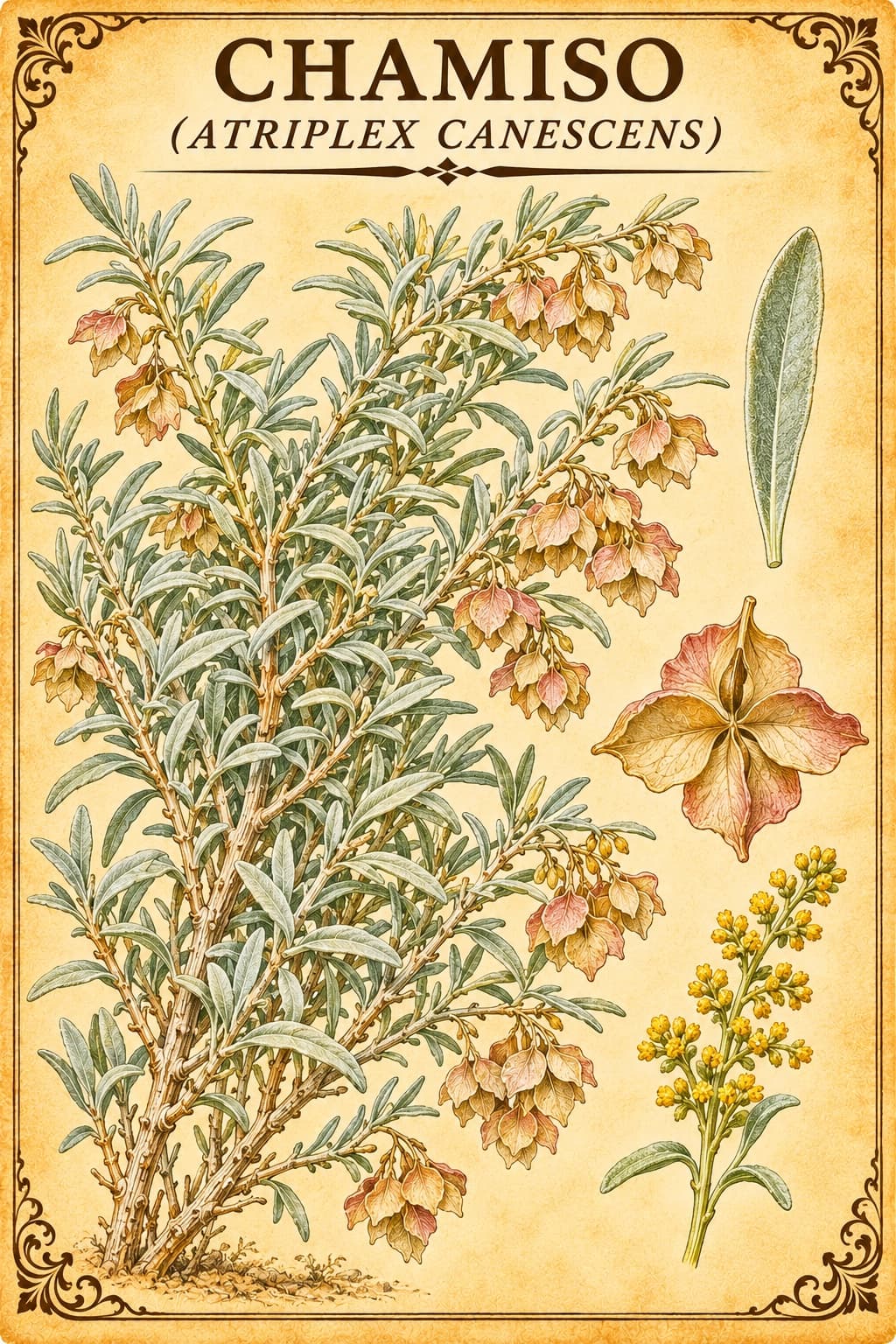
Chamiso
Atriplex canescens
Four-wing saltbush, a shrub of the western US. Southwestern peoples put its leaves on ant bites and used its ashes like baking soda to keep blue corn blue.
Safety at a glance
- PregnancyNothing recorded
- BreastfeedingNothing recorded
- MedicinesNothing recorded
- Who should avoid itNothing recorded
- AllergiesNothing recorded
- ToxicityNothing recorded
Tap a box to read the safety notes below. “Nothing recorded” means our sources don't cover it, not that it's safe.
What is Chamiso?
- Plant family
- Amaranthaceae, the amaranth family
- Parts used
- The leaves, roots, flowers, seeds and ashes
- Where it grows
- Western North America
- Genus
- Atriplex
- Species
- canescens
Also called
Four-wing Saltbush, Fourwing Saltbush
Traditionally used for
- Ant bites
- Itchy rashes
- Cough (traditional)
Traditionally described as
- Salty leaves; alkaline ashes
Health topics
Where Chamiso appears in symptom search, and why. Being listed doesn't mean it's a proven treatment.
- Cough
The Ramah Navajo took a tea of the leaves or roots for a bad cough. Not studied in people.
- Skin Irritation, Rashes and Itching
A traditional Native American remedy for ant bites and itchy rashes. Not studied in people.
Traditions that use it
- Native American Ethnobotany
Used by the Navajo, Hopi, Zuni, Havasupai, Jemez, Tewa, Shoshoni and other peoples of the Southwest.
How it's prepared
Common ways Chamiso is prepared or sold. This isn't advice on how to take it; see Safety below.
- Poultice
Crushed leaves or flowers put on ant bites.[1]Traditional text
What does the research say?
Traditional use
These are traditional uses, not proven treatments.
The Navajo, Zuni and Jemez put crushed leaves or flowers on ant bites. The Havasupai whipped the leaves into a soapy lather to wash hair and soothe itchy rashes such as chickenpox and measles.[1]Traditional text
Ramah Navajo healers gave a tea of the leaves or roots for a bad cough, a tea of the tops or roots to bring up a painful stomach, and a warm root poultice for toothache. Leaves were used as a snuff for nose trouble.[1]Traditional text
The Hopi and Tewa use its ashes like baking soda in cooking, and to keep blue corn meal and piki bread blue. The Navajo dye wool yellow with the leaves and twigs, and feed the plant to sheep for salt in winter. The Gosiute ate the seeds.[1]Traditional text
Watch the name: in northern New Mexico, "chamiso" usually means big sagebrush (Artemisia tridentata), a different plant with different uses. "Chamisa" is rabbitbrush.[2]General reference
Outside the US, the leaves are used for stomach and gut infections in Mexico, and a leaf paste is put on snake bites in Gilgit-Baltistan, Pakistan.[3]Study
Laboratory & animal research
Lab and animal results show what might be worth studying in people. They don't show that the herb has these effects in humans.
In lab tests, a leaf extract slowed the growth of E. coli and Salmonella bacteria, and extracts killed mosquito larvae. Very little else has been studied; the leaves contain 20-hydroxyecdysone, a plant steroid, and betaine.[3]Study
In short
No human or safety studies were found.
Sources
- [1] Native American Ethnobotany Database: Atriplex canescens — Botanical Research Institute of Texas (BRIT); compiled by Daniel E. MoermanTraditional text
- [2] Herb of the month: Chamiso — The Taos NewsGeneral reference
- [3] The Therapeutic Properties, Ethno pharmacology and Phyto-chemistry of Atriplex Species: A review · DOI: 10.52700/pjbb.v2i1.38Peer-reviewed study
This information is educational and traditional in nature, and is not a substitute for professional medical advice. Unfamiliar word? See what these words mean.