
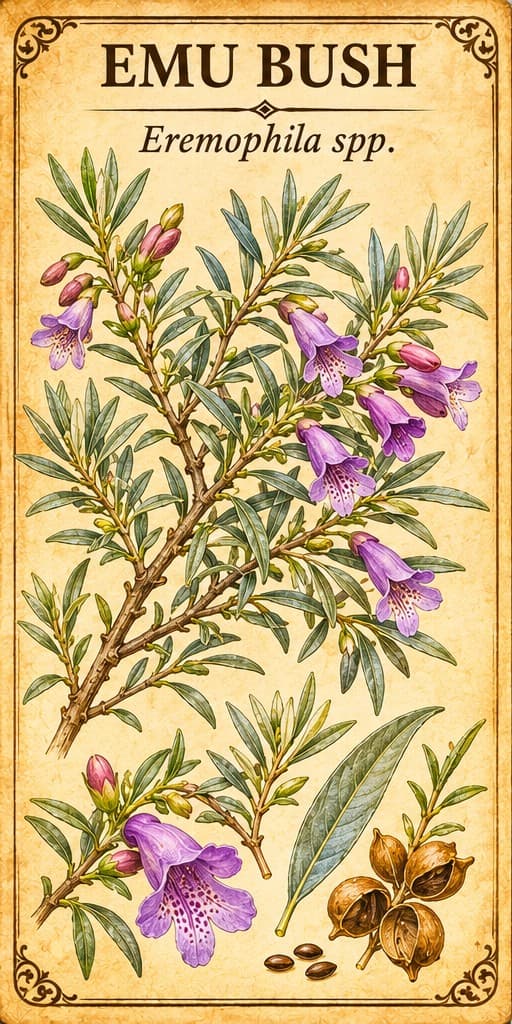
Emu Bush
Eremophila spp.
A group of about 200 Australian desert shrubs, many of them traditional medicines of the First Australians for colds, flu, wounds and skin infections.
Safety at a glance
- PregnancyNothing recorded
- BreastfeedingNothing recorded
- MedicinesNothing recorded
- Who should avoid itNothing recorded
- AllergiesNothing recorded
- ToxicityNothing recorded
Tap a box to read the safety notes below. “Nothing recorded” means our sources don't cover it, not that it's safe.
What is Emu Bush?
- Plant family
- Scrophulariaceae, the figwort family
- Parts used
- The leaves and twigs
- Where it grows
- Arid and semi-arid Australia
- Genus
- Eremophila
- Species
- spp.
Also called
Poverty Bush
Traditionally used for
- Colds and flu
- Wounds
- Skin infections
- Scabies (traditional)
Traditionally described as
- Leaves rich in terpenoids that kill germs in lab tests
Health topics
Where Emu Bush appears in symptom search, and why. Being listed doesn't mean it's a proven treatment.
- Colds and Nasal Congestion
Leaf decoctions were a widely used First Australian remedy for colds and flu. Not studied in people.
- Cuts, Wounds, Burns and Skin Ulcers
Leaf decoctions were used as hot baths for wounds and skin infections. Not studied in people.
- Head Lice and Scabies
Several species were used as a body wash for scabies. Not studied in people.
Safety
Depends on how it's prepared
There are about 200 species and their uses differ, so the traditional uses of one species don't apply to all of them. No human safety studies were found.[1]Study
What does the research say?
Traditional use
These are traditional uses, not proven treatments.
There are about 200 Eremophila species across Australia's dry country, and many are traditional medicines of the First Australians. The name emu bush comes from the belief that emus eat the fruit.[1]Study
Leaf decoctions of several species were used as hot baths to treat wounds and skin infections, and as a body wash for scabies. Leaves and twigs were wrapped around the head for sinus problems and a blocked nose.[1]Study
Many First Australian groups drank Eremophila leaf decoctions for colds and flu, and used them for headaches and other aches and pains. Some species were also burned in smoking ceremonies.[1]Study
Several Eremophila species hold great cultural significance to Australia's First Peoples.[2]Study
Laboratory & animal research
Lab and animal results show what might be worth studying in people. They don't show that the herb has these effects in humans.
Lab studies have found that many species kill bacteria and fungi, largely due to compounds called terpenoids. Their effects in people haven't been studied.[1]Study
In short
Uses differ between species; no human safety studies were found.
Sources
- [1] Phytochemistry, Medicinal Properties, Bioactive Compounds, and Therapeutic Potential of the Genus Eremophila (Scrophulariaceae) · DOI: 10.3390/molecules27227734Peer-reviewed study
- [2] Biodiscoveries within the Australian plant genus Eremophila based on international and interdisciplinary collaboration: results and perspectives on outstanding ethical dilemmas · DOI: 10.1111/tpj.15866Peer-reviewed study
This information is educational and traditional in nature, and is not a substitute for professional medical advice. Unfamiliar word? See what these words mean.