
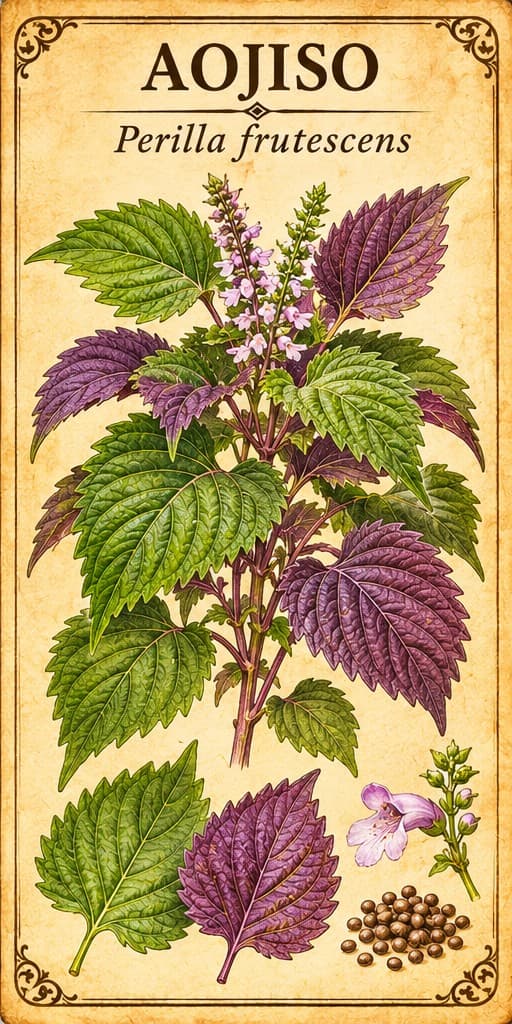
Aojiso
Perilla frutescens
Green shiso leaf, a Japanese herb and an official medicine in the Chinese and Japanese pharmacopoeias, used for colds, nausea and allergies. Perilla extracts eased hay fever in human studies.
Safety at a glance
- PregnancyNothing recorded
- BreastfeedingNothing recorded
- MedicinesNothing recorded
- Who should avoid itNothing recorded
- AllergiesNothing recorded
- ToxicityNothing recorded
Tap a box to read the safety notes below. “Nothing recorded” means our sources don't cover it, not that it's safe.
What is Aojiso?
- Plant family
- Lamiaceae, the mint family
- Parts used
- The leaves
- Where it grows
- East and South Asia
- Genus
- Perilla
- Species
- frutescens
Also called
Green Shiso, Shiso Leaf, Perilla Leaf
Traditional names
Perillae Folium
Traditionally used for
- Food
- Colds
- Nausea
- Hay fever
Traditionally described as
- Leaves rich in rosmarinic acid
Health topics
Where Aojiso appears in symptom search, and why. Being listed doesn't mean it's a proven treatment.
- Colds and Nasal Congestion
A traditional remedy for colds, flu and a stuffy nose. Not tested for colds in people.
- Hay Fever
Perilla extracts helped allergic hay fever and itchy eyes in human studies, especially in young people.
- Occasional Nausea
Traditionally used for nausea and vomiting. Not studied in people.
Traditions that use it
- Traditional Chinese Medicine
Perilla leaf (Perillae Folium) is listed in the Chinese and Japanese pharmacopoeias.
Natural compounds
What does the research say?
Traditional use
These are traditional uses, not proven treatments.
Perilla leaf is an official herbal medicine in the Chinese and Japanese pharmacopoeias. Perilla has traditionally been used for coughs, colds and flu, fever, headache, a stuffy nose, nausea and vomiting, indigestion, allergies and anxiety.[1]Study
The leaves are eaten as a spicy vegetable and herb across East Asia. Leaves range from green to purple, and both colors can appear in the same variety.[1]Study
Laboratory & animal research
Lab and animal results show what might be worth studying in people. They don't show that the herb has these effects in humans.
Rosmarinic acid, a main compound in perilla, reduced allergic reactions in rats and mice about as well as a whole perilla decoction.[2]Study
Research in people
A 2023 review of human studies found perilla extracts helped allergic hay fever and itchy, watery eyes, especially in young people, and lowered blood fats. Most perilla research is in animals and cells, so more controlled trials are needed.[2]Study
In short
Perilla seeds can cause serious allergic reactions.
Sources
- [1] Ethnomedicinal, Phytochemical and Pharmacological Investigations of Perilla frutescens (L.) Britt. · DOI: 10.3390/molecules24010102Peer-reviewed study
- [2] Applications of Perilla frutescens Extracts in Clinical Practice · DOI: 10.3390/antiox12030727Peer-reviewed study
This information is educational and traditional in nature, and is not a substitute for professional medical advice. Unfamiliar word? See what these words mean.