
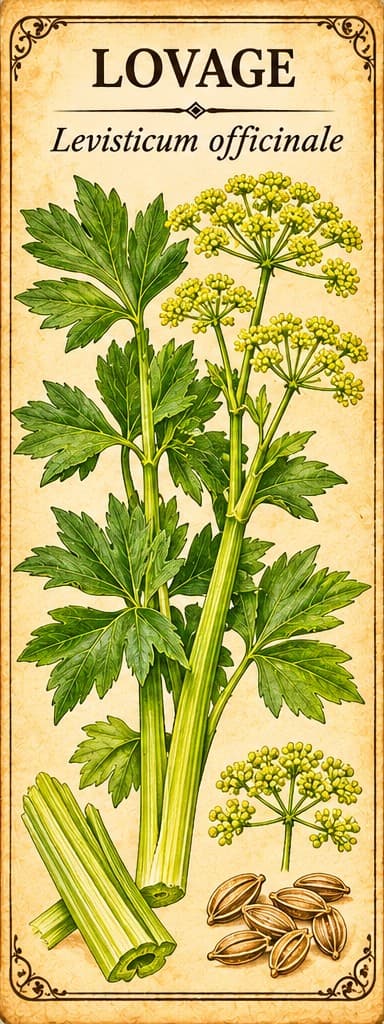
Lovage
Levisticum officinale
A celery-flavored herb whose root is an EU traditional herbal medicine to flush the urinary tract in minor urinary complaints.
Safety at a glance
- Pregnancy1 note →
- BreastfeedingNothing recorded
- MedicinesNothing recorded
- Who should avoid it1 note →
- AllergiesNothing recorded
- ToxicityNothing recorded
Tap a box to read the safety notes below. “Nothing recorded” means our sources don't cover it, not that it's safe.
What is Lovage?
- Plant family
- Apiaceae, the carrot and parsley family
- Parts used
- The root, leaves, stems and seeds
- Where it grows
- Southwest Asia
- Genus
- Levisticum
- Species
- officinale
Traditionally used for
- Minor urinary complaints
- Culinary herb
Traditionally described as
- Root rich in coumarins
Health topics
Where Lovage appears in symptom search, and why. Being listed doesn't mean it's a proven treatment.
- Bladder and Urinary Tract Infections (UTIs)
An EU traditional herbal medicine to flush the urinary tract in minor urinary complaints. See a doctor if you have fever, painful urination or blood in the urine.
Traditions that use it
- European Folk Medicine
Lovage root is an EU traditional herbal medicine for flushing the urinary tract.
How it's prepared
Common ways Lovage is prepared or sold. This isn't advice on how to take it; see Safety below.
- Tea / Infusion
2 to 3 g of root in 150 ml of boiling water, twice a day.[1]Health agency
Safety
Who should avoid it
Don't use if you're allergic to lovage, other plants in the carrot and celery family (Apiaceae), or anethole. Not recommended for anyone under 18.[1]Health agency
Pregnancy
Not recommended during pregnancy or breastfeeding, because its safety hasn't been established.[1]Health agency
How much to use
EU monograph dose for adults: a tea of 2 to 3 g of root in 150 ml of boiling water, twice a day, for no more than 2 to 4 weeks. See a doctor if you get fever, painful urination, spasms or blood in the urine.[1]Health agency
What does the research say?
Traditional use
These are traditional uses, not proven treatments.
The European Medicines Agency recognizes lovage root tea as a traditional herbal medicine to increase urine and flush the urinary tract, alongside treatment for minor urinary complaints.[1]Health agency
Lovage is an aromatic culinary and medicinal plant related to celery and parsley; its roots, leaves and seeds are all eaten. Its root is rich in coumarins, including xanthotoxin.[2]Study
Laboratory & animal research
Lab and animal results show what might be worth studying in people. They don't show that the herb has these effects in humans.
Lovage is known in traditional medicine for easing cramps and increasing urine. In lab tests, a compound from the root slowed the growth of Staphylococcus aureus, E. coli and a drug-resistant Enterococcus.[3]Study
In short
Avoid with celery-family allergy, in pregnancy and under 18; use no longer than 2 to 4 weeks.
Sources
- [1] Community herbal monograph on Levisticum officinale Koch, radix (EMA/HMPC/524621/2011) — European Medicines Agency, Committee on Herbal Medicinal Products (HMPC)Government health agency
- [2] Coumarins of Lovage Roots (Levisticum officinale W.D.J.Koch): LC-MS Profile, Quantification, and Stability during Postharvest Storage · DOI: 10.3390/metabo13010003Peer-reviewed study
- [3] Characterization and Antibacterial Activity of Phthalides from the Roots of the Medicinal Herb Levisticum officinale W.D.J. Koch · DOI: 10.22037/ijpr.2020.112583.13839Peer-reviewed study
This information is educational and traditional in nature, and is not a substitute for professional medical advice. Unfamiliar word? See what these words mean.