
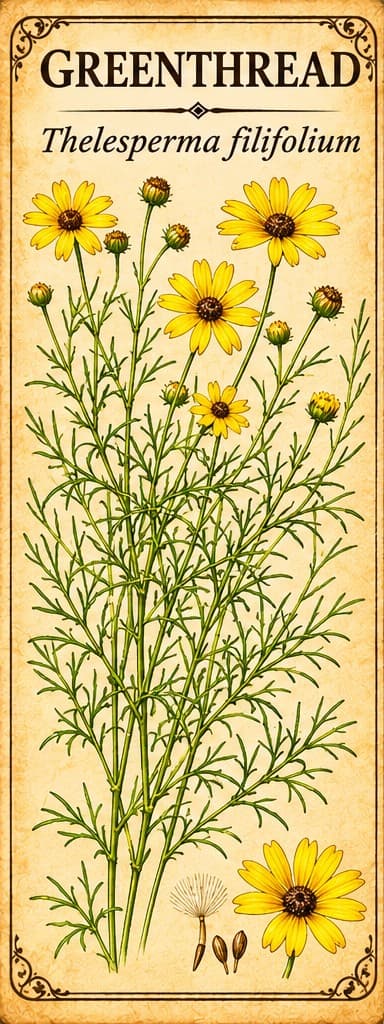
Greenthread
Thelesperma filifolium
A threadleaf wildflower of the Southwest, steeped as a tea by Pueblo peoples. Its close relative, Navajo tea, is a popular wild tea.
Safety at a glance
- PregnancyNothing recorded
- BreastfeedingNothing recorded
- MedicinesNothing recorded
- Who should avoid itNothing recorded
- AllergiesNothing recorded
- ToxicityNothing recorded
Tap a box to read the safety notes below. “Nothing recorded” means our sources don't cover it, not that it's safe.
What is Greenthread?
- Plant family
- Asteraceae, the daisy family
- Parts used
- The leaves, stems and flowers
- Where it grows
- Central and southwestern US and northern Mexico
- Genus
- Thelesperma
- Species
- filifolium
Also called
Navajo Tea, Indian Tea
Regional names
Cota
Traditionally used for
- Tea
- Tuberculosis (traditional)
Traditionally described as
- Leaves and flowers make a tea
Health topics
Where Greenthread appears in symptom search, and why. Being listed doesn't mean it's a proven treatment.
- Fever
Cota tea is a Hispanic folk remedy for fever in New Mexico. Not studied in people.
Traditions that use it
- Native American Ethnobotany
Drunk as a tea by the Tewa and Western Keres; its relative Navajo tea by the Navajo, Hopi and Apache.
How it's prepared
Common ways Greenthread is prepared or sold. This isn't advice on how to take it; see Safety below.
- Tea / Infusion
Leaves and flowers steeped as a tea.[1]Traditional text
Safety
Contamination
Navajo tea, a close relative, gathered near uranium mines and busy roads on the Navajo Nation had cadmium above WHO limits for medicinal plants.[2]Study
What does the research say?
Traditional use
These are traditional uses, not proven treatments.
The Tewa and Western Keres steeped the plant as a tea to drink. The Western Keres also gave it to children with tuberculosis.[1]Traditional text
Its close relative Navajo tea (Thelesperma megapotamicum) is a popular wild tea. The Navajo drank it as a stimulant and for toothache, and the Hopi, Apache and Keres boiled the flowers and young leaves for tea. The Hopi also used the flowers as a reddish-brown dye.[3]Traditional text
Known in New Mexico as cota, greenthread and its relatives make a reddish-brown, slightly sweet tea enjoyed across the Southwest by Native Americans, Hispanics and Anglos. A Zuni bundle of about 12 dried stalks makes about 10 cups.[4]Traditional text
In Hispanic folk medicine the tea is used to bring down fever, soothe babies' chafed skin, and increase urine. At Zuni, two kinds of cota are recognized, and expectant mothers drink one or the other in the hope of having a boy or a girl. Navajo weavers and Hopi basket makers use it as a dye.[4]Traditional text
Herbalist Charles Kane describes Navajo tea, a close relative, as a pleasant, non-bitter beverage tea that slightly increases urination but otherwise isn't significantly medicinal. Its very young leaves can be chopped into salads.[5]General reference
Laboratory & animal research
Lab and animal results show what might be worth studying in people. They don't show that the herb has these effects in humans.
The tea provides small amounts of potassium, calcium and magnesium.[4]Traditional text
In short
A related tea plant gathered near mines and roads had high cadmium.
Sources
- [1] Native American Ethnobotany Database: Thelesperma filifolium — Botanical Research Institute of Texas (BRIT); compiled by Daniel E. MoermanTraditional text
- [2] Occurrence and Risk of Metal(loid)s in Thelesperma megapotamicum Tea Plant · DOI: 10.3390/plants9010021Peer-reviewed study
- [3] Native American Ethnobotany Database: Thelesperma megapotamicum (Navajo tea) — Botanical Research Institute of Texas (BRIT); compiled by Daniel E. MoermanTraditional text
- [4] A Place at Mother Earth's Table: Edible Wild Plants of the Rio Grande Region (Cota) — Maxwell Museum of Anthropology, University of New MexicoTraditional text
- [5] Thelesperma megapotamicum (Greenthread): medicinal uses (citing Medicinal Plants of the American Southwest and Wild Edible Plants of New Mexico) — Applied Medical BotanyGeneral reference
This information is educational and traditional in nature, and is not a substitute for professional medical advice. Unfamiliar word? See what these words mean.