
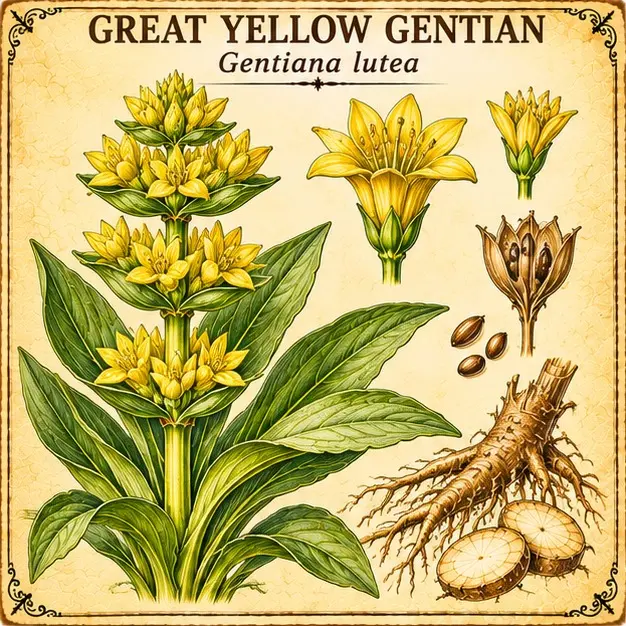
Great Yellow Gentian
Gentiana lutea
A gentian whose bitter root is recognized in Europe as a traditional medicine for loss of appetite and indigestion.
Safety at a glance
- Pregnancy1 note →
- BreastfeedingNothing recorded
- MedicinesNothing recorded
- Who should avoid itNothing recorded
- AllergiesNothing recorded
- ToxicityNothing recorded
Tap a box to read the safety notes below. “Nothing recorded” means our sources don't cover it, not that it's safe.
What is Great Yellow Gentian?
- Plant family
- Gentianaceae, the gentian family
- Parts used
- The root
- Genus
- Gentiana
- Species
- lutea
Also called
Yellow Gentian, Gentian Root
Traditionally used for
- Loss of appetite
- Indigestion
Traditionally described as
- Bitter root
Health topics
Where Great Yellow Gentian appears in symptom search, and why. Being listed doesn't mean it's a proven treatment.
- Indigestion
Recognized in Europe as a traditional medicine for mild indigestion.
- Loss of Appetite
Recognized in Europe as a traditional medicine for temporary loss of appetite.
Traditions that use it
- European Folk Medicine
Recognized in Europe as a traditional herbal medicine for loss of appetite and indigestion.
Safety
Pregnancy
Not recommended during pregnancy or breastfeeding, because its safety hasn't been studied.[1]Health agency
How much to use
Gentian root medicines are for adults only. See a doctor if symptoms get worse or last longer than 2 weeks.[2]Health agency
What does the research say?
Traditional use
These are traditional uses, not proven treatments.
Based on long-standing use, the European Medicines Agency recognizes gentian root as a traditional herbal medicine for adults:
- Temporary loss of appetite
- Mild stomach and gut complaints, such as indigestion
It is taken as a tea, extract or tincture, before meals.[2]Health agency
In short
Adults only; not in pregnancy.
Sources
- [1] European Union herbal monograph on Gentiana lutea L., radix, Revision 1 (EMA/HMPC/607861/2017) — European Medicines Agency, Committee on Herbal Medicinal Products (HMPC)Government health agency
- [2] Gentian root (Gentiana lutea L., radix): summary of the HMPC conclusions (EMA/836995/2018) — European Medicines Agency, Committee on Herbal Medicinal Products (HMPC)Government health agency
This information is educational and traditional in nature, and is not a substitute for professional medical advice. Unfamiliar word? See what these words mean.