
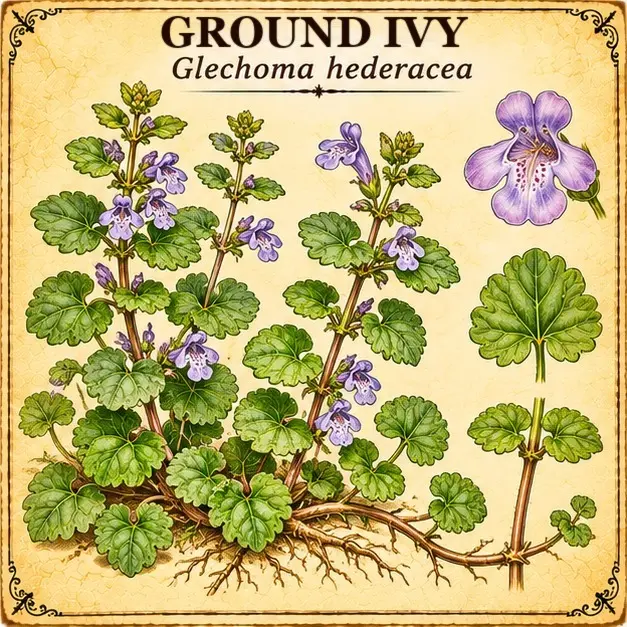
Ground Ivy
Glechoma hederacea
An aromatic mint-family herb used in Europe since ancient times for digestive, liver, breathing and skin complaints.
Safety at a glance
- PregnancyNothing recorded
- BreastfeedingNothing recorded
- MedicinesNothing recorded
- Who should avoid itNothing recorded
- AllergiesNothing recorded
- ToxicityNothing recorded
Tap a box to read the safety notes below. “Nothing recorded” means our sources don't cover it, not that it's safe.
What is Ground Ivy?
- Plant family
- Lamiaceae, the mint family
- Parts used
- The above-ground parts
- Genus
- Glechoma
- Species
- hederacea
Traditionally used for
- Digestion
- Liver and bile
- Breathing
- Skin
Traditionally described as
- Aromatic; rich in phenolic acids and flavonoids
Health topics
Where Ground Ivy appears in symptom search, and why. Being listed doesn't mean it's a proven treatment.
- Indigestion
Traditionally used for digestive problems.
Traditions that use it
- European Folk Medicine
Recorded in European medicine since antiquity for digestive, liver, breathing and skin complaints.
Safety
Depends on how it's prepared
There are no clinical studies, so its safety in people isn't well known.[1]Study
What does the research say?
Traditional use
These are traditional uses, not proven treatments.
An aromatic mint-family herb recorded in European medicine since ancient times. It's still used for digestive problems, liver and bile complaints, breathing problems and skin conditions.[1]Study
Laboratory & animal research
Lab and animal results show what might be worth studying in people. They don't show that the herb has these effects in humans.
In lab and animal studies, extracts protected the liver, eased inflammation, acted as antioxidants and slowed some cancer cells. There are no clinical studies yet.[1]Study
In mice fed a gallstone-causing diet, a ground ivy extract taken 3 times a day shrank gallstone crystals and lowered cholesterol in bile.[2]Study
In short
No clinical studies.
Sources
- [1] Glechoma hederacea: A Comprehensive Insight into the Botanical Specification, Traditional Uses, Phytochemistry, Nutritional Value, Pharmacology, and Non-medicinal Applications · DOI: 10.1055/a-2866-3799Peer-reviewed study
- [2] Protective effect of Glechoma hederacea extract against gallstone formation in rodent models · DOI: 10.1186/s12906-021-03368-1Peer-reviewed study
This information is educational and traditional in nature, and is not a substitute for professional medical advice. Unfamiliar word? See what these words mean.