
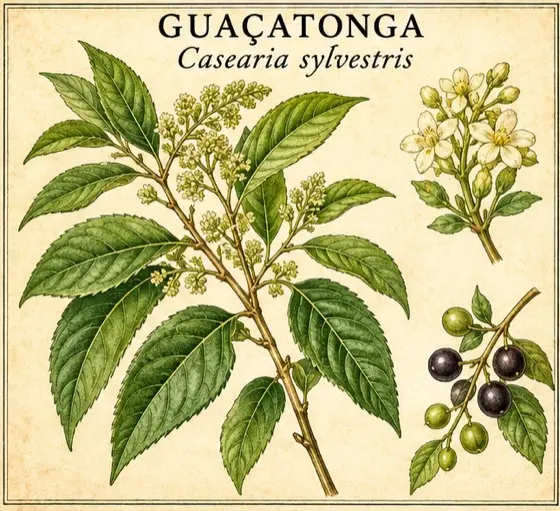
Guaçatonga
Casearia sylvestris
A South American tree whose leaves are a Brazilian folk remedy for ulcers, wounds, pain and diarrhea. It protected against stomach ulcers in rats, but caused skeletal problems in rat pups during pregnancy.
Safety at a glance
- Pregnancy1 note →
- BreastfeedingNothing recorded
- MedicinesNothing recorded
- Who should avoid itNothing recorded
- AllergiesNothing recorded
- ToxicityNothing recorded
Tap a box to read the safety notes below. “Nothing recorded” means our sources don't cover it, not that it's safe.
What is Guaçatonga?
- Plant family
- Salicaceae, the willow family
- Parts used
- The leaves
- Where it grows
- Tropical and subtropical America, especially Brazil
- Genus
- Casearia
- Species
- sylvestris
Also called
Guacatonga
Traditional names
Erva-de-bugre
Traditionally used for
- Stomach ulcers (traditional and animal research)
- Wounds and pain (traditional)
- Diarrhea (traditional)
Traditionally described as
- Leaves rich in clerodane diterpenes and flavonoids
Health topics
Where Guaçatonga appears in symptom search, and why. Being listed doesn't mean it's a proven treatment.
- Cuts, Wounds, Burns and Skin Ulcers
Traditionally used on wounds; studied for wound healing in animals.
- Diarrhea
Used for diarrhea in Brazilian folk medicine.
- Stomach Ulcers and H. pylori
Protected against and helped heal stomach ulcers in rats.
Natural compounds
How it's prepared
Common ways Guaçatonga is prepared or sold. This isn't advice on how to take it; see Safety below.
- Tea / Infusion
The leaves are made into a water extract or tea.[1]Study
Safety
Side effects
There are no clinical studies, and its chemistry isn't standardized, so its safety in people hasn't been established.[2]Study
Pregnancy
Avoid during pregnancy. In pregnant rats, a guaçatonga leaf extract given during early pregnancy caused skeletal problems in the unborn pups, such as extra ribs and changes in the breastbone. The mothers showed no signs of poisoning.[3]Study
Technical detail: 175, 350 or 700 mg/kg from gestational day 6 to 15; skeletal anomalies at 350 and 700 mg/kg; increased placental basal zone and female anogenital distance.
What does the research say?
Traditional use
These are traditional uses, not proven treatments.
Guaçatonga is a small tree native to the Americas, also called erva-de-bugre in Brazil. Its leaves are widely used in South America for inflammation and stomach and gut problems. It's listed in Brazil's public health system (SUS) and is used for diarrhea, wounds, pain and ulcers.[3]Study
Laboratory & animal research
Lab and animal results show what might be worth studying in people. They don't show that the herb has these effects in humans.
In rats, a water extract of the leaves, prepared like the traditional tea, protected the stomach from ulcers caused by alcohol and by the painkiller piroxicam. It also helped existing ulcers heal.[1]Study
Technical detail: 3–300 mg/kg; acetic-acid ulcer healing model; antisecretory activity in pylorus-ligated rats; GSH, SOD and GST measured.
A 2026 review of patents and studies found generally supportive but varied lab and animal evidence for guaçatonga in wound healing and pain. Products in development include sprays, films and treatments for mouth sores during cancer therapy. Its effects are mainly linked to clerodane diterpenes and flavonoids. There are no clinical trials.[2]Study
Technical detail: 8 of 41 patent families and 7 of 51 articles included; oral mucositis formulations.
In short
Avoid in pregnancy: caused skeletal defects in rat pups. No human studies.
Sources
- [1] Gastroprotective and gastric healing effects of the aqueous extract of Casearia sylvestris in rodents: Ultrasound, histological and biochemical analyzes · DOI: 10.1016/j.jep.2022.115660Peer-reviewed study
- [2] Mapping the Technological and Pharmacological Landscape of Casearia sylvestris: An Evidence-Based Prospection for Wound Healing and Pain Management · DOI: 10.1002/cbdv.71292Peer-reviewed study
- [3] Maternal-fetal safety evaluation of an aqueous extract of Casearia sylvestris leaves in rats · DOI: 10.1002/bdr2.2257Peer-reviewed study
This information is educational and traditional in nature, and is not a substitute for professional medical advice. Unfamiliar word? See what these words mean.