
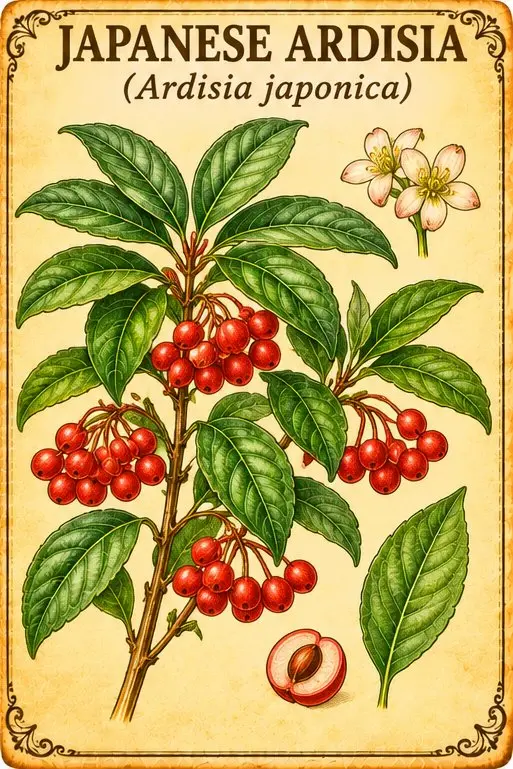
Japanese Ardisia
Ardisia japonica
A Chinese medicinal plant used for nearly a thousand years for cough, phlegm and asthma. Its compound bergenin is a cough medicine in China.
Safety at a glance
- PregnancyNothing recorded
- BreastfeedingNothing recorded
- MedicinesNothing recorded
- Who should avoid itNothing recorded
- AllergiesNothing recorded
- ToxicityNothing recorded
Tap a box to read the safety notes below. “Nothing recorded” means our sources don't cover it, not that it's safe.
What is Japanese Ardisia?
- Plant family
- Primulaceae, the primrose family
- Parts used
- The whole plant, dried
- Genus
- Ardisia
- Species
- japonica
Traditionally used for
- Cough
- Phlegm
- Asthma (traditional)
Traditionally described as
- Contains bergenin
Health topics
Where Japanese Ardisia appears in symptom search, and why. Being listed doesn't mean it's a proven treatment.
- Cancer Research
Lab and animal studies only: listed among many effects, it slowed or killed some cancer cells. Not tested against cancer in people.
- Chest Congestion and Bronchitis
Traditionally used to loosen phlegm.
- Cough
Used in Chinese medicine for cough and phlegm; its compound bergenin is a cough medicine in China.
Traditions that use it
- Traditional Chinese Medicine
Used for nearly a thousand years to relieve cough, loosen phlegm and ease asthma.
What does the research say?
Traditional use
These are traditional uses, not proven treatments.
Japanese ardisia has been used as medicine in China for nearly a thousand years, to relieve cough, loosen phlegm and ease asthma. Today it is used in China for breathing and liver problems, and 23 Chinese patent medicines containing it are sold there for breathing conditions.[1]Study
It is also used in traditional Chinese medicine to increase urine and to stop bleeding from the womb.[2]Study
Laboratory & animal research
Lab and animal results show what might be worth studying in people. They don't show that the herb has these effects in humans.
Lab and animal studies report effects against inflammation, coughing, airway changes, liver injury and scarring, bacteria, viruses and tumors.[1]Study
Research in people
Bergenin, one of the plant's compounds, is widely used in clinics in China as a cough and phlegm medicine for long-term inflammation of the windpipe (chronic tracheitis).[3]Study
In short
No human safety data for the whole plant.
Sources
- [1] Ardisia japonica (Thunb.) Blume: Traditional applications, phytochemistry, pharmacological activities, network pharmacology, and quality control · DOI: 10.1016/j.jep.2025.120761Peer-reviewed study
- [2] Simultaneous Quantification of Gallic Acid, Bergenin, Epicatechin, Epicatechin Gallate, Isoquercitrin, and Quercetin-3-Rhamnoside in Rat Plasma by LC-MS/MS Method and Its Application to Pharmacokinetics after Oral Administration of Ardisia japonica Extract · DOI: 10.1155/2018/4964291Peer-reviewed study
- [3] Unravelling and reconstructing the biosynthetic pathway of bergenin · DOI: 10.1038/s41467-024-47502-2Peer-reviewed study
This information is educational and traditional in nature, and is not a substitute for professional medical advice. Unfamiliar word? See what these words mean.