
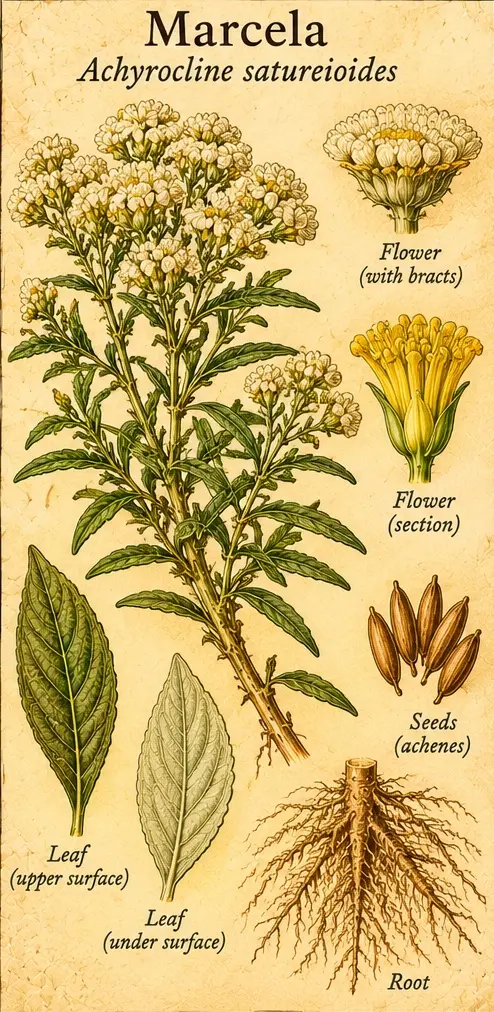
Marcela
Achyrocline satureioides
A small daisy-family plant of southern South America whose flower tea is a popular remedy for colds. In one trial, marcela tea helped sore throats and sneezing clear up faster.
Safety at a glance
- PregnancyNothing recorded
- BreastfeedingNothing recorded
- MedicinesNothing recorded
- Who should avoid itNothing recorded
- AllergiesNothing recorded
- ToxicityNothing recorded
Tap a box to read the safety notes below. “Nothing recorded” means our sources don't cover it, not that it's safe.
What is Marcela?
- Plant family
- Asteraceae, the daisy family
- Parts used
- The flower heads (inflorescences)
- Where it grows
- Southern Brazil, Uruguay, Argentina and Paraguay
- Genus
- Achyrocline
- Species
- satureioides
Traditional names
Macela, Marcela-do-campo
Traditionally used for
- Colds and sore throat (traditional and studied)
- Anxiety and sleep (folk use in pillows)
Traditionally described as
- Aromatic flower heads rich in flavonoids such as quercetin
Health topics
Where Marcela appears in symptom search, and why. Being listed doesn't mean it's a proven treatment.
- Anxiety
Marcela pillows are a folk remedy for anxiety, depression and sleep problems.
- Colds and Nasal Congestion
Traditionally used for mild respiratory infections; eased sneezing faster in a trial.
- Sore Throat
In one trial, marcela tea helped sore throats clear up faster.
Natural compounds
How it's prepared
Common ways Marcela is prepared or sold. This isn't advice on how to take it; see Safety below.
- Tea / Infusion
1.5 g of flower heads in 150 mL of boiling water for 15 minutes, twice a day.[1]Study
Safety
Side effects
In the 14-day trial, there were no significant side effects. One person stopped taking marcela because of mild stomach discomfort. Its safety in pregnancy, while breastfeeding and alongside medicines hasn't been studied.[1]Study
What does the research say?
Traditional use
These are traditional uses, not proven treatments.
Marcela is a small, aromatic plant of the daisy family from southern South America, with clusters of tiny straw-colored flower heads. A tea of the flowers is widely used in southern Brazil, Uruguay and Argentina for mild viral infections of the nose and throat, and for other conditions.[1]Study
In some South American countries, marcela is traditionally harvested at dawn on Good Friday. The flower tea is used for many complaints, including mental and emotional ones. Pillows and cushions are stuffed with marcela to ease depression, anxiety and sleep problems.[2]Study
Laboratory & animal research
Lab and animal results show what might be worth studying in people. They don't show that the herb has these effects in humans.
In lab tests, marcela tea prepared the traditional way protected human nerve cells exposed to rotenone, a toxin. Fewer cells died and there was less cell damage. Normal strengths weren't harmful to the cells, but the highest strength increased cell death.[2]Study
Technical detail: SH-SY5Y cells; reduced lipid peroxidation, protein carbonylation and DNA damage (micronucleus assay); 300 µL/mL increased apoptosis.
Research in people
In a trial in Brazil in 2021, 240 adults with mild viral respiratory infections (some with COVID-19) drank marcela tea or apple tea twice a day for 14 days. 138 people completed the study. Marcela helped sore throats and sneezing clear up faster. Unvaccinated people with COVID-19 recovered faster from sore throat, body aches, fever and cough. Participants knew which tea they had, which limits the results.[1]Study
Technical detail: randomized, placebo-controlled, open-label; 1.5 g of flower heads in 150 mL of boiling water, infused 15 minutes (Brazilian Pharmacopoeia); control Malus domestica infusion; day 8 dyspnea recovery 64% vs 36.3% (p = 0.037), sneezing 65.8% vs 42.1% (p = 0.034).
In short
One person in a trial stopped because of mild stomach discomfort. Safety in pregnancy is unknown.
Sources
- [1] Validation of a Traditional Medicine, Achyrocline satureioides Infusion, for the Improvement of Mild Respiratory Infection Symptoms: A Randomized, Placebo-Controlled and Open-Label Clinical Trial · DOI: 10.3390/ph18060861Peer-reviewed study
- [2] Achyrocline satureioides infusion, popularly prepared and consumed, has an in vitro protective effect on human neural cells exposed to rotenone · DOI: 10.1016/j.jep.2024.118350Peer-reviewed study
This information is educational and traditional in nature, and is not a substitute for professional medical advice. Unfamiliar word? See what these words mean.