
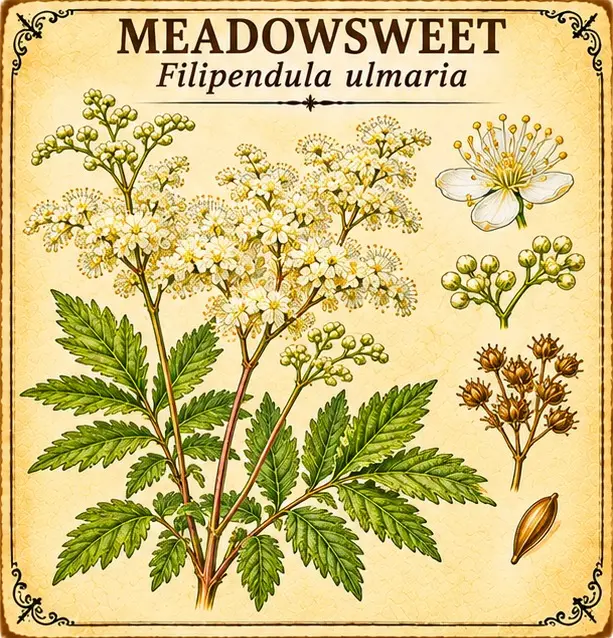
Meadowsweet
Filipendula ulmaria
A creamy-flowered meadow herb recognized in Europe as a traditional medicine for colds and minor joint pain.
Safety at a glance
- Pregnancy1 note →
- BreastfeedingNothing recorded
- MedicinesNothing recorded
- Who should avoid it1 note →
- AllergiesNothing recorded
- ToxicityNothing recorded
Tap a box to read the safety notes below. “Nothing recorded” means our sources don't cover it, not that it's safe.
What is Meadowsweet?
- Plant family
- Rosaceae, the rose family
- Parts used
- The flowering tops and the flowers
- Genus
- Filipendula
- Species
- ulmaria
Older scientific names
Spiraea ulmaria
Traditionally used for
- Common cold
- Minor joint pain
Traditionally described as
- Contains salicylates
Health topics
Where Meadowsweet appears in symptom search, and why. Being listed doesn't mean it's a proven treatment.
- Colds and Nasal Congestion
Recognized in Europe as a traditional medicine to support treatment of the common cold.
- Joint Discomfort
Recognized in Europe as a traditional medicine for minor joint pain.
Traditions that use it
- European Folk Medicine
Recognized in Europe as a traditional herbal medicine for colds and minor joint pain.
Safety
Who should avoid it
Don't use meadowsweet if you're allergic to salicylates, such as aspirin. Don't take it with aspirin or other NSAID pain relievers unless a doctor says it's OK.[1]Health agency
Pregnancy
Not recommended during pregnancy or breastfeeding, because its safety hasn't been studied.[1]Health agency
How much to use
Meadowsweet medicines are for adults only. For colds, see a doctor if symptoms last more than 7 days, or if fever goes above 39°C (102°F) or comes with a bad headache. For joint pain, don't use it for more than 4 weeks, and see a doctor for a sudden flare of arthritis.[1]Health agency
What does the research say?
Traditional use
These are traditional uses, not proven treatments.
Based on long-standing use, the European Medicines Agency recognizes meadowsweet herb and flower as a traditional herbal medicine for adults:
- Supportive treatment of the common cold
- Relief of minor joint pain
It is taken as a tea, powder or tincture.[1]Health agency
The flowers alone are recognized for the same two uses, taken as a tea.[2]Health agency
In short
Avoid with aspirin allergy; adults only.
Sources
- [1] Community herbal monograph on Filipendula ulmaria (L.) Maxim., herba (EMA/HMPC/434881/2010) — European Medicines Agency, Committee on Herbal Medicinal Products (HMPC)Government health agency
- [2] Community herbal monograph on Filipendula ulmaria (L.) Maxim., flos (EMA/HMPC/434894/2010) — European Medicines Agency, Committee on Herbal Medicinal Products (HMPC)Government health agency
This information is educational and traditional in nature, and is not a substitute for professional medical advice. Unfamiliar word? See what these words mean.