
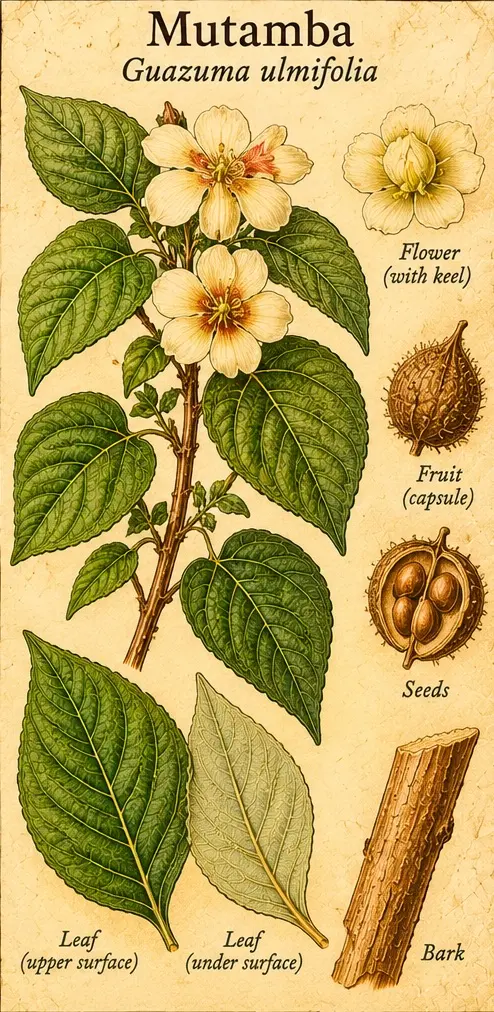
Mutamba
Guazuma ulmifolia
A Latin American tree whose bark is used in folk medicine for diarrhea, coughs and stomach and heart problems. Animal studies show mixed results, and it hasn't been tested in people.
Safety at a glance
- PregnancyNothing recorded
- BreastfeedingNothing recorded
- MedicinesNothing recorded
- Who should avoid itNothing recorded
- AllergiesNothing recorded
- ToxicityNothing recorded
Tap a box to read the safety notes below. “Nothing recorded” means our sources don't cover it, not that it's safe.
What is Mutamba?
- Plant family
- Malvaceae, the mallow family
- Parts used
- The stem bark, leaves and fruit
- Where it grows
- Tropical America, from Mexico to Brazil
- Genus
- Guazuma
- Species
- ulmifolia
Also called
West Indian Elm, Bay Cedar
Traditional names
Guácimo
Traditionally used for
- Diarrhea (traditional and animal research)
- Coughs (traditional)
- Cholesterol (animal research)
Traditionally described as
- Bark rich in condensed tannins (proanthocyanidins)
Health topics
Where Mutamba appears in symptom search, and why. Being listed doesn't mean it's a proven treatment.
- Cough
Traditionally used for coughs in Latin America.
- Diarrhea
Traditionally used for diarrhea; reduced diarrhea in animal studies.
- High Cholesterol
A bark tea improved cholesterol and triglycerides in obese rats.
Natural compounds
How it's prepared
Common ways Mutamba is prepared or sold. This isn't advice on how to take it; see Safety below.
Safety
Side effects
There are no studies of mutamba in people, so its safety hasn't been established. In mice, bark extracts worsened some inflammation and hormone measures.[2]Study
What does the research say?
Traditional use
These are traditional uses, not proven treatments.
Mutamba is a tropical tree found across Latin America, especially in Brazil and Mexico. It's used in traditional medicine for:
- Diarrhea
- Coughs
- Stomach and gut problems
- Heart and circulation problems
Laboratory & animal research
Lab and animal results show what might be worth studying in people. They don't show that the herb has these effects in humans.
In lab and animal studies, mutamba extracts acted against germs and parasites, acted as antioxidants, reduced diarrhea and protected the heart. These effects are linked mainly to its condensed tannins (proanthocyanidins). They haven't been tested in people.[3]Study
Technical detail: proanthocyanidin dimer B and trimer C.
In obese rats on a high-fat diet, a tea made from mutamba stem bark reduced how much they ate and how much weight they gained. It also improved total cholesterol and triglycerides.[1]Study
Technical detail: aqueous decoction of stem bark; 29 compounds identified by HPLC-DAD-MS, including flavonoids, coumarins and organic acids; VLDL-c also improved.
In another study, mice on a high-fat diet ate less when given mutamba bark extracts, but they didn't gain less weight or fat. Blood sugar and insulin weren't affected, and some inflammation and hormone measures got worse. The authors concluded that, in this study, mutamba didn't help.[2]Study
Technical detail: C57BL/6 mice; aqueous and ethanolic stem-bark extracts containing gallocatechin, epigallocatechin and EGCG; leptin increased.
In short
No human studies. Bark extracts worsened some inflammation and hormone measures in mice.
Sources
- [1] Effect of Guazuma ulmifolia (Malvaceae) on the metabolic profile of obesity-induced Wistar rats · DOI: 10.1590/1519-6984.296969Peer-reviewed study
- [2] Use of Guazuma ulmifolia Lam. Stem Bark Extracts to Prevent High-Fat Diet Induced Metabolic Disorders in Mice · DOI: 10.3390/ijms25168889Peer-reviewed study
- [3] Phytochemicals and biological activities of mutamba (Guazuma ulmifolia Lam.): A review · DOI: 10.1016/j.foodres.2019.108713Peer-reviewed study
This information is educational and traditional in nature, and is not a substitute for professional medical advice. Unfamiliar word? See what these words mean.