
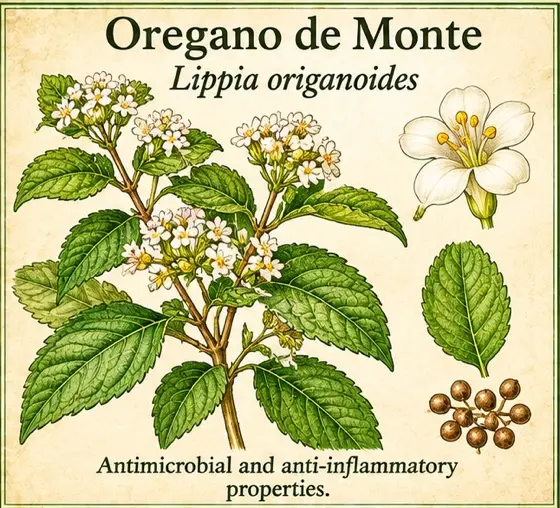
Oregano de Monte
Lippia origanoides
An aromatic shrub of tropical America whose essential oil is rich in carvacrol and thymol. Quilombola women in Brazil use it for painful periods; it lowered blood sugar in diabetic rats.
Safety at a glance
- PregnancyNothing recorded
- BreastfeedingNothing recorded
- MedicinesNothing recorded
- Who should avoid itNothing recorded
- AllergiesNothing recorded
- ToxicityNothing recorded
Tap a box to read the safety notes below. “Nothing recorded” means our sources don't cover it, not that it's safe.
What is Oregano de Monte?
- Plant family
- Verbenaceae, the verbena family
- Parts used
- The leaves and flowering tops; also their essential oil
- Where it grows
- Tropical America, including the Cerrado and Caatinga of Brazil
- Genus
- Lippia
- Species
- origanoides
Also called
Mountain Oregano
Traditional names
Salva-de-marajó, Orégano de Monte
Traditionally used for
- Painful periods (traditional)
- Blood sugar (animal research)
Traditionally described as
- Essential oil rich in carvacrol and thymol
Health topics
Where Oregano de Monte appears in symptom search, and why. Being listed doesn't mean it's a proven treatment.
- High Blood Sugar
Lowered blood sugar and blood fats in diabetic rats.
- Menstrual Discomfort
Used by Quilombola women in Brazil as a tea and steam bath for painful periods.
Natural compounds
How it's prepared
Common ways Oregano de Monte is prepared or sold. This isn't advice on how to take it; see Safety below.
- Decoction
Leaves and flowering tops boiled and drunk, or used as a steam sitz bath.[1]Study
- Essential Oil
The oil is rich in carvacrol and thymol.[1]Study
Safety
Side effects
There are no studies of oregano de monte in people, so its safety, including in pregnancy, hasn't been established.[2]Study
Depends on how it's prepared
Its chemistry varies from plant to plant and with the age of the leaves, so the strength of teas and oils can differ.[3]Study
What does the research say?
Traditional use
These are traditional uses, not proven treatments.
Oregano de monte is an aromatic shrub of the verbena family, native to the Americas. It's widely used in Brazilian folk medicine. In Brazil it's called salva-de-marajó.[3]Study
Quilombola women (descendants of escaped enslaved Africans) in Oriximiná, in Brazil's Pará State, use it for painful periods. They drink a decoction of the leaves and flowering tops, or sit in a bath over its steam.[1]Study
Laboratory & animal research
Lab and animal results show what might be worth studying in people. They don't show that the herb has these effects in humans.
Its essential oil is rich in carvacrol and thymol, the same aromatic compounds that give oregano and thyme their scent. The tea contains flavonoids such as orientin and vitexin.[1]Study
Technical detail: carvacrol up to 61.9%, thymol up to 17.0% and p-cymene up to 24.9% of the oil.
In lab and animal studies, extracts and the essential oil have acted against germs and as antioxidants, and have shown calming and heart-related effects. Most research has looked at the essential oil. Far fewer studies have looked at the water and alcohol extracts that are closer to traditional use.[2]Study
Technical detail: naringenin and eriodictyol are the main non-volatile markers; pinocembrin also reported.
In diabetic rats, an oregano de monte extract lowered blood sugar, triglycerides and cholesterol, including LDL ("bad") cholesterol. It also protected the liver and kidneys.[4]Study
Technical detail: hydroalcoholic extract 75, 150 and 250 mg/kg orally in alloxan-diabetic rats; glibenclamide as positive control.
In short
No human studies; its chemistry varies between plants.
Sources
- [1] Qualitative chemical characterization of salva-de-marajó (Lippia origanoides, Verbenaceae) preparations · DOI: 10.1016/j.fitote.2024.106302Peer-reviewed study
- [2] Phytochemical Diversity and Therapeutic Perspectives of Volatile and Nonvolatile Fractions of Lippia alba and Lippia origanoides: Current Advances and Research Gaps · DOI: 10.1002/cbdv.202503149Peer-reviewed study
- [3] Sources of variation of the chemical composition of Lippia origanoides Kunth (Verbenaceae) · DOI: 10.1080/14786419.2025.2463119Peer-reviewed study
- [4] Hypoglycemic and hypolipidemic effects of Lippia origanoides Kunth in diabetic rats · DOI: 10.1002/fsn3.4162Peer-reviewed study
This information is educational and traditional in nature, and is not a substitute for professional medical advice. Unfamiliar word? See what these words mean.