
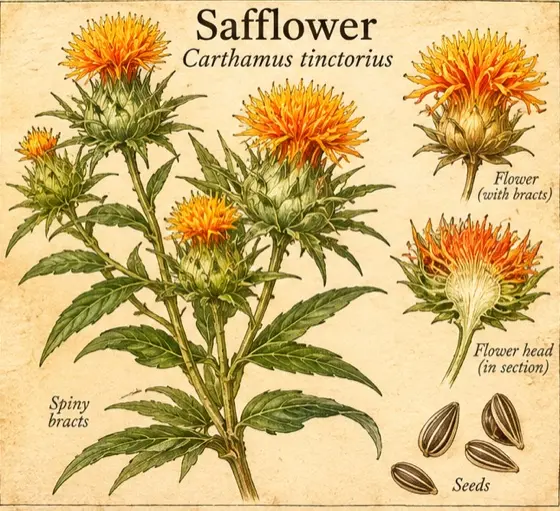
Safflower
Carthamus tinctorius
A thistle-like plant with orange flowers, long used as a dye and in Chinese medicine (hong hua) for circulation, painful periods and bruises. Its seed oil lowers LDL cholesterol, but in one trial in men with heart disease it was linked to more deaths.
Safety at a glance
- PregnancyNothing recorded
- BreastfeedingNothing recorded
- MedicinesNothing recorded
- Who should avoid itNothing recorded
- AllergiesNothing recorded
- ToxicityNothing recorded
Tap a box to read the safety notes below. “Nothing recorded” means our sources don't cover it, not that it's safe.
What is Safflower?
- Plant family
- Asteraceae, the daisy family
- Parts used
- The dried flowers (in medicine and as dye) and the seeds (for oil)
- Where it grows
- Western Asia and the Middle East
- Genus
- Carthamus
- Species
- tinctorius
Also called
Dyer's Saffron, Bastard Saffron
Traditional names
Hong Hua, Carthami Flos
Traditionally used for
- Dye and food coloring
- Circulation and painful periods (traditional Chinese)
- Bruises (traditional)
- Cooking oil
Traditionally described as
- Flowers rich in yellow pigments such as hydroxysafflor yellow A; seed oil rich in linoleic acid
Health topics
Where Safflower appears in symptom search, and why. Being listed doesn't mean it's a proven treatment.
- High Cholesterol
Safflower oil ranked best among cooking oils for lowering LDL cholesterol, though one trial in men with heart disease found more deaths.
- Menstrual Discomfort
Used in traditional Chinese, Indian and Persian medicine for painful or absent periods.
- Sprains and Bruises
A traditional Chinese remedy for bruises and injuries.
Traditions that use it
- Traditional Chinese Medicine
Known as hong hua. Used to promote blood circulation, remove "blood stasis", relieve pain and bring on periods, and for bruises and injuries.
Natural compounds
Safety
Depends on how it's prepared
In men with heart disease, replacing saturated fat with safflower oil was linked to more deaths, not fewer, in one long-term trial.[1]Study
What does the research say?
Traditional use
These are traditional uses, not proven treatments.
Safflower is a thistle-like plant with orange-red flowers. In China it was first brought in from the west during the Han Dynasty, mainly as a dye. Its flowers have long been used as a dye, food coloring and flavoring, rouge and medicine. The species name tinctorius means "used for dyeing".[2]Study
In traditional Chinese medicine, safflower is used to improve blood circulation, relieve pain and bring on menstrual periods. It's used for heavy periods, painful periods, bruises and injuries.
Other traditional uses include:
- Scabies, arthritis and breast pain (Indian medicine)
- Skin patches, baldness and colic (Iranian medicine)
- Painful periods and constipation (water extract)
Technical detail: in TCM it acts on the liver and heart meridians, "activating blood and dispersing stasis".
Laboratory & animal research
Lab and animal results show what might be worth studying in people. They don't show that the herb has these effects in humans.
Safflower's main compounds are yellow and red pigments (flavonoids), especially hydroxysafflor yellow A. In lab and animal studies, its extracts have been studied as antioxidants and for protecting the liver, reducing inflammation, and preventing blood clots.[2]Study
Technical detail: principal metabolites are flavonoids, polyacetylenes and alkaloids; hydroxysafflor yellows reduced thrombosis in vivo.
Research in people
A 2018 review compared 13 oils and fats across 54 trials. Safflower oil ranked best of all for lowering LDL ("bad") cholesterol and total cholesterol. Replacing butter with safflower oil, or several other plant oils, lowered LDL cholesterol.[3]Review or trial
Technical detail: network meta-analysis; safflower oil SUCRA 82% for LDL-C and 90% for total cholesterol. Plant oils lowered LDL-C by 0.23–0.42 mmol/L compared with butter.
A 1960s–70s trial in Sydney asked 458 men who'd recently had a heart attack or similar event to replace saturated fats with safflower oil and safflower margarine. Recovered data showed more deaths in this group than in men given no diet advice:
- All causes: 17.6% vs 11.8%
- Heart and blood vessel disease: 17.2% vs 11.0%
The authors say the heart benefits of linoleic acid, the main fat in safflower oil, haven't been established.[1]Study
Technical detail: Sydney Diet Heart Study (NCT01621087); all-cause mortality HR 1.62 (95% CI 1.00 to 2.64); CVD HR 1.70; CHD HR 1.74. An updated meta-analysis showed no cardiovascular benefit of linoleic acid interventions.
In short
Replacing saturated fat with safflower oil was linked to more deaths in men with heart disease in one trial.
Sources
- [1] Use of dietary linoleic acid for secondary prevention of coronary heart disease and death: evaluation of recovered data from the Sydney Diet Heart Study and updated meta-analysis · DOI: 10.1136/bmj.e8707Peer-reviewed study
- [2] Carthamus tinctorius L.: a comprehensive review of its ethnomedicine, phytochemistry, pharmacology, and clinical applications · DOI: 10.3389/fphar.2025.1609299Peer-reviewed study
- [3] Effects of oils and solid fats on blood lipids: a systematic review and network meta-analysis · DOI: 10.1194/jlr.P085522Review or clinical trial
This information is educational and traditional in nature, and is not a substitute for professional medical advice. Unfamiliar word? See what these words mean.