
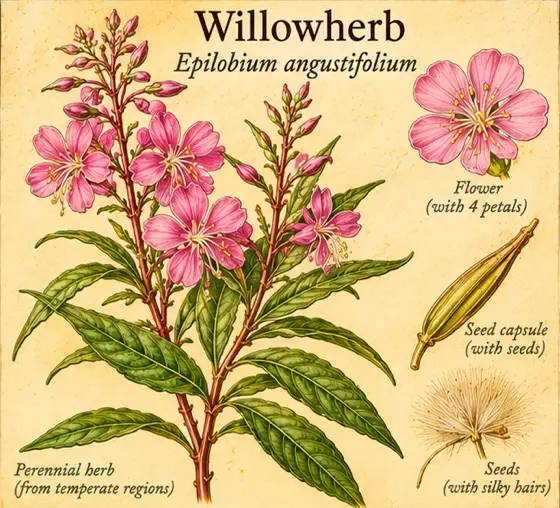
Willowherb
Epilobium angustifolium
Fireweed and small-flowered willowherb, accepted in Europe as a traditional tea for urinary symptoms of a benign enlarged prostate.
Safety at a glance
- PregnancyNothing recorded
- BreastfeedingNothing recorded
- MedicinesNothing recorded
- Who should avoid it1 note →
- AllergiesNothing recorded
- ToxicityNothing recorded
Tap a box to read the safety notes below. “Nothing recorded” means our sources don't cover it, not that it's safe.
What is Willowherb?
- Plant family
- Onagraceae, the evening primrose family
- Parts used
- The dried flowering tops (aerial parts)
- Where it grows
- Across the cooler parts of the Northern Hemisphere, including Europe, Asia and North America
- Genus
- Epilobium
- Species
- angustifolium
Also called
Fireweed, Rosebay Willowherb, Small-flowered Willowherb
Traditional names
Ivan Chai
Older scientific names
Chamerion angustifolium, Epilobium parviflorum
Traditionally used for
- Enlarged prostate urinary symptoms (traditional)
Traditionally described as
- Contains the tannin oenothein B
Health topics
Where Willowherb appears in symptom search, and why. Being listed doesn't mean it's a proven treatment.
- Enlarged Prostate (BPH)
Accepted in Europe as a traditional tea for urinary symptoms of a benign enlarged prostate.
Traditions that use it
- European Folk Medicine
Willowherb tea is a traditional European remedy for urinary symptoms in men with an enlarged prostate.
Natural compounds
How it's prepared
Common ways Willowherb is prepared or sold. This isn't advice on how to take it; see Safety below.
- Tea / Infusion
1.5 to 2 g of dried herb in 250 mL of boiling water, twice a day.[1]Health agency
Safety
Who should avoid it
See a doctor first to rule out serious conditions. See a doctor promptly if, while using it, you get:
- Fever
- Spasms
- Blood in the urine
- Pain when urinating
- Difficulty passing urine
Also see a doctor if your symptoms get worse.[1]Health agency
Side effects
No side effects or medicine interactions are known. Don't use it if you're allergic to willowherb. It isn't meant for anyone under 18.[1]Health agency
What does the research say?
Traditional use
These are traditional uses, not proven treatments.
Willowherb includes fireweed (Epilobium angustifolium), a tall plant with spikes of pink-purple flowers, and the small-flowered willowherb (E. parviflorum). Based on long-standing use, European regulators accept either one as a traditional herbal medicine. It's used to relieve urinary symptoms caused by a benign (non-cancerous) enlarged prostate, after a doctor has ruled out anything serious.
This is based on long use, not on clinical trials.[1]Health agency
Technical detail: traditional-use indication for lower urinary tract symptoms related to benign prostatic hyperplasia (BPH).
The European guidance for adult men is 1.5 to 2 g of the cut dried herb in 250 mL of boiling water as a tea, twice a day. It can be used long term.[1]Health agency
Laboratory & animal research
Lab and animal results show what might be worth studying in people. They don't show that the herb has these effects in humans.
In lab tests on colon cancer cells, water extracts of fireweed leaves, and their main compound oenothein B, reduced how many cells survived and how well their mitochondria (the cell's energy factories) worked. Fermenting the leaves made the extracts slightly weaker.[2]Study
Technical detail: Caco-2 cells, 48 h; IC50 0.843 mg/mL (unfermented), 1.548 and 1.931 mg/mL (fermented 24 and 48 h), oenothein B 0.09 mg/mL (57 µM).
Research in people
In a look back at 59 men with an enlarged prostate and urinary symptoms, a supplement containing fireweed and 4 other ingredients, mostly taken with standard medicines, was linked to better urine flow and symptoms. The study wasn't randomized and didn't test fireweed alone.[3]Study
Technical detail: retrospective, multicentre; Oxyfil (E. angustifolium, Ptychopetalum olacoides, Ginkgo biloba, Equisetum arvense, citrulline); also reduced LPS-induced COX-2, iNOS, TNFα and IL-6 gene expression in isolated mouse prostate.
In short
See a doctor first to rule out serious prostate problems, and promptly if you get fever, blood in the urine or can't pass urine.
Sources
- [1] European Union herbal monograph on Epilobium angustifolium L. and/or Epilobium parviflorum Schreb., herba (EMA/HMPC/712511/2014) — European Medicines Agency, Committee on Herbal Medicinal Products (HMPC)Government health agency
- [2] Effect of Fireweed (Chamerion angustifolium L.) Extracts and Oenothein B on Colon Cancer Cells: Impact of Leaf Fermentation on Viability and Mitochondrial Function · DOI: 10.3390/medicina61111957Peer-reviewed study
- [3] Protective Effects Induced by a Novel Food Supplement Based on Epilobium angustifolium, Ptychopetalum olacoides, Ginkgo biloba, and Equisetum arvense Extracts and Citrulline in the Lower Urinary Tract: Preclinical and Clinical Evidence · DOI: 10.1002/ptr.70438Peer-reviewed study
This information is educational and traditional in nature, and is not a substitute for professional medical advice. Unfamiliar word? See what these words mean.