
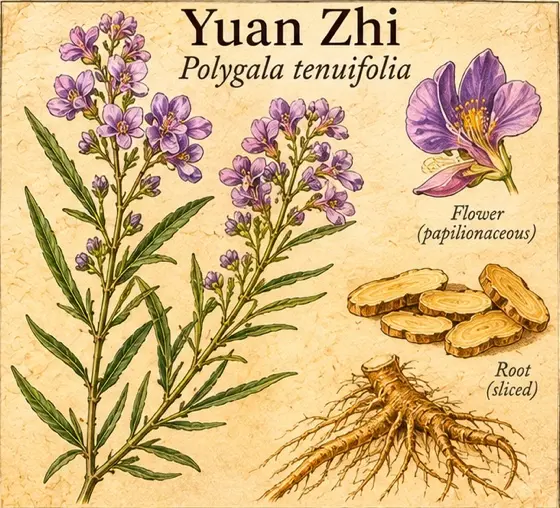
Yuan Zhi
Polygala tenuifolia
A Chinese root used for memory, insomnia, forgetfulness and coughs. Animal studies support calming and nerve-protecting effects, but it hasn't been tested on its own in people.
Safety at a glance
- PregnancyNothing recorded
- BreastfeedingNothing recorded
- MedicinesNothing recorded
- Who should avoid itNothing recorded
- AllergiesNothing recorded
- ToxicityNothing recorded
Tap a box to read the safety notes below. “Nothing recorded” means our sources don't cover it, not that it's safe.
What is Yuan Zhi?
- Plant family
- Polygalaceae
- Parts used
- The dried root
- Where it grows
- Northern China, Korea, Mongolia and Siberia
- Genus
- Polygala
- Species
- tenuifolia
Also called
Chinese Senega, Thinleaf Milkwort
Traditional names
Polygalae Radix
Traditionally used for
- Memory and forgetfulness (traditional Chinese)
- Insomnia (traditional)
- Cough (traditional)
Traditionally described as
- Root rich in saponins
- xanthones and oligosaccharide esters
Health topics
Where Yuan Zhi appears in symptom search, and why. Being listed doesn't mean it's a proven treatment.
- Memory and Thinking
Used in traditional Chinese medicine to improve memory; not yet tested on its own in well-designed human trials.
- Sleep Problems (Insomnia)
A traditional Chinese remedy for insomnia; calming effects seen in animal studies.
Traditions that use it
- Traditional Chinese Medicine
Used to improve memory and thinking, and for insomnia, forgetfulness, low mood, cough and palpitations.
Safety
Side effects
Raw yuan zhi root can irritate the throat. Large doses or long-term use can irritate the stomach and gut. Its saponins are the main irritating compounds, so it's usually processed or combined with other herbs to reduce this.[1]Study
What does the research say?
Traditional use
These are traditional uses, not proven treatments.
Yuan zhi is the dried root of a small Chinese milkwort plant. In traditional Chinese medicine it's used to improve memory and thinking. It's also widely used in China for:
- Insomnia
- Forgetfulness
- Depression
- Cough
- Palpitations (a fast or pounding heartbeat)
Laboratory & animal research
Lab and animal results show what might be worth studying in people. They don't show that the herb has these effects in humans.
More than 160 compounds have been found in the root, including saponins, xanthones and oligosaccharide esters. In lab and animal studies, it protected the nervous, immune, heart and breathing systems, and acted as an antioxidant and against seizures.[1]Study
Other lab and animal studies report calming and sleep-promoting effects, and effects against depression, inflammation, viruses, tumors, aging and irregular heartbeat.[2]Study
Technical detail: reported activities include neuroprotective, antidepressant, hypnotic-sedative, anti-inflammatory, antiviral, antitumor, antioxidant, antiaging and antiarrhythmic effects.
In short
The raw root can irritate the throat, and large doses can upset the stomach.
Sources
- [1] Polygalae Radix: review of metabolites, pharmacological activities and toxicology · DOI: 10.3389/fphar.2024.1420853Peer-reviewed study
- [2] Polygalae Radix: A review of its traditional uses, phytochemistry, pharmacology, toxicology, and pharmacokinetics · DOI: 10.1016/j.fitote.2020.104759Peer-reviewed study
This information is educational and traditional in nature, and is not a substitute for professional medical advice. Unfamiliar word? See what these words mean.