
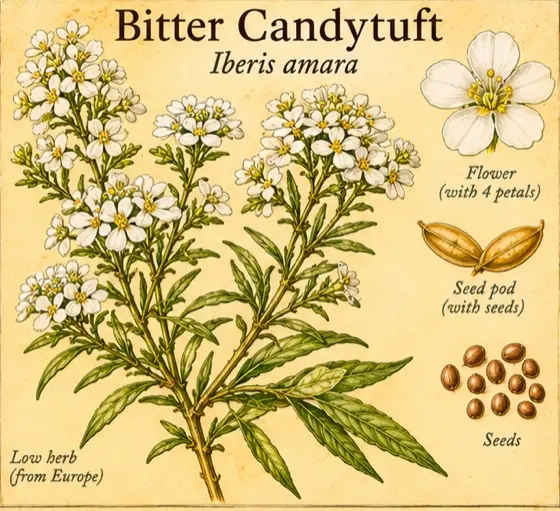
Bitter Candytuft
Iberis amara
A white-flowered European plant that's a key ingredient of the herbal stomach remedy Iberogast. Iberogast mixtures eased ongoing indigestion in trials.
Safety at a glance
- PregnancyNothing recorded
- BreastfeedingNothing recorded
- MedicinesNothing recorded
- Who should avoid itNothing recorded
- AllergiesNothing recorded
- Toxicity1 note →
Tap a box to read the safety notes below. “Nothing recorded” means our sources don't cover it, not that it's safe.
What is Bitter Candytuft?
- Plant family
- Brassicaceae, the mustard and cabbage family
- Parts used
- The whole fresh flowering plant, with its seeds
- Where it grows
- Europe, mainly in sunny grain fields on chalky soil
- Genus
- Iberis
- Species
- amara
Also called
Candytuft, Rocket Candytuft, Iberis
Traditional names
Iberis amara totalis
Traditionally used for
- Indigestion (studied in a mixture)
- IBS (studied)
- Stomach ulcers (animal research)
Traditionally described as
- Contains cucurbitacins and flavonoids
Health topics
Where Bitter Candytuft appears in symptom search, and why. Being listed doesn't mean it's a proven treatment.
- Bloating
Iberogast mixtures eased fullness and feeling full early in trials.
- Indigestion
Part of the Iberogast herbal mixture, which eased ongoing indigestion in trials.
- Irritable Bowel Syndrome (IBS)
A candytuft extract eased IBS symptoms more than placebo in one trial.
Traditions that use it
- European Folk Medicine
Long known in Europe for its bitter, inflammation-reducing properties; today the fresh plant is a key ingredient of the stomach remedy Iberogast.
Natural compounds
How it's prepared
Common ways Bitter Candytuft is prepared or sold. This isn't advice on how to take it; see Safety below.
Safety
Side effects
Reviews describe Iberogast mixtures as having a favorable safety profile. Bitter candytuft has mainly been studied as part of these mixtures, not on its own.[2]Study
Toxicity testing
In lab and animal tests, the fresh plant extract at normal doses wasn't toxic and didn't damage DNA.[1]Study
Technical detail: no cytotoxic or acute toxic action in cell lines, rats and mice; no genotoxic or mutagenic potential.
What does the research say?
Traditional use
These are traditional uses, not proven treatments.
Bitter candytuft is a small annual of the cabbage family, with flat clusters of white flowers. It grows wild in European grain fields. An extract of the whole fresh flowering plant, with its seeds, is used in Iberogast, a herbal remedy for stomach and gut complaints.[1]Study
Iberogast has been available for more than 50 years. The original version combines 9 herbs, and a newer version 6. It's used mainly for ongoing indigestion with no clear cause.[2]Study
Technical detail: indicated for functional dyspepsia (FD); the nine-herb formula is STW 5; the six-herb version is STW 5-II.
Laboratory & animal research
Lab and animal results show what might be worth studying in people. They don't show that the herb has these effects in humans.
In lab and rat studies, the fresh plant extract made the muscles of the stomach and small intestine work more strongly. In rats it also protected against stomach ulcers about as well as the ulcer drug cimetidine, and lowered stomach acid.[1]Study
Technical detail: tonicising effect on guinea pig ileum and rat stomach; indomethacin-induced ulcer model; lowered leukotrienes and raised prostaglandin E2.
In rats with arthritis, a bitter candytuft extract reduced joint swelling and inflammation markers and improved how blood vessels worked.[3]Study
Technical detail: carrageenan paw edema and adjuvant-induced arthritis; reduced TNF-α, IL-1β, PGE2 and malondialdehyde; aortic ring reactivity tested ex vivo.
Research in people
A 2024 review pooled patient data from trials of STW 5-II, a six-herb Iberogast mixture, in people with ongoing indigestion that has no clear cause. It found 4 trials with 613 patients. Over 4 to 8 weeks, the mixture eased overall symptoms more than a placebo, including fullness, feeling full early and upper stomach pain. Side effects were no more common than with placebo.[4]Review or trial
Technical detail: functional dyspepsia (FD); symptom sum score mean difference 1.74 (4 weeks) and 2.07 (8 weeks); 2 of 4 RCTs eligible for efficacy analysis; Rome IV criteria.
In a double-blind trial, a bitter candytuft extract eased symptoms more than a placebo in people with irritable bowel syndrome (IBS). This included people with mainly diarrhea and those whose diarrhea and constipation alternated.[1]Study
Technical detail: multicentre, prospective, randomized, parallel-group comparison.
In short
Well tolerated in trials of herbal mixtures; little studied on its own.
Sources
- [1] Iberis amara L. (bitter candytuft) – profile of a medicinal plant · DOI: 10.1159/000068646Peer-reviewed study
- [2] Iberogast in functional dyspepsia: yesterday, today, and tomorrow – a narrative review of a multitarget phytomedicine · DOI: 10.1080/14656566.2025.2597281Peer-reviewed study
- [3] Mechanisms Involved in the Anti-inflammatory and Vascular Effects of Iberis amara Extract · DOI: 10.1055/s-0035-1546244Peer-reviewed study
- [4] Efficacy and Safety of STW 5-II for Functional Dyspepsia Treatment: A Patient Data-Based Meta-Analysis · DOI: 10.1159/000535672Review or clinical trial
This information is educational and traditional in nature, and is not a substitute for professional medical advice. Unfamiliar word? See what these words mean.