
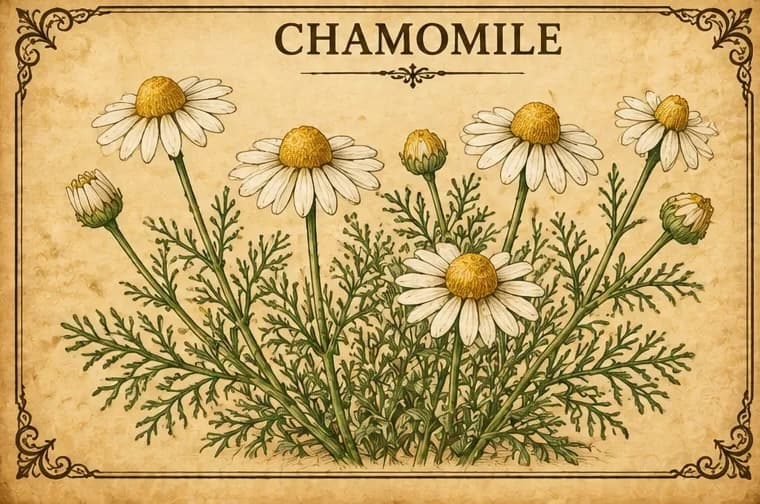
Chamomile
Matricaria chamomilla
A daisy-like flower, usually made into tea, traditionally used for relaxation and digestive comfort.
Safety at a glance
- Pregnancy1 note →
- BreastfeedingNothing recorded
- Medicines1 note →
- Who should avoid it1 note →
- Allergies1 note →
- ToxicityNothing recorded
Tap a box to read the safety notes below. “Nothing recorded” means our sources don't cover it, not that it's safe.
Chamomile may interact with some medicines. If you take any medicine, read Interactions with medicines below and talk to your doctor or pharmacist before using it.
What is Chamomile?
- Plant family
- Asteraceae, the daisy family
- Parts used
- The flower heads
- Genus
- Matricaria
- Species
- chamomilla
Also called
German Chamomile, Wild Chamomile, Scented Mayweed
Older scientific names
Chamomilla recutita (L.) Rauschert, Matricaria recutita L.
Traditionally used for
- Sleep
- Calming tea
- Soothing skin
Traditionally described as
- Mildly relaxing
- May help reduce inflammation
- May ease cramps
Health topics
Where Chamomile appears in symptom search, and why. Being listed doesn't mean it's a proven treatment.
- Anxiety
Early studies suggest it may help generalized anxiety disorder.
- Dry Skin
Used in oils to soothe dry, itchy skin. No trials of chamomile for dry skin were found.
- Eczema
In a small trial, chamomile cream did slightly better than mild hydrocortisone but only marginally better than plain cream for atopic eczema.
- Sleep Problems (Insomnia)
Traditionally used for relaxation and known as a sleep aid, but a 2019 review found little research support for insomnia.
Traditions that use it
- Western Herbalism
Recorded in ancient Egyptian, Greek and Roman medical writings, with long-standing use for digestive complaints and skin irritation.
Natural compounds
How it's prepared
Common ways Chamomile is prepared or sold. This isn't advice on how to take it; see Safety below.
- Extract
Liquid extracts of the flowers are taken by mouth, or diluted for rinses, skin washes, steam inhalation or bath water.[1]Health agency
- Salve
Creams and ointments made with chamomile flower extracts are applied to the skin.[1]Health agency
- Tea / Infusion
The dried flower heads are made into an herbal tea to drink, or steeped in hot water for steam inhalation, mouth rinses or skin washes.[1]Health agency
- Tincture
Herbalists use it as a tincture.[2]General reference
Safety
Interactions with medicines
Chamomile may affect how these work:
- Birth control pills
- Medicines that are broken down by the liver
- Blood thinners, such as warfarin
- Sedatives (medicines that make you sleepy)
Who should avoid it
Chamomile may act a little like the hormone estrogen. This could make hormone-sensitive conditions worse, such as breast or uterine cancer.[3]Health agency
Allergies
You're more likely to react to chamomile if you're allergic to ragweed, chrysanthemums, marigolds, daisies or related plants.[3]Health agency
Side effects
Side effects are uncommon. They can include nausea, dizziness and allergic reactions. In rare cases, people have had a severe allergic reaction (anaphylaxis). It can irritate the eyes if it gets in them.[3]Health agency
Pregnancy
Little is known about whether chamomile is safe during pregnancy or while breastfeeding.[3]Health agency
What does the research say?
Traditional use
These are traditional uses, not proven treatments.
Chamomile appears in ancient Egyptian, Greek and Roman medical writings. Traditionally, it has been used for digestive discomfort, skin irritation, and calming and relaxation.[4]Study
Chamomile essential oil is used in massage and bath oils to soothe dry or damaged skin and relieve itching, including for people in palliative care.[5]Study
Research in people
Studies in people have not produced enough reliable evidence to show that chamomile works for the conditions it's commonly promoted for. Early studies suggest it may help people with generalized anxiety disorder (long-lasting, hard-to-control worry) and the depression that can come with it. A 2019 review found little research support for using chamomile for insomnia, despite its reputation as a sleep aid.[3]Health agency
In a small 2000 study of people with moderate atopic eczema, each person used a chamomile cream on one side of the body and either a mild steroid cream (0.5% hydrocortisone) or a plain cream on the other, for 2 weeks. The chamomile cream did slightly better than the hydrocortisone, but only marginally better than the plain cream.[6]Study
Technical detail: partially double-blind, randomized half-side comparison; Kamillosan cream.
A 2013 review reports that chamomile flower ointments and creams:
- Reduced chemically caused skin inflammation better than 0.1% hydrocortisone in a study in people
- Worked about as well as 0.25% hydrocortisone for inflamed skin on the hands, forearms and lower legs
- Reduced redness from UV light
Chamomile flower is used on the skin for inflammation and irritation, nappy rash, cradle cap, eczema, wounds and insect bites.[7]Study
In short
May cause an allergic reaction in people allergic to ragweed.
Sources
- [1] European Union herbal monograph on Matricaria recutita L., flos — European Medicines Agency, Committee on Herbal Medicinal Products (HMPC)Government health agency
- [2] Chamomile — Herban Herbalist materia medica — Herban Herbalist (herb shop)General reference
- [3] Chamomile: Usefulness and Safety — National Center for Complementary and Integrative Health (NIH)Government health agency
- [4] Chamomile (Matricaria chamomilla L.): An overview — Pharmacognosy Reviews · DOI: 10.4103/0973-7847.79103Peer-reviewed study
- [5] Pruritus in Palliative Care: A Narrative Review of Essential Oil-Based Strategies to Alleviate Cutaneous Discomfort · DOI: 10.3390/diseases13080232Peer-reviewed study
- [6] Proof of efficacy of Kamillosan cream in atopic eczema — European Journal of Medical ResearchPeer-reviewed study
- [7] Medicinal plants used in treatment of inflammatory skin diseases — Postępy Dermatologii i Alergologii · DOI: 10.5114/pdia.2013.35620Peer-reviewed study
This information is educational and traditional in nature, and is not a substitute for professional medical advice. Unfamiliar word? See what these words mean.