
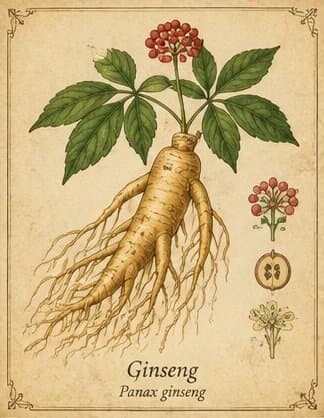
Ginseng
Panax ginseng
A root long used in traditional Chinese medicine as a calming herb and an adaptogen. Research on its effects is mixed.
Safety at a glance
- Pregnancy1 note →
- BreastfeedingNothing recorded
- Medicines1 note →
- Who should avoid it1 note →
- AllergiesNothing recorded
- ToxicityNothing recorded
Tap a box to read the safety notes below. “Nothing recorded” means our sources don't cover it, not that it's safe.
Ginseng may interact with some medicines. If you take any medicine, read Interactions with medicines below and talk to your doctor or pharmacist before using it.
What is Ginseng?
- Plant family
- Araliaceae, the ginseng family
- Parts used
- The root
- Where it grows
- The Far East, including Korea, northeastern China and far-eastern Siberia
- Genus
- Panax
- Species
- ginseng
Also called
Asian Ginseng, Chinese Ginseng, Korean Ginseng, Red Ginseng, White Ginseng
Traditionally used for
- Energy
- Thinking and focus
- Blood sugar
- Alongside lung cancer chemotherapy (studied)
Traditionally described as
- Adaptogen
- Calming
Health topics
Where Ginseng appears in symptom search, and why. Being listed doesn't mean it's a proven treatment.
- Hair Loss
A few small human studies found Korean red ginseng increased hair thickness and density, and helped alongside standard treatments.
- High Blood Pressure
A review of 17 trials found ginseng didn't raise or lower blood pressure.
- High Blood Sugar
Some studies in people with prediabetes or diabetes found lower fasting blood sugar, but the results conflict.
- High Cholesterol
A 2022 review found lower total cholesterol in people with prediabetes or diabetes, but the research is inconclusive.
- Liver Safety Warnings
Liver damage has been reported with Asian ginseng.
- Low Blood Pressure
In a small study without a comparison group, chewing Korean red ginseng reduced drops in blood pressure during kidney dialysis.
- Menopause Symptoms
A review of 10 trials found low-quality evidence it may help sexual function and overall hot flash scores, but not how often hot flashes happen.
Traditions that use it
- Traditional Chinese Medicine
Used in traditional Chinese medicine as a calming herb, and as an adaptogen.
How it's prepared
Common ways Ginseng is prepared or sold. This isn't advice on how to take it; see Safety below.
- Decoction
Herbalists simmer 1 to 2 teaspoons of the dried root in a cup of water.[1]General reference
- Extract
Dry, soft and liquid extracts of the root, some standardized to ginsenosides, are taken by mouth in tablets, capsules or liquids.[2]Health agency
- Powder
The powdered root is taken by mouth.[2]Health agency
- Tea / Infusion
The dried, cut root is made into an herbal tea.[2]Health agency
- Tincture
Herbalists use it as a tincture.[1]General reference
Safety
Interactions with medicines
Asian ginseng might lower blood sugar and may interfere with blood clotting. It may interact with some medicines, so check with your health care provider before using it.[3]Health agency
Who should avoid it
Experts recommend against Asian ginseng for babies, children and people who are pregnant or breastfeeding. It may make autoimmune conditions worse.[3]Health agency
Side effects
Taking Asian ginseng by mouth for up to 6 months in recommended amounts appears safe for most people. The most common side effect is trouble sleeping. Severe rashes, liver damage and severe allergic reactions have also been reported.[3]Health agency
In one trial in menopausal women, 2 women had vaginal bleeding that was likely caused by Korean red ginseng.[4]Review or trial
Pregnancy
Asian ginseng may be unsafe during pregnancy. One of its compounds caused birth defects in animal studies.[3]Health agency
What does the research say?
Traditional use
These are traditional uses, not proven treatments.
Asian ginseng has been used as a calming herb in traditional Chinese medicine and as an adaptogen. The root is the part most often used.[3]Health agency
Laboratory & animal research
Lab and animal results show what might be worth studying in people. They don't show that the herb has these effects in humans.
Many lab and animal studies have found that ginseng and its compounds encourage hair growth.[5]Study
Research in people
Research in people so far suggests:
- Thinking: it may improve abstract thinking, attention, arithmetic and reaction time in middle-aged adults, but not in young adults.
- Tiredness: a 2023 review found it may have a small benefit for general fatigue.
- Blood sugar: a 2022 review found improvements in fasting blood sugar, total cholesterol and some markers of inflammation in people with prediabetes or diabetes, but overall the research is inconclusive and conflicting.
- Erectile dysfunction: it seems to improve sexual function.
- Exercise: most research shows it doesn't improve athletic performance.
- Flu: early research suggests it may lower the risk of getting the flu, but not how bad it is or how long it lasts.
A 2016 review of 17 trials with 1,381 people found ginseng had no significant effect on blood pressure, up or down. The authors concluded people don't need to avoid ginseng out of concern that it raises blood pressure, and called for better trials.[6]Review or trial
Technical detail: randomized controlled trials lasting 4 weeks or more; systolic, diastolic and mean arterial pressure; genus Panax.
A 2021 review combined 28 trials with 2,503 people with the most common type of lung cancer (non-small cell). Adding ginseng or its compounds to chemotherapy was linked to:
- More tumours shrinking or staying stable
- Fewer side effects, such as low blood counts, liver damage, nausea and vomiting, and diarrhoea
- Better quality of life
- More people alive at 1 and 2 years
Most of the trials were of low to moderate quality, so stronger trials are needed to confirm this.[7]Review or trial
Technical detail: objective response rate RR 1.35 (95% CI 1.21 to 1.50); disease control rate RR 1.20 (1.14 to 1.28); leucopenia RR 0.59 (0.50 to 0.70); hepatotoxicity RR 0.67 (0.52 to 0.87); 1-year survival RR 1.35 (1.13 to 1.60); 2-year survival RR 3.21 (1.51 to 6.81); quality of life 1.31 (1.22 to 1.41). Included whole ginseng, ginsenosides and ginseng polysaccharides.
Blood pressure often drops too low during kidney dialysis. In a 2012 study, 38 people with this problem chewed 3.5 g of Korean red ginseng slices at each dialysis session for 4 weeks. Their blood pressure fell less during dialysis, and they had fewer sessions disrupted by symptoms of low blood pressure. The study compared people with themselves before treatment, without a dummy-treatment group.[8]Study
Technical detail: intradialytic hypotension; raised endothelin-1 and angiotensin II after dialysis (p < 0.01).
In a few small human studies, Korean red ginseng increased hair thickness and density. In people with alopecia areata (patchy hair loss), adding it to steroid injections improved hair growth over 12 weeks, and adding it to minoxidil worked better than minoxidil alone.[5]Study
A 2016 review of 10 placebo-controlled trials in menopausal women found some evidence that ginseng improves sexual function and arousal, and that Korean red ginseng lowers overall hot flash scores. It didn't reduce how often hot flashes happened, or change hormone levels or the lining of the womb. The evidence was low quality.[4]Review or trial
In short
May lower blood sugar and affect blood clotting; not for children or during pregnancy or breastfeeding.
Sources
- [1] Ginseng — Herban Herbalist materia medica — Herban Herbalist (herb shop)General reference
- [2] European Union herbal monograph on Panax ginseng C.A.Mey., radix — European Medicines Agency, Committee on Herbal Medicinal Products (HMPC)Government health agency
- [3] Asian Ginseng: Usefulness and Safety — National Center for Complementary and Integrative Health (NIH)Government health agency
- [4] Ginseng for managing menopausal woman's health: A systematic review of double-blind, randomized, placebo-controlled trials · DOI: 10.1097/MD.0000000000004914Review or clinical trial
- [5] Hair-Growth Potential of Ginseng and Its Major Metabolites: A Review on Its Molecular Mechanisms · DOI: 10.3390/ijms19092703Peer-reviewed study
- [6] The effect of ginseng (genus Panax) on blood pressure: a systematic review and meta-analysis of randomized controlled clinical trials — Journal of Human Hypertension · DOI: 10.1038/jhh.2016.18Review or clinical trial
- [7] Efficacy of ginseng and its ingredients as adjuvants to chemotherapy in non-small cell lung cancer — Food & Function · DOI: 10.1039/d0fo03341cReview or clinical trial
- [8] Korean red ginseng improves blood pressure stability in patients with intradialytic hypotension — Evidence-Based Complementary and Alternative Medicine · DOI: 10.1155/2012/595271Peer-reviewed study
This information is educational and traditional in nature, and is not a substitute for professional medical advice. Unfamiliar word? See what these words mean.