
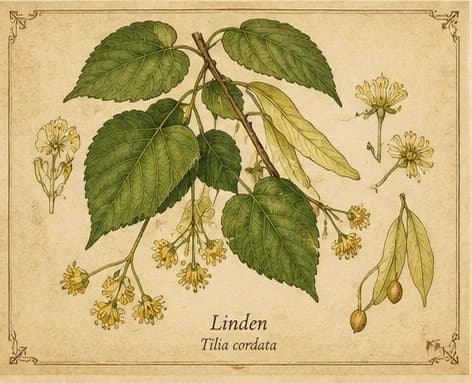
Linden
Tilia cordata
Flowers of the lime (linden) tree, traditionally made into tea for colds, stress and nervous heart complaints.
Safety at a glance
- Pregnancy1 note →
- BreastfeedingNothing recorded
- Medicines1 note →
- Who should avoid it2 notes →
- Allergies1 note →
- ToxicityNothing recorded
Tap a box to read the safety notes below. “Nothing recorded” means our sources don't cover it, not that it's safe.
What is Linden?
- Plant family
- Malvaceae, the mallow family
- Parts used
- The dried flowers
- Where it grows
- Native throughout Europe, as far north as about 65° latitude; also cultivated in Europe and North America
- Genus
- Tilia
- Species
- cordata
Also called
Lime Flower, Lime Tree
Traditionally used for
- Tea
- Colds
- Stress
- Palpitations
Traditionally described as
- Calming
Health topics
Where Linden appears in symptom search, and why. Being listed doesn't mean it's a proven treatment.
- Colds and Nasal Congestion
Recognized in Europe as a traditional medicine to relieve cold symptoms.
- Heart Palpitations
Traditionally drunk as a tea for heart palpitations.
- High Blood Pressure
Traditionally used for high blood pressure linked to nervous tension. This use hasn't been confirmed by research.
- Stress
Recognized in Europe as a traditional remedy for mild symptoms of mental stress.
Traditions that use it
- European Folk Medicine
Recognized by the European Medicines Agency as a traditional herbal medicine for cold symptoms and mild mental stress. Traditionally drunk as a tea for anxiety-related indigestion, heart palpitations and vomiting.
How it's prepared
Common ways Linden is prepared or sold. This isn't advice on how to take it; see Safety below.
- Extract
Liquid extracts of the flowers are taken by mouth.[1]Health agency
- Tea / Infusion
The dried flowers are made into an herbal tea.[1]Health agency
- Tincture
Linden flower tinctures (alcohol extracts) are taken by mouth.[1]Health agency
Safety
Interactions with medicines
No interactions with medicines have been reported.[1]Health agency
Who should avoid it
Some herbal references advise people with an existing heart condition to avoid lime flower, because heavy use may affect the heart. The scientific basis for this warning is not known.[2]Health agency
Don't use lime flower if you're allergic to it. For stress, it's not recommended for children under 12; for colds, not for children under 4. See a doctor if cold symptoms last more than a week or get worse, or if you become short of breath or develop a high fever or pus-like mucus.[1]Health agency
Allergies
Allergy to lime tree pollen is one of the more common pollen allergies. Some allergic reactions to lime flower have been reported; how often is not known.[2]Health agency
Side effects
No side effects are known.[1]Health agency
Pregnancy
Lime flower is not recommended during pregnancy or breastfeeding, because its safety hasn't been established.[1]Health agency
How much to use
European guidance for adults and teens: as a tea, 1.5 g of dried flowers in 150 ml of boiling water, 2–4 times a day (3–6 g a day).[1]Health agency
What does the research say?
Traditional use
These are traditional uses, not proven treatments.
The European Medicines Agency recognizes lime flower as a traditional herbal medicine, based only on long-standing use, for:
- Relief of common cold symptoms
- Relief of mild symptoms of mental stress
Herbal references describe lime flower as traditionally used for migraine, feverish colds, and high blood pressure linked to hardened arteries and nervous tension. It has also been drunk as a tea for heart palpitations, anxiety-related indigestion and vomiting, and has been reported to lower high blood pressure caused by stress.[2]Health agency
Technical detail: traditionally described as sedative, antispasmodic, diaphoretic, hypotensive and diuretic; "arteriosclerotic hypertension" (Barnes et al. 2007); Blumenthal et al. 1998, as cited in the EMA assessment report.
Laboratory & animal research
Lab and animal results show what might be worth studying in people. They don't show that the herb has these effects in humans.
In lab tests, lime flowers strongly blocked enzymes that break down starch into sugar. Researchers suggested this may be relevant to preventing high blood sugar and high blood pressure in type 2 diabetes.[2]Health agency
Technical detail: α-glucosidase and α-amylase inhibition (Ranilla et al. 2010, as cited in the EMA assessment report).
In short
Some sources advise people with heart conditions to avoid it; not recommended during pregnancy.
Sources
- [1] Community herbal monograph on Tilia cordata Miller, Tilia platyphyllos Scop., Tilia x vulgaris Heyne or their mixtures, flos (EMA/HMPC/337066/2011) — European Medicines Agency, Committee on Herbal Medicinal Products (HMPC)Government health agency
- [2] Assessment report on Tilia cordata Miller, Tilia platyphyllos Scop., Tilia x vulgaris Heyne or their mixtures, flos (draft, EMA/HMPC/337067/2011) — European Medicines Agency, Committee on Herbal Medicinal Products (HMPC)Government health agency
This information is educational and traditional in nature, and is not a substitute for professional medical advice. Unfamiliar word? See what these words mean.