
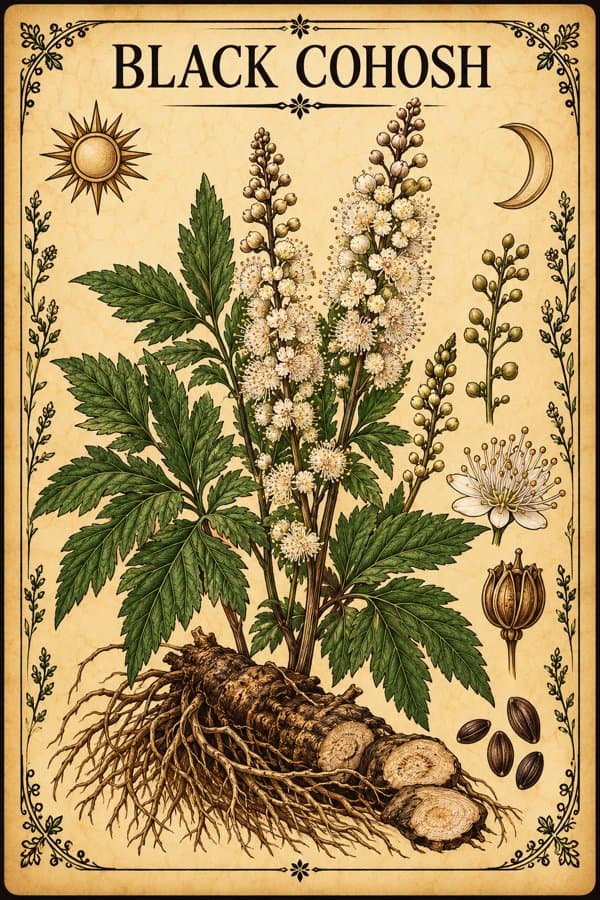
Black Cohosh
Actaea racemosa
A root used traditionally by Native Americans and recognized in Europe for menopausal hot flushes. Rare liver problems have been reported.
Safety at a glance
- PregnancyNothing recorded
- BreastfeedingNothing recorded
- Medicines1 note →
- Who should avoid it1 note →
- AllergiesNothing recorded
- Toxicity3 notes →
Tap a box to read the safety notes below. “Nothing recorded” means our sources don't cover it, not that it's safe.
Black Cohosh may interact with some medicines. If you take any medicine, read Interactions with medicines below and talk to your doctor or pharmacist before using it.
What is Black Cohosh?
- Plant family
- Ranunculaceae, the buttercup family
- Parts used
- The root and rhizome (underground stem)
- Genus
- Actaea
- Species
- racemosa
Also called
Black Snakeroot, Bugbane, Rattleweed, Macrotys
Older scientific names
Cimicifuga racemosa
Traditionally used for
- Menopause
- Hot flashes
Traditionally described as
- May ease hot flashes
Health topics
Where Black Cohosh appears in symptom search, and why. Being listed doesn't mean it's a proven treatment.
- Liver Safety Warnings
Cases of liver damage have been reported, though it's not certain black cohosh caused them. Stop and see a doctor if you notice dark urine or yellow skin or eyes.
- Menopausal Weight Gain
Reduced weight gain in female rats on a high-fat diet. No human studies on weight; watch for liver warning signs.
- Menopause Symptoms
Recognized in Europe for hot flushes and sweating, but a Cochrane review found too little evidence. Watch for liver warning signs.
- Menstrual Discomfort
Traditionally used by Native Americans for menstrual cramps.
Traditions that use it
- Native American Ethnobotany
Used by Native Americans for kidney problems, malaria, sore throat and menstrual cramps.
- European Folk Medicine
Used as a medicine in Germany since the late 1800s. The European Medicines Agency recognizes it for menopausal hot flushes and heavy sweating.
How it's prepared
Common ways Black Cohosh is prepared or sold. This isn't advice on how to take it; see Safety below.
- Decoction
Herbalists simmer 1 to 2 teaspoons of the dried root in a cup of water.[1]General reference
- Extract
Dry extracts of the root are usually taken by mouth as tablets or capsules.[2]Health agency
- Tincture
Herbalists use it as a tincture.[1]General reference
Safety
Interactions with medicines
Black cohosh may interact with some medicines. Check with your health care provider before using it.[3]Health agency
Who should avoid it
Its safety is uncertain for people with hormone-sensitive cancers, such as some breast cancers, and during pregnancy or breastfeeding.[3]Health agency
Side effects
Other side effects include allergic skin reactions (rash, itching), swelling of the face, hands or feet, indigestion and diarrhea.[2]Health agency
Toxicity testing
Cases of liver damage have been reported in people taking black cohosh, though it's not certain black cohosh caused them. Watch for signs such as dark urine and tiredness.[3]Health agency
Stop taking black cohosh and see a doctor straight away if you get signs of liver problems: tiredness, loss of appetite, yellow skin or eyes, severe upper stomach pain with nausea and vomiting, or dark urine.[2]Health agency
A 2025 safety review said recent studies indicate black cohosh doesn't work for menopause symptoms and that its extract can damage DNA in lab tests. Reported side effects range from mild reactions to liver damage and, rarely, death.[4]Study
How much to use
Black cohosh medicines are for adult women. Don't take them for more than 6 months without talking to a doctor.[2]Health agency
Contamination
Some black cohosh products have contained the wrong herb or ingredients not listed on the label. Blue cohosh is a different herb that may cause serious side effects.[3]Health agency
What does the research say?
Traditional use
These are traditional uses, not proven treatments.
Native Americans used black cohosh for kidney problems, malaria, sore throat and menstrual cramps. It has been used as a medicine in Germany since the late 19th century.[3]Health agency
Laboratory & animal research
Lab and animal results show what might be worth studying in people. They don't show that the herb has these effects in humans.
In female rats on a high-fat diet for 12 weeks, a black cohosh extract (Ze 450) reduced weight gain and belly fat about as much as exercise did, and improved blood sugar handling.[5]Study
Research in people
Based on around 20 clinical studies with more than 6,000 patients, the European Medicines Agency concluded that black cohosh extracts can treat menopausal complaints such as hot flushes and heavy sweating.[2]Health agency
Technical detail: "well-established use" for dry extracts.
A 2023 review found black cohosh products may help overall menopause symptoms, improving hot flashes but not anxiety or depression. It's unclear whether it helps hot flashes caused by breast cancer treatment, and there isn't enough data for other uses.[3]Health agency
A 2012 Cochrane review of 16 trials with 2,027 women found black cohosh didn't reduce hot flashes or menopause symptom scores more than placebo, and hormone therapy worked better. Because the quality of the trials was unclear, the reviewers concluded there isn't enough evidence to support black cohosh for menopause symptoms, though more research is justified.[6]Review or trial
Technical detail: median dose 40 mg/day for a mean of 23 weeks; hot flushes MD 0.07 per day (95% CI −0.43 to 0.56), 3 trials, 393 women; symptom scores SMD −0.10 (95% CI −0.32 to 0.11), 4 trials.
In short
Stop and see a doctor if you notice dark urine, yellow skin or eyes, or unusual tiredness.
Sources
- [1] Black Cohosh — Herban Herbalist materia medica — Herban Herbalist (herb shop)General reference
- [2] Black cohosh (Cimicifuga racemosa (L.) Nutt., rhizoma): summary of the HMPC conclusions (EMA/265439/2018) — European Medicines Agency, Committee on Herbal Medicinal Products (HMPC)Government health agency
- [3] Black Cohosh: Usefulness and Safety — National Center for Complementary and Integrative Health (NIH)Government health agency
- [4] Review of black cohosh-induced toxicity and adverse clinical effects · DOI: 10.1080/26896583.2025.2513795Peer-reviewed study
- [5] Exercise-associated and metabolic effects of Cimicifuga racemosa extract Ze 450 in a high-fat diet model in female rats · DOI: 10.1016/j.biopha.2026.119549Peer-reviewed study
- [6] Black cohosh (Cimicifuga spp.) for menopausal symptoms — Cochrane Database of Systematic Reviews · DOI: 10.1002/14651858.CD007244.pub2Review or clinical trial
This information is educational and traditional in nature, and is not a substitute for professional medical advice. Unfamiliar word? See what these words mean.