
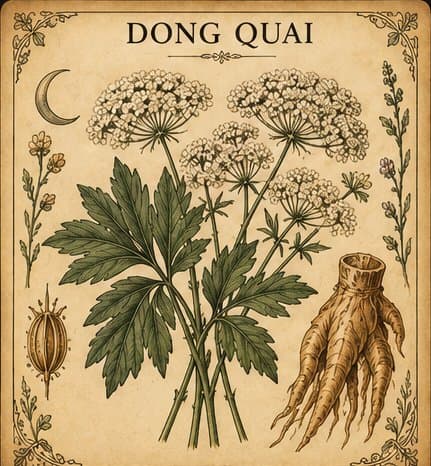
Dong Quai
Angelica sinensis
A root that is one of the most widely used herbs in traditional Chinese medicine for women's health, including period pain and menopause.
Safety at a glance
- Pregnancy1 note →
- Breastfeeding1 note →
- Medicines1 note →
- Who should avoid it1 note →
- AllergiesNothing recorded
- ToxicityNothing recorded
Tap a box to read the safety notes below. “Nothing recorded” means our sources don't cover it, not that it's safe.
Dong Quai may interact with some medicines. If you take any medicine, read Interactions with medicines below and talk to your doctor or pharmacist before using it.
What is Dong Quai?
- Plant family
- Apiaceae, the carrot and parsley family
- Parts used
- The root
- Genus
- Angelica
- Species
- sinensis
Also called
Chinese Angelica, Tang Kuei, Female Ginseng
Traditional names
Danggui
Traditionally used for
- Period pain
- Menopause
- Women's health
Traditionally described as
- Women's tonic (traditional)
Health topics
Where Dong Quai appears in symptom search, and why. Being listed doesn't mean it's a proven treatment.
- Menopause Symptoms
Traditionally used for hot flashes, but in a 24-week trial of 71 women dong quai on its own worked no better than placebo. A formula combining it with astragalus also did no better overall.
- Menstrual Discomfort
A traditional Chinese remedy for period pain. Some research supports it, but formal trials are limited.
- PMS (Premenstrual Syndrome)
Some research supports its use for PMS, but formal trials are limited.
Traditions that use it
- Traditional Chinese Medicine
One of the herbs most commonly used by Traditional Chinese Medicine practitioners, with a long history in China, Korea and Japan, mainly for women's reproductive problems such as period pain, missing periods and menopause.
How it's prepared
Common ways Dong Quai is prepared or sold. This isn't advice on how to take it; see Safety below.
- Capsule
It's also commonly taken as capsules.[1]General reference
- Decoction
Herbalists simmer 1 to 2 teaspoons of the root in a cup of water for 2 minutes, then steep it covered for 15 minutes. Wine infusions are a traditional Chinese preparation.[1]General reference
- Extract
Fluid extracts of the root are also used.[2]Health agency
- Powder
The dried root is used as a powder.[2]Health agency
- Tincture
Herbalists use it as a tincture.[1]General reference
Safety
Interactions with medicines
Dong quai may increase the risk of bleeding with blood thinners such as warfarin. It may also affect how the body handles several other medicines, including anti-platelet medicines and clozapine, and long-term use may make some medicines less effective.[3]General reference
Technical detail: CYP3A4 substrates; dual antiplatelet therapy (altered pharmacokinetics); clozapine (induces metabolism); lisinopril worsened anemia in animal models.
Who should avoid it
If you have a hormone-sensitive cancer, talk to your doctor before using dong quai, because it can act like estrogen.[3]General reference
Side effects
Side effects include skin sensitivity to sunlight and sun-related rashes, loss of appetite, bloating, diarrhea and fever. Breast enlargement in men and high blood pressure have also been reported.[3]General reference
Pregnancy
Avoid dong quai during pregnancy because of the risk of miscarriage.[3]General reference
Breastfeeding
Avoid dong quai while breastfeeding.[3]General reference
What does the research say?
Traditional use
These are traditional uses, not proven treatments.
Dong quai (danggui) has a long history of use in China, Korea and Japan, and is still one of the herbs most commonly used by Traditional Chinese Medicine practitioners in China and Europe. It is mainly used for women's reproductive problems, such as period pain, missing periods and menopause.[4]Study
Technical detail: dysmenorrhea, amenorrhoea.
In traditional Chinese medicine, dong quai is used for menstrual cramps and for menopausal symptoms such as hot flashes.[3]General reference
Laboratory & animal research
Lab and animal results show what might be worth studying in people. They don't show that the herb has these effects in humans.
In lab studies, dong quai showed anti-tumor effects, and in animals it protected against damage from chemotherapy and radiation. But it also acted like estrogen in the lab, and it promoted the growth of estrogen-sensitive breast tumors in mice.[3]General reference
Technical detail: estrogen receptor-positive breast tumors in a murine model.
In lab tests on mouse bone marrow cells, a dong quai extract stopped the cells that break down bone from forming, without harming the cells. The authors suggest it might help prevent bone loss, but it wasn't tested in animals or people.[5]Study
Technical detail: inhibited RANKL-induced osteoclast differentiation in bone marrow macrophages, dose-dependently; suppressed c-Fos, c-Jun and NFATc1.
Ligustilide, the main active compound in dong quai, helped bone-building cells develop in lab tests. In zebrafish, it lessened the bone loss caused by a steroid medicine (prednisolone).[6]Study
Technical detail: promoted osteoblast differentiation of MC3T3-E1 cells and bone marrow mesenchymal stem cells via GPR30/EGFR signaling.
In mice with prediabetes or diabetes, a sugar-based compound (polysaccharide) from fresh dong quai root lowered blood sugar and insulin resistance. It also lowered cholesterol and triglycerides. In prediabetic mice it reduced body weight.[7]Study
Technical detail: Angelica sinensis polysaccharide (ASP); prediabetic and streptozotocin-induced diabetic mice; HOMA-IR decreased; hepatic and muscle glycogen increased; serum IL-6 and TNF-α reduced.
In rats made depressed by 5 weeks of mild, unpredictable stress, a dong quai extract (1 g per kg of body weight) brought their behavior back to normal. It also raised levels of a brain protein (BDNF) linked to mood.[8]Study
Technical detail: chronic unpredictable mild stress model; sucrose preference, forced swim and open field tests; upregulated hippocampal BDNF and phosphorylated CREB and ERK1/2.
Research in people
Studies of dong quai for menopausal symptoms are inconclusive. Some research supports its use for PMS and period pain, but formal clinical trials are limited.[3]General reference
Well-designed trials using standardized dong quai are in short supply, though research on its extracts and compounds suggests many of its traditional uses have some scientific basis.[4]Study
In a small trial of 22 men with hot flashes caused by prostate cancer hormone treatment, dong quai taken daily for 3 months made no difference to how often, how badly or how long they had hot flashes, compared with placebo.[9]Study
Technical detail: randomized, double-blind, placebo-controlled pilot; 17 of 22 completed.
In a US trial, 71 women past menopause who had hot flashes took dong quai on its own or a placebo for 24 weeks. Dong quai worked no better than placebo for hot flashes or other menopausal symptoms. It also didn't act like estrogen on the lining of the womb or the vagina.[10]Review or trial
Technical detail: double-blind, randomized, placebo-controlled; no significant differences in endometrial thickness, vaginal maturation index, vasomotor flush count or Kupperman index.
In a 6-month trial in Hong Kong, 100 women with menopausal symptoms took a traditional formula (Dang Gui Buxue Tang, 1 part dong quai to 5 parts astragalus) or a placebo. Overall it worked no better than placebo for hot flashes and night sweats; it did better only for mild hot flashes. No serious side effects were linked to it.[11]Review or trial
Technical detail: randomized, double-blind, placebo-controlled; 103 enrolled, 50 per group; mild flushes per month 18.9 to 8.6 (p < 0.01) vs placebo 26.0 to 12.4 (p = 0.062).
In short
May increase bleeding with blood thinners; avoid during pregnancy and breastfeeding.
Sources
- [1] Dong quai — Herban Herbalist materia medica — Herban Herbalist (herb shop)General reference
- [2] WHO monographs on selected medicinal plants, Volume 2 — "Radix Angelicae Sinensis" monograph — World Health OrganizationGovernment health agency
- [3] Dong Quai — Memorial Sloan Kettering Cancer Center, About HerbsGeneral reference
- [4] Danggui to Angelica sinensis root: are potential benefits to European women lost in translation? A review — Journal of Ethnopharmacology · DOI: 10.1016/j.jep.2013.12.018Peer-reviewed study
- [5] Angelica sinensis extract inhibits RANKL-mediated osteoclastogenesis by down-regulated the expression of NFATc1 in mouse bone marrow cells — BMC Complementary and Alternative Medicine · DOI: 10.1186/1472-6882-14-481Peer-reviewed study
- [6] Ligustilide, a major bioactive component of Angelica sinensis, promotes bone formation via the GPR30/EGFR pathway — Scientific Reports · DOI: 10.1038/s41598-019-43518-7Peer-reviewed study
- [7] Angelica sinensis polysaccharide regulates glucose and lipid metabolism disorder in prediabetic and streptozotocin-induced diabetic mice through the elevation of glycogen levels and reduction of inflammatory factors — Food & Function · DOI: 10.1039/c4fo00859fPeer-reviewed study
- [8] The Antidepressant Effect of Angelica sinensis Extracts on Chronic Unpredictable Mild Stress-Induced Depression Is Mediated via the Upregulation of the BDNF Signaling Pathway in Rats — Evidence-Based Complementary and Alternative Medicine · DOI: 10.1155/2016/7434692Peer-reviewed study
- [9] Dong Quai (angelica sinensis) in the treatment of hot flashes for men on androgen deprivation therapy: results of a randomized double-blind placebo controlled trial — Canadian Urological Association Journal · DOI: 10.5489/cuaj.775Peer-reviewed study
- [10] Does dong quai have estrogenic effects in postmenopausal women? A double-blind, placebo-controlled trial — Fertility and Sterility · DOI: 10.1016/s0015-0282(97)00397-xReview or clinical trial
- [11] A randomized, double-blind, placebo-controlled study of the effect of a Chinese herbal medicine preparation (Dang Gui Buxue Tang) on menopausal symptoms in Hong Kong Chinese women — Climacteric · DOI: 10.1080/13697130802073029Review or clinical trial
This information is educational and traditional in nature, and is not a substitute for professional medical advice. Unfamiliar word? See what these words mean.