
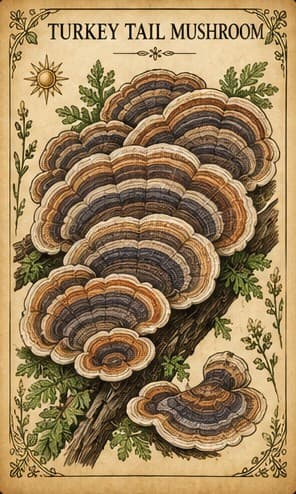
Turkey Tail
Trametes versicolor
A mushroom used in traditional Chinese medicine as a tonic. Extracts from it are used alongside cancer treatment in Japan and China.
Safety at a glance
- Pregnancy1 note →
- BreastfeedingNothing recorded
- Medicines1 note →
- Who should avoid itNothing recorded
- AllergiesNothing recorded
- ToxicityNothing recorded
Tap a box to read the safety notes below. “Nothing recorded” means our sources don't cover it, not that it's safe.
Turkey Tail may interact with some medicines. If you take any medicine, read Interactions with medicines below and talk to your doctor or pharmacist before using it.
What is Turkey Tail?
- Plant family
- Polyporaceae, a family of bracket fungi (mushrooms that grow on wood)
- Parts used
- The mushroom; extracts called PSK and PSP are made from it
- Genus
- Trametes
- Species
- versicolor
Also called
Turkey Tail Mushroom, Kawaratake, PSK, PSP, Krestin
Traditional names
Yun Zhi, Yunzhi
Older scientific names
Coriolus versicolor, Polyporus versicolor
Traditionally used for
- Immune support
- General health
- Cancer care (alongside treatment)
Traditionally described as
- Immune support
Health topics
Where Turkey Tail appears in symptom search, and why. Being listed doesn't mean it's a proven treatment.
- Immune Support (Colds and Flu)
Traditionally used in Chinese medicine to boost the immune system.
- Liver Disease (Hepatitis, Cirrhosis)
A small trial in advanced liver cancer found no clear effect on survival; results in liver cancer are described as mixed.
Traditions that use it
- Traditional Chinese Medicine
Used as a tonic to improve general health and boost the immune system.
How it's prepared
Common ways Turkey Tail is prepared or sold. This isn't advice on how to take it; see Safety below.
- Tea / Infusion
Turkey tail is used in food and in tea.[1]General reference
Safety
Interactions with medicines
Herbal supplements, including turkey tail, can interact with some medicines and affect how they work.[1]General reference
Side effects
Turkey tail extracts are generally well tolerated. Reported side effects include dark stools (not caused by bleeding) and darkened fingernails. Mild digestive and blood-count problems were seen when it was used with chemotherapy, though the chemotherapy may have caused them.[1]General reference
Pregnancy
It isn't known whether turkey tail supplements are safe during pregnancy or breastfeeding. Talk to your healthcare provider first.[1]General reference
How much to use
It's generally safe to use turkey tail in food and tea. Supplements are stronger than the amounts used in cooking, so talk with your healthcare providers before taking them.[1]General reference
Contamination
Many over-the-counter turkey tail products aren't standardized, so their strength can vary between brands.[1]General reference
What does the research say?
Traditional use
These are traditional uses, not proven treatments.
In traditional Chinese medicine, turkey tail (yun zhi) is used as a tonic to improve general health and boost the immune system.[1]General reference
Laboratory & animal research
Lab and animal results show what might be worth studying in people. They don't show that the herb has these effects in humans.
In lab tests, turkey tail extracts killed leukemia cells and slowed the growth of breast cancer cells. In mice, very high doses of a hot-water extract (10 to 13 times the doses people use) increased intestinal tumors.[1]General reference
Research in people
PSK, an extract developed in Japan, is used there and in China alongside standard cancer treatment to lower the chance of cancer coming back. Added to treatment, it appears to improve survival in stomach and colorectal cancer, and may help in esophageal cancer. Results in breast cancer, liver cancer and leukemia are mixed. The US FDA hasn't approved turkey tail extracts as cancer treatments.[1]General reference
In a small trial, 15 people with advanced liver cancer who couldn't have standard treatment took turkey tail or a placebo. There was no clear difference in survival or in how fast the cancer grew. People taking turkey tail reported better emotional and social wellbeing, less pain and less loss of appetite.[2]Study
Technical detail: randomized 2:1; median overall survival 6.5 vs 2.2 months, HR 0.35 (95% CI 0.10 to 1.25, p = 0.105); time to progression HR 0.70 (p = 0.634).
A 2022 Cochrane review of 7 trials (1,569 people, mostly in Japan) looked at a turkey tail extract (PSK) given with treatment for bowel cancer. It's uncertain whether it reduces chemotherapy side effects such as low white blood cells, mouth sores, nausea or tiredness. There was a small improvement in 5-year survival: about 1 extra person alive for every 16 treated. The evidence was of low to very low certainty.[3]Review or trial
Technical detail: 5-year survival RR 1.08 (95% CI 1.01 to 1.15; 3 studies, 1,094 people).
An older 2012 review of 13 trials found that adding turkey tail (yun zhi) to standard cancer treatment reduced 5-year deaths by 9%, mainly in breast, stomach and bowel cancer treated with chemotherapy, but not in oesophageal or nasopharyngeal cancer.[4]Review or trial
In short
Its safety in pregnancy and breastfeeding isn't known; talk to your doctor before using supplements.
Sources
- [1] Coriolus versicolor — Memorial Sloan Kettering Cancer Center, About HerbsGeneral reference
- [2] Coriolus versicolor (Yunzhi) Use as Therapy in Advanced Hepatocellular Carcinoma Patients with Poor Liver Function or Who Are Unfit for Standard Therapy — Journal of Alternative and Complementary Medicine · DOI: 10.1089/acm.2016.0136Peer-reviewed study
- [3] Coriolus (Trametes) versicolor mushroom to reduce adverse effects from chemotherapy or radiotherapy in people with colorectal cancer · DOI: 10.1002/14651858.CD012053.pub2Review or clinical trial
- [4] Efficacy of Yun Zhi (Coriolus versicolor) on survival in cancer patients: systematic review and meta-analysis · DOI: 10.2174/187221312798889310Review or clinical trial
This information is educational and traditional in nature, and is not a substitute for professional medical advice. Unfamiliar word? See what these words mean.