
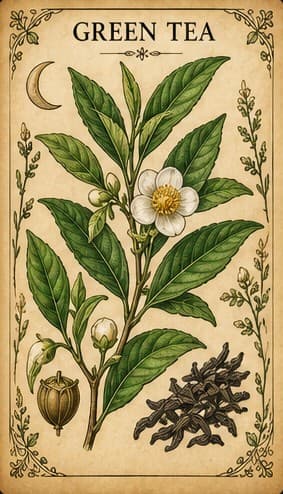
Green Tea
Camellia sinensis
Unfermented leaves of the tea plant, drunk for thousands of years. Drinking the tea is considered safe, but concentrated green tea extract supplements have rarely caused serious liver damage.
Safety at a glance
- Pregnancy1 note →
- Breastfeeding1 note →
- Medicines1 note →
- Who should avoid itNothing recorded
- AllergiesNothing recorded
- Toxicity3 notes →
Tap a box to read the safety notes below. “Nothing recorded” means our sources don't cover it, not that it's safe.
Green Tea may interact with some medicines. If you take any medicine, read Interactions with medicines below and talk to your doctor or pharmacist before using it.
What is Green Tea?
- Plant family
- Theaceae, the tea family
- Parts used
- The leaves, steamed, pan-fried and dried without being fermented
- Where it grows
- First grown in China thousands of years ago
- Genus
- Camellia
- Species
- sinensis
Also called
Green Tea Extract, Tea Plant
Traditionally used for
- Tea
- Weight
- Cholesterol
- Fatty liver
Traditionally described as
- Antioxidant
Health topics
Where Green Tea appears in symptom search, and why. Being listed doesn't mean it's a proven treatment.
- Fatty Liver (NAFLD)
A 2020 review found green tea lowered liver enzymes moderately in people with fatty liver disease.
- High Cholesterol
Research found green tea lowered total and LDL cholesterol slightly.
- Liver Safety Warnings
Green tea extract supplements are a well-established, though rare, cause of liver injury. Drinking green tea hasn't been linked to it.
Traditions that use it
- Traditional Chinese Medicine
The tea plant was first grown in China thousands of years ago, and tea has been used for health for about 3,000 years.
Natural compounds
How it's prepared
Common ways Green Tea is prepared or sold. This isn't advice on how to take it; see Safety below.
- Extract
Green tea extracts are sold as dietary supplements.[1]Health agency
- Tea / Infusion
Green tea is made from the leaves of the tea plant (Camellia sinensis), the same plant as black and oolong tea, prepared in a different way.[1]Health agency
Safety
Interactions with medicines
Green tea may affect some medicines:
- Large amounts lowered blood levels of nadolol, a beta-blocker for high blood pressure and heart problems.
- Green tea extract lowered blood levels of the cholesterol medicine atorvastatin.
- It interacted with raloxifene, a medicine for osteoporosis.
Side effects
No safety concerns have been reported for adults drinking green tea, but it contains caffeine. Green tea extract supplements can cause nausea, constipation, stomach discomfort and higher blood pressure.[1]Health agency
Tea can block the body from absorbing iron. A case report described a middle-aged man whose iron-deficiency anaemia was linked to drinking large amounts of green tea; it came back when he started drinking it again.[2]Study
Pregnancy
During pregnancy, keep caffeine to moderate amounts.[1]Health agency
Breastfeeding
Breastfed babies usually aren't affected when their mothers have low to moderate amounts of caffeine, but large amounts can cause fussiness and poor sleep.[1]Health agency
Toxicity testing
Green tea extract, and more rarely drinking very large amounts of green tea, has caused sudden liver injury. This has included liver failure needing an urgent transplant, and deaths. More than 100 cases have been reported. Injury usually starts 1 to 6 months after starting the product, often with yellow skin or eyes. Most people recover within 1 to 2 months of stopping.[3]Health agency
Technical detail: LiverTox likelihood score A (well-established cause of clinically apparent liver injury); hepatocellular pattern; linked to HLA-B*35:01; catechins, mainly EGCG, implicated.
Liver injury is uncommon and has mostly involved green tea extract tablets or capsules. People with a particular gene variant, which 5 to 15 percent of Americans have, appear to be more likely to be affected.[1]Health agency
Green tea extract is an ingredient in many weight-loss supplements, some of which have been linked to rare liver injury. If you've had liver injury from green tea extract, avoid products that might contain it.[3]Health agency
How much to use
In studies, single doses of up to 1.6 grams of green tea extract were well tolerated. The safety of taking extracts for a long time isn't well known.[3]Health agency
What does the research say?
Traditional use
These are traditional uses, not proven treatments.
The tea plant was first grown in China thousands of years ago, and there is evidence of tea being used for health for about 3,000 years. Green, black and oolong teas all come from the same plant; green tea isn't fermented. Today, green tea and its extracts are promoted for weight loss, lowering cholesterol, and preventing heart disease and cancer.[1]Health agency
Research in people
What research in people has found:
- Cancer: studies of green tea and cancer risk have had inconsistent results.
- Heart disease: drinking green tea has been linked to lower risk in Asian populations, but not in Western ones.
- Weight: its catechins and caffeine may have a modest effect on body weight.
- Cholesterol: green tea lowered total and LDL cholesterol slightly, but didn't affect HDL cholesterol or triglycerides.
An ointment made from a green tea extract is approved by the FDA for external genital warts.[1]Health agency
Drinking green tea hasn't been linked to liver injury. Surveys suggest that people who regularly drink green tea tend to have slightly lower liver enzyme levels.[3]Health agency
A 2020 review of 15 trials found that green tea or its catechins had no overall effect on liver enzymes. In people with non-alcoholic fatty liver disease, liver enzymes went down moderately, while in healthy people they went up slightly. The authors concluded that the effect depends on a person's health.[4]Review or trial
Technical detail: ALT SMD −0.17 (95% CI −0.42 to 0.08); AST SMD −0.07 (−0.43 to 0.29); ALP SMD −0.17 (−0.45 to 0.10); subgroup analyses by health status.
In short
Green tea extract pills have rarely caused severe liver damage; contains caffeine.
Sources
- [1] Green Tea: Usefulness and Safety — National Center for Complementary and Integrative Health (NIH)Government health agency
- [2] Iron deficiency anemia due to excessive green tea drinking — Clinical Case Reports · DOI: 10.1002/ccr3.707Peer-reviewed study
- [3] Green Tea. In: LiverTox: Clinical and Research Information on Drug-Induced Liver Injury — LiverTox, National Institute of Diabetes and Digestive and Kidney Diseases (NIH)Government health agency
- [4] Effects of green tea or green tea catechin on liver enzymes in healthy individuals and people with nonalcoholic fatty liver disease: A systematic review and meta-analysis of randomized clinical trials — Phytotherapy Research · DOI: 10.1002/ptr.6637Review or clinical trial
This information is educational and traditional in nature, and is not a substitute for professional medical advice. Unfamiliar word? See what these words mean.