
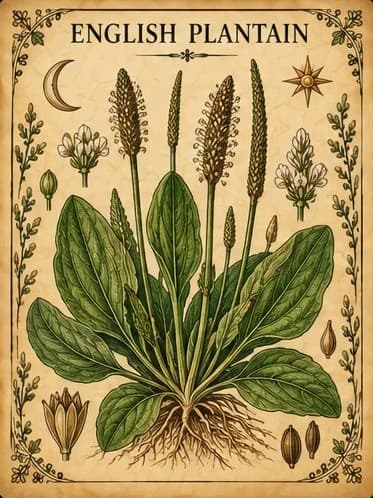
English Plantain
Plantago lanceolata
A plant (also called ribwort plantain) whose leaves are recognized in Europe as a traditional medicine for coughs, sore throats and minor skin inflammation.
Safety at a glance
- Pregnancy1 note →
- BreastfeedingNothing recorded
- MedicinesNothing recorded
- Who should avoid itNothing recorded
- Allergies1 note →
- ToxicityNothing recorded
Tap a box to read the safety notes below. “Nothing recorded” means our sources don't cover it, not that it's safe.
What is English Plantain?
- Plant family
- Plantaginaceae, the plantain family
- Parts used
- The leaves
- Genus
- Plantago
- Species
- lanceolata
Also called
Ribwort Plantain, Ribwort, Narrowleaf Plantain, Plantain
Traditionally used for
- Skin inflammation
- Cough
- Sore throat
Traditionally described as
- Soothing (traditional)
Health topics
Where English Plantain appears in symptom search, and why. Being listed doesn't mean it's a proven treatment.
- Cough
Recognized in Europe as a traditional medicine for dry cough and cough with a cold.
- Skin Irritation, Rashes and Itching
Recognized in Europe in 2025 as a traditional medicine for minor skin inflammation.
Traditions that use it
- European Folk Medicine
Recognized in Europe as a traditional herbal medicine for sore throats, dry and cold-related coughs, and minor skin inflammation.
How it's prepared
Common ways English Plantain is prepared or sold. This isn't advice on how to take it; see Safety below.
- Tea / Infusion
The dried, cut leaves are made into an herbal tea to drink or to use in the mouth, for example as a gargle.[1]Health agency
Safety
Allergies
Don't use it if you're allergic to plantain leaf or to ribwort plantain pollen.[1]Health agency
Side effects
No side effects are known. See a doctor if you notice any.[1]Health agency
Pregnancy
Its safety during pregnancy and breastfeeding hasn't been established, so it isn't recommended at these times.[1]Health agency
How much to use
Plantain on the skin isn't recommended for children under 3. Taken by mouth, some forms aren't recommended under 3, 6 or 12, depending on the product. See a doctor if you get shortness of breath, fever or colored phlegm.[1]Health agency
What does the research say?
Traditional use
These are traditional uses, not proven treatments.
Based on long-standing use, the European Medicines Agency recognizes plantain leaf as a traditional herbal medicine for:
- Soothing irritation of the mouth and throat and the dry cough that goes with it
- Relieving cough with a cold
- Minor skin inflammation (used on the skin)
Research in people
In a small 2015 Italian study, people who rinsed with an English plantain tea mouthwash for 7 days had a bigger drop in tooth-decay-linked streptococcus bacteria in their saliva than those using a dummy rinse. The authors suggest it could help control decay-causing bacteria.[2]Study
In short
Don't use it if you're allergic to plantain or its pollen.
Sources
- [1] European Union herbal monograph on Plantago lanceolata L., folium, Revision 1 (EMA/HMPC/887979/2022) — European Medicines Agency, Committee on Herbal Medicinal Products (HMPC)Government health agency
- [2] Determination of the in vitro and in vivo antimicrobial activity on salivary Streptococci and Lactobacilli and chemical characterisation of the phenolic content of a Plantago lanceolata infusion · DOI: 10.1155/2015/286817Peer-reviewed study
This information is educational and traditional in nature, and is not a substitute for professional medical advice. Unfamiliar word? See what these words mean.