
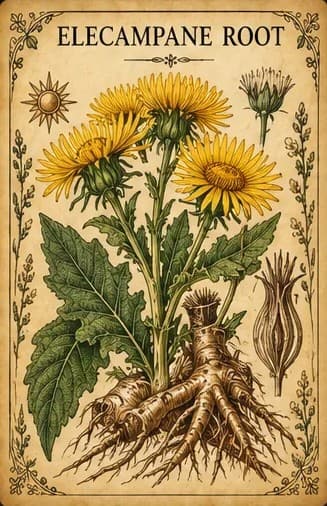
Elecampane
Inula helenium
A root used for centuries in European medicine, including medieval Ireland, for coughs, bronchitis and other chest complaints. Germany's Commission E didn't approve it, citing weak evidence and possible side effects.
Safety at a glance
- PregnancyNothing recorded
- BreastfeedingNothing recorded
- MedicinesNothing recorded
- Who should avoid itNothing recorded
- Allergies1 note →
- ToxicityNothing recorded
Tap a box to read the safety notes below. “Nothing recorded” means our sources don't cover it, not that it's safe.
What is Elecampane?
- Plant family
- Asteraceae, the daisy family
- Parts used
- The root
- Genus
- Inula
- Species
- helenium
Also called
Elecampane Root
Traditionally used for
- Cough
- Bronchitis
- Chest congestion
Traditionally described as
- May help loosen mucus (traditional)
Health topics
Where Elecampane appears in symptom search, and why. Being listed doesn't mean it's a proven treatment.
- Chest Congestion and Bronchitis
Listed in the British Herbal Pharmacopoeia for chest mucus and bronchitis. It hasn't been tested in people.
- Cough
Traditionally used for coughs; Germany's Commission E rejected it for lack of evidence and possible side effects.
Traditions that use it
- European Folk Medicine
Used in Irish and wider European medicine for coughs, lung problems and skin ailments.
How it's prepared
Common ways Elecampane is prepared or sold. This isn't advice on how to take it; see Safety below.
- Decoction
The root is traditionally boiled in water to make a decoction.[1]Study
- Syrup
It's also made into a syrup.[2]General reference
- Tincture
Herbalists also prepare it as a tincture, lozenges or capsules.[2]General reference
Safety
Allergies
Elecampane contains compounds (sesquiterpene lactones) linked to skin allergies in daisy-family plants, and is suspected of causing them, though there's no data on how often this happens.[1]Study
What does the research say?
Traditional use
These are traditional uses, not proven treatments.
In Irish folk medicine, elecampane is often used for breathing and skin problems. A medieval Irish medical text (around 1415) describes it for the lungs, coughs and tuberculosis, boiled with barley water, licorice, cinnamon and sugar.[1]Study
The British Herbal Pharmacopoeia lists elecampane root for chest and throat mucus, cough, bronchitis, and whooping cough in children. It is traditionally taken as a decoction (the root boiled in water).[1]Study
Laboratory & animal research
Lab and animal results show what might be worth studying in people. They don't show that the herb has these effects in humans.
In lab tests on human immune cells and airway cells, elecampane root compounds reduced signals that drive inflammation in the airways. Other lab tests found root compounds (such as alantolactone) slowed the growth of Staphylococcus bacteria.[3]Study
Research in people
In the 1980s, Germany's Commission E rejected elecampane root as a medicine because there wasn't enough evidence it works and because of the risk of side effects. It has since been left out of major official herbal references.[1]Study
In short
Not officially approved as a medicine because of weak evidence and possible side effects; may cause skin allergies.
Sources
- [1] From Monographs to Chromatograms: The Antimicrobial Potential of Inula helenium L. (Elecampane) Naturalised in Ireland — Molecules · DOI: 10.3390/molecules27041406Peer-reviewed study
- [2] Elecampane — Herban Herbalist materia medica — Herban Herbalist (herb shop)General reference
- [3] Inula helenium and Grindelia squarrosa as a source of compounds with anti-inflammatory activity in human neutrophils and cultured human respiratory epithelium — Journal of Ethnopharmacology · DOI: 10.1016/j.jep.2019.112311Peer-reviewed study
This information is educational and traditional in nature, and is not a substitute for professional medical advice. Unfamiliar word? See what these words mean.