
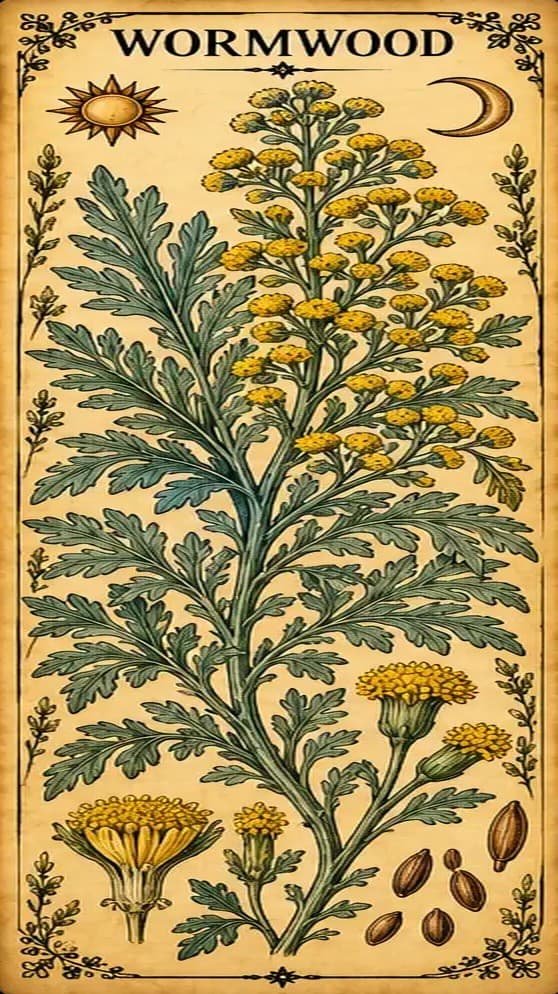
Wormwood
Artemisia absinthium
A bitter herb recognized in Europe as a traditional medicine for temporary loss of appetite and mild heartburn and stomach and gut complaints.
Safety at a glance
- Pregnancy1 note →
- BreastfeedingNothing recorded
- MedicinesNothing recorded
- Who should avoid it1 note →
- AllergiesNothing recorded
- ToxicityNothing recorded
Tap a box to read the safety notes below. “Nothing recorded” means our sources don't cover it, not that it's safe.
What is Wormwood?
- Plant family
- Asteraceae, the daisy family
- Parts used
- The above-ground parts (herb)
- Genus
- Artemisia
- Species
- absinthium
Traditionally used for
- Loss of appetite
- Indigestion
- Heartburn
Traditionally described as
- Bitter
Health topics
Where Wormwood appears in symptom search, and why. Being listed doesn't mean it's a proven treatment.
- Indigestion
Recognized in Europe as a traditional medicine for mild heartburn and stomach complaints.
- Loss of Appetite
Recognized in Europe as a traditional medicine for temporary loss of appetite.
Traditions that use it
- European Folk Medicine
Recognized in Europe as a traditional herbal medicine for loss of appetite and mild stomach and gut complaints.
How it's prepared
Common ways Wormwood is prepared or sold. This isn't advice on how to take it; see Safety below.
- Powder
The powdered plant is taken by mouth in tablets or capsules.[1]Health agency
- Tea / Infusion
The dried flowering plant is made into an herbal tea.[1]Health agency
- Tincture
Wormwood tinctures (alcohol extracts), and juice pressed from the fresh plant, are taken by mouth.[1]Health agency
Safety
Who should avoid it
Don't use wormwood if you have liver disease, a blocked or inflamed bile duct, or an allergy to wormwood or other daisy-family plants. Ask a doctor first if you have gallstones or other bile problems.[1]Health agency
Side effects
No side effects have been reported.[2]Health agency
Pregnancy
There's little or no data on use during pregnancy and breastfeeding, so it isn't recommended at these times.[1]Health agency
How much to use
Wormwood medicines are for adults only. See a doctor if symptoms get worse or last longer than 2 weeks.[2]Health agency
What does the research say?
Traditional use
These are traditional uses, not proven treatments.
Based on long-standing use, the European Medicines Agency recognizes wormwood herb as a traditional herbal medicine for adults:
- Temporary loss of appetite
- Mild heartburn and stomach and gut complaints
It is taken as a tea, powder, juice or tincture.[2]Health agency
Laboratory & animal research
Lab and animal results show what might be worth studying in people. They don't show that the herb has these effects in humans.
In rats, wormwood preparations protected against stomach ulcers. Its bitter compounds may stimulate the gut, which makes its use for poor appetite plausible. There are no studies in patients with these conditions.[2]Health agency
Research in people
In a small trial, 20 people with active Crohn's disease added 750 mg of powdered wormwood 3 times a day, or nothing, to their usual treatment for 6 weeks. Symptoms went into remission in 8 of 10 people taking wormwood versus 2 of 10 without it, and an inflammation marker (TNF-alpha) fell.[3]Study
In a 2024 Iranian trial, 112 women after menopause used a wormwood vaginal cream or a dummy cream 3 times a week for 4 weeks. Sexual satisfaction scores rose slightly with wormwood.[4]Study
In short
For adults only; don't use it with liver disease, a blocked bile duct, or during pregnancy or breastfeeding.
Sources
- [1] European Union herbal monograph on Artemisia absinthium L., herba — European Medicines Agency, Committee on Herbal Medicinal Products (HMPC)Government health agency
- [2] Wormwood herb (Artemisia absinthium L., herba): summary of the HMPC conclusions (EMA/366468/2017) — European Medicines Agency, Committee on Herbal Medicinal Products (HMPC)Government health agency
- [3] Wormwood (Artemisia absinthium) suppresses tumour necrosis factor alpha and accelerates healing in patients with Crohn's disease - A controlled clinical trial · DOI: 10.1016/j.phymed.2009.10.013Peer-reviewed study
- [4] Evaluating the safety and efficacy of wormwood vaginal cream on sexual satisfaction and quality of sexual life of postmenopausal women: a randomized, triple-blinds, placebo-controlled clinical trial · DOI: 10.1186/s12905-024-03515-zPeer-reviewed study
This information is educational and traditional in nature, and is not a substitute for professional medical advice. Unfamiliar word? See what these words mean.