
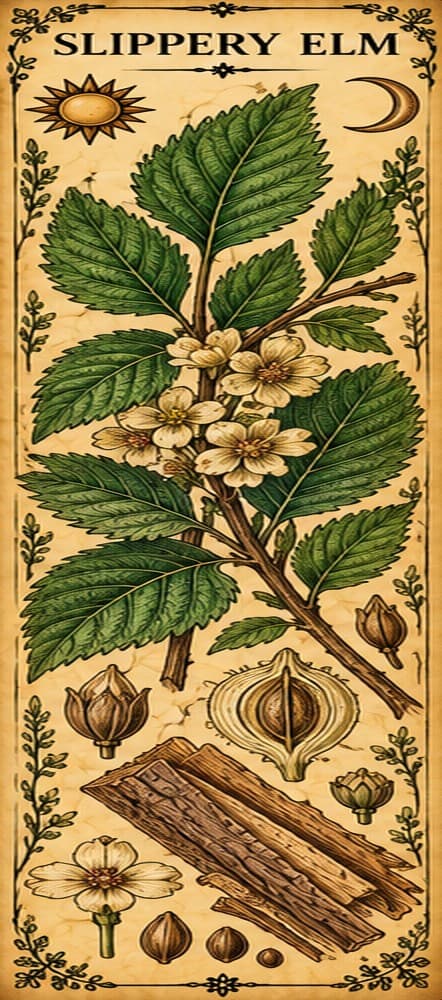
Slippery Elm
Ulmus rubra
The inner bark of a North American elm, taken by mouth for sore throat and stomach upset and used on the skin for rashes. It is generally recognized as safe.
Safety at a glance
- PregnancyNothing recorded
- BreastfeedingNothing recorded
- MedicinesNothing recorded
- Who should avoid itNothing recorded
- AllergiesNothing recorded
- Toxicity1 note →
Tap a box to read the safety notes below. “Nothing recorded” means our sources don't cover it, not that it's safe.
What is Slippery Elm?
- Plant family
- Ulmaceae, the elm family
- Parts used
- The inner bark
- Where it grows
- Native to the eastern and central United States and Canada
- Genus
- Ulmus
- Species
- rubra
Traditionally used for
- Stomach upset
- Sore throat
- Skin irritation
Traditionally described as
- Soothing (traditional)
Health topics
Where Slippery Elm appears in symptom search, and why. Being listed doesn't mean it's a proven treatment.
- Indigestion
Traditionally taken for stomach and gut upset; not tested in trials.
- Sore Throat
Traditionally taken for sore throat; not tested in trials.
How it's prepared
Common ways Slippery Elm is prepared or sold. This isn't advice on how to take it; see Safety below.
- Decoction
Herbalists simmer 1 to 2 teaspoons of the dried inner bark in a cup of water for 10 to 15 minutes; the decoction can be made into a cough syrup.[1]General reference
- Poultice
The dried bark is mixed with a little boiling water into a paste and applied to wounds, sores and minor burns.[1]General reference
- Tea / Infusion
The inner bark of slippery elm is one of the herbs in Essiac, a mixture taken by mouth as a tea.[2]Health agency
Safety
Toxicity testing
Slippery elm is generally recognized as safe. There's no evidence it raises liver enzymes or causes liver injury.[3]Health agency
What does the research say?
Traditional use
These are traditional uses, not proven treatments.
The inner bark of slippery elm is taken by mouth for sore throat and stomach and gut upset, and put on the skin for rashes and irritation.[3]Health agency
In short
Generally recognized as safe; it hasn't been linked to liver injury.
Sources
- [1] Slippery Elm — Herban Herbalist materia medica — Herban Herbalist (herb shop)General reference
- [2] Essiac/Flor Essence (PDQ): Health Professional Version — National Cancer Institute (NIH)Government health agency
- [3] Slippery Elm. In: LiverTox: Clinical and Research Information on Drug-Induced Liver Injury — LiverTox, National Institute of Diabetes and Digestive and Kidney Diseases (NIH)Government health agency
This information is educational and traditional in nature, and is not a substitute for professional medical advice. Unfamiliar word? See what these words mean.