
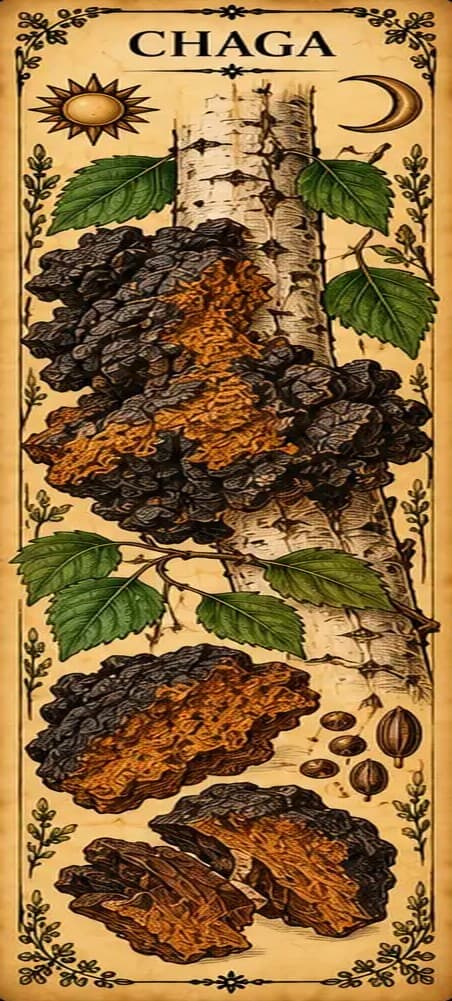
Chaga
Inonotus obliquus
A dark, crusty fungus that grows on birch trees, long used as a folk remedy in Siberia and Russia for immunity. It is very high in oxalate, and long-term use has caused kidney damage.
Safety at a glance
- PregnancyNothing recorded
- BreastfeedingNothing recorded
- MedicinesNothing recorded
- Who should avoid itNothing recorded
- AllergiesNothing recorded
- Toxicity2 notes →
Tap a box to read the safety notes below. “Nothing recorded” means our sources don't cover it, not that it's safe.
What is Chaga?
- Plant family
- Hymenochaetaceae, a family of bracket fungi that grow on trees
- Parts used
- The fungal growth (sclerotium) on the tree
- Where it grows
- Grows on birch trees in cold northern regions, mainly Siberia, North America and Scandinavia
- Genus
- Inonotus
- Species
- obliquus
Also called
Chaga Mushroom
Traditionally used for
- Immune support
- Digestive tea (traditional)
Traditionally described as
- Immune support (traditional)
Health topics
Where Chaga appears in symptom search, and why. Being listed doesn't mean it's a proven treatment.
- Immune Support (Colds and Flu)
A traditional Siberian immune remedy; only lab and animal studies exist, and long-term use has damaged kidneys.
Traditions that use it
- European Folk Medicine
Long used as a folk remedy in Western Siberia and Russia for immunity and inflammation.
How it's prepared
Common ways Chaga is prepared or sold. This isn't advice on how to take it; see Safety below.
Safety
What does the research say?
Traditional use
These are traditional uses, not proven treatments.
Chaga has a long history as a folk remedy in Western Siberia and Russia, where it is valued for supporting the immune system and easing inflammation.[1]Study
Laboratory & animal research
Lab and animal results show what might be worth studying in people. They don't show that the herb has these effects in humans.
In lab and animal studies, chaga compounds showed antioxidant, antimicrobial and anti-cancer effects and reduced inflammation, and water extracts and chaga melanin were active against several viruses, including flu viruses.[1]Study
Chaga polysaccharides (complex sugars) showed effects on immunity, gut bacteria, blood sugar, cholesterol, tumors and viruses in lab and animal studies. These haven't been confirmed in people.[3]Study
In short
Very high in oxalate; long-term use has caused kidney damage.
Sources
- [1] A brief overview of the medicinal and nutraceutical importance of Inonotus obliquus (chaga) mushrooms — Heliyon · DOI: 10.1016/j.heliyon.2024.e35638Peer-reviewed study
- [2] Kidney Injury Induced by High-Dose Chaga Mushroom Consumption: Experimental Evidence in a Rat Model — Journal of Korean Medical Science · DOI: 10.3346/jkms.2026.41.e37Peer-reviewed study
- [3] Inonotus obliquus Polysaccharides: Preparation, Structural Characteristics, Structure-Activity Relationships, Biological Activities and Applications — Nutrients · DOI: 10.3390/nu18071125Peer-reviewed study
This information is educational and traditional in nature, and is not a substitute for professional medical advice. Unfamiliar word? See what these words mean.