
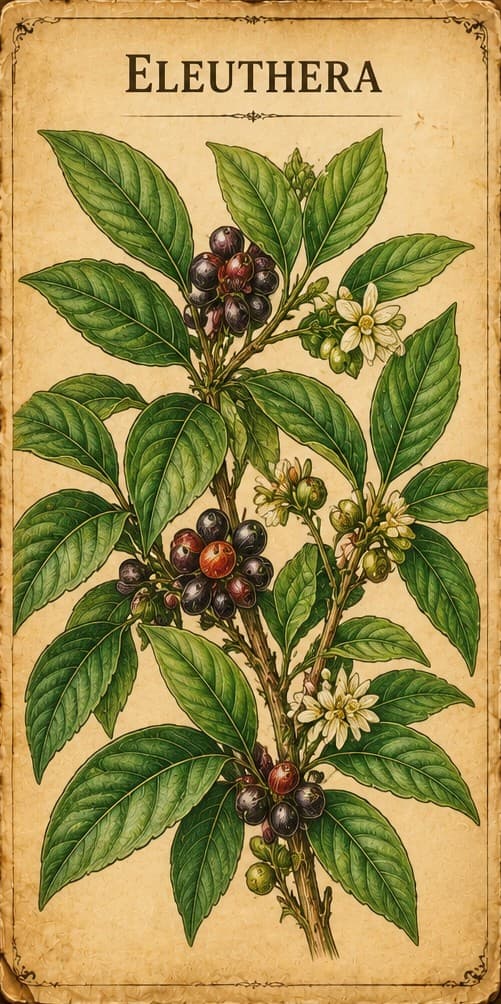
Eleuthera
Croton eluteria
The bitter, aromatic bark of a small Bahamian tree, also called cascarilla. It was once a standard medicine for indigestion, gas, diarrhea and vomiting, and is now mainly a flavoring for drinks.
Safety at a glance
- PregnancyNothing recorded
- BreastfeedingNothing recorded
- MedicinesNothing recorded
- Who should avoid itNothing recorded
- AllergiesNothing recorded
- ToxicityNothing recorded
Tap a box to read the safety notes below. “Nothing recorded” means our sources don't cover it, not that it's safe.
What is Eleuthera?
- Plant family
- Euphorbiaceae, the spurge family
- Parts used
- The bark, which is warm, aromatic and very bitter
- Where it grows
- The West Indies, especially the Bahamas, where it is named after the island of Eleuthera
- Genus
- Croton
- Species
- eluteria
Also called
Cascarilla, Eleuthera Bark, Sweet-wood Tree, Cascarilla-bark Tree
Older scientific names
Clutia eluteria
Traditionally used for
- Indigestion (traditional)
- Gas (traditional)
- Diarrhea (traditional)
- Vomiting (traditional)
- Flavoring
Traditionally described as
- Bitter tonic (traditional)
Health topics
Where Eleuthera appears in symptom search, and why. Being listed doesn't mean it's a proven treatment.
- Diarrhea
Used by 19th-century doctors for long-lasting diarrhea. Not tested in modern studies.
- Indigestion
Used by 19th-century doctors as a bitter tonic for indigestion and gas. Not tested in modern studies.
- Occasional Nausea
Used by 19th-century doctors for vomiting and to prevent nausea from other medicines. Not tested in modern studies.
Traditions that use it
- Western Herbalism
Listed in the US Pharmacopoeia and used by 19th-century American doctors as a bitter tonic for indigestion, diarrhea and vomiting.
How it's prepared
Common ways Eleuthera is prepared or sold. This isn't advice on how to take it; see Safety below.
- Powder
Historically, the bark was taken as a powder.[1]Traditional text
- Tea / Infusion
Historically, the bark was taken as a tea.[1]Traditional text
- Tincture
Historically, the bark was taken as a tincture.[1]Traditional text
Safety
Side effects
A 19th-century medical text warned that cascarilla can cause unpleasant symptoms if used too freely.[1]Traditional text
How much to use
In the US, cascarilla bark extracts and oils are listed as generally recognised as safe for use in food, for example as flavorings. This doesn't cover larger medicinal doses.[2]Health agency
Technical detail: 21 CFR 182.20 lists "Cascarilla bark (Croton eluteria Benn.)". Historical medicinal doses: powder 20–40 grains; tincture 1–4 fluid drachms; infusion 1–4 fluid ounces.
What does the research say?
Traditional use
These are traditional uses, not proven treatments.
Doctors in the 1800s used cascarilla bark as a bitter tonic and stimulant for:
- Indigestion and gas
- Long-lasting diarrhea
- Weakness and recovery after illness
- Vomiting
It was also given to prevent the nausea caused by cinchona, a bark used against malaria. It was taken as a powder, tincture or tea.[1]Traditional text
In short
Old medical texts warned it can cause unpleasant symptoms if used too freely.
Sources
- [1] King's American Dispensatory: Cascarilla (U.S.P.) — Ohio Valley Co. (hosted by Henriette's Herbal Homepage)Traditional text
- [2] 21 CFR 182.20: Essential oils, oleoresins (solvent-free), and natural extractives (including distillates) — US Food and Drug Administration (Code of Federal Regulations)Government health agency
This information is educational and traditional in nature, and is not a substitute for professional medical advice. Unfamiliar word? See what these words mean.