
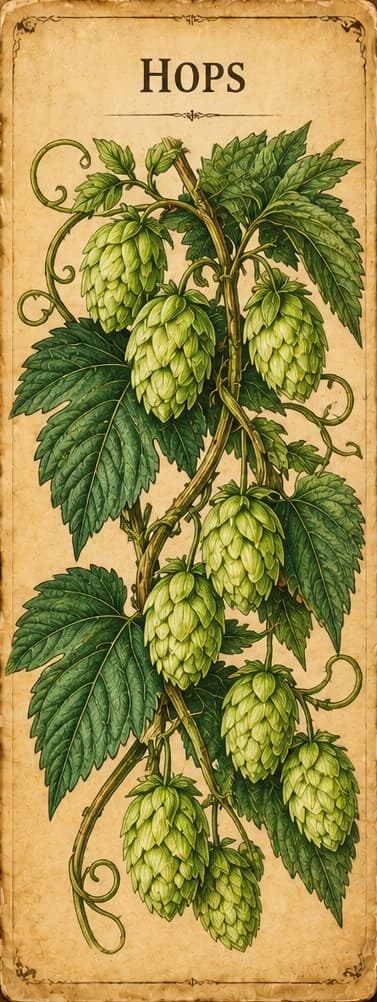
Hops
Humulus lupulus
The cone-like flowers of the hop vine, best known for flavoring beer. Recognised in Europe as a traditional remedy for mild stress and to help sleep.
Safety at a glance
- Pregnancy1 note →
- BreastfeedingNothing recorded
- MedicinesNothing recorded
- Who should avoid it1 note →
- AllergiesNothing recorded
- ToxicityNothing recorded
Tap a box to read the safety notes below. “Nothing recorded” means our sources don't cover it, not that it's safe.
What is Hops?
- Plant family
- Cannabaceae, the hemp family, which includes hops
- Parts used
- The cone-like female flowers (strobiles), dried, as a tea, powder, tincture or extract
- Genus
- Humulus
- Species
- lupulus
Also called
Hop, Hop Strobile, Lupuli Flos
Traditionally used for
- Sleep
- Stress
- Beer flavoring
Traditionally described as
- May make you feel sleepy or relaxed (traditional)
Health topics
Where Hops appears in symptom search, and why. Being listed doesn't mean it's a proven treatment.
- Menopause Symptoms
A vaginal hop gel worked about as well as vaginal estrogen for sexual problems after menopause in one trial.
- Sleep Problems (Insomnia)
Recognised in Europe as a traditional remedy to help sleep. Based on long use, not clinical trials.
- Stress
Recognised in Europe as a traditional remedy for mild symptoms of mental stress. Based on long use, not clinical trials.
Traditions that use it
- European Folk Medicine
Recognised in Europe as a traditional remedy for mild stress and to help sleep.
How it's prepared
Common ways Hops is prepared or sold. This isn't advice on how to take it; see Safety below.
- Extract
Dry and liquid extracts of hop cones are taken by mouth.[1]Health agency
- Powder
The powdered hop cones are taken by mouth in tablets or capsules.[1]Health agency
- Tea / Infusion
The dried, cut hop cones (the flowers) are made into an herbal tea.[1]Health agency
- Tincture
Hop tinctures (alcohol extracts) are taken by mouth.[1]Health agency
Safety
Who should avoid it
Not recommended for children under 12. Don't use it if you're allergic to hops.[1]Health agency
Side effects
Hops may make you drowsy. If it affects you, don't drive or use machinery.[1]Health agency
Pregnancy
Not recommended during pregnancy or breastfeeding, because its safety hasn't been established.[1]Health agency
How much to use
For stress: a tea of 0.5 g of dried hops in a cup of boiling water, up to 4 times a day. For sleep: a tea of 0.5 to 1 g, 30 to 60 minutes before bed. See a doctor if symptoms last more than 2 weeks or get worse.[1]Health agency
Technical detail: 500 mg comminuted herb in 150–200 ml boiling water; sleep dose 500–1000 mg. Other forms: powder 400 mg twice daily (adults) for stress or 800–2000 mg before bed; tincture (1:5) 1–2 ml up to 3 times daily; dry extract (4–5:1) 125–250 mg.
What does the research say?
Traditional use
These are traditional uses, not proven treatments.
The European Medicines Agency recognises hops as a traditional herbal medicine to relieve mild symptoms of mental stress and to help sleep, for adults and children over 12. This is based on long use, not on clinical trials.[1]Health agency
Research in people
In a 2023 Iranian trial, 63 women after menopause with sexual problems used either a vaginal gel with hop extract or vaginal estrogen cream for about 2 months. Both groups improved by a similar amount on a standard sexual function questionnaire, and no side effects were reported with the hop gel.[2]Study
In short
Can make you drowsy, so don't drive if affected; not recommended in pregnancy or for under-12s.
Sources
- [1] Community herbal monograph on Humulus lupulus L., flos — European Medicines Agency (EMA), Committee on Herbal Medicinal ProductsGovernment health agency
- [2] Effect of Humulus lupulus L. (Hop) on Postmenopausal Sexual Dysfunction: A Randomized Clinical Trial · DOI: 10.1155/2023/9528335Peer-reviewed study
This information is educational and traditional in nature, and is not a substitute for professional medical advice. Unfamiliar word? See what these words mean.