
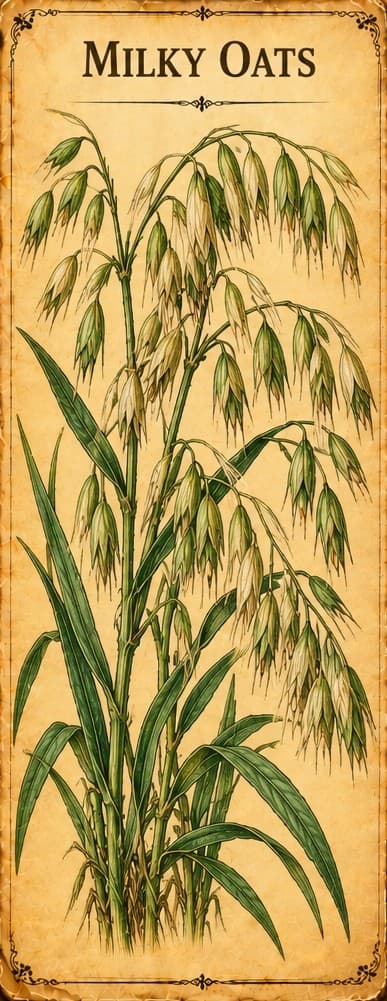
Milky Oats
Avena sativa
The green oat plant, sold as milky oats or oat herb. Oat herb harvested before flowering is recognised in Europe as a traditional remedy for mild stress and to help sleep.
Safety at a glance
- Pregnancy1 note →
- BreastfeedingNothing recorded
- MedicinesNothing recorded
- Who should avoid it1 note →
- AllergiesNothing recorded
- ToxicityNothing recorded
Tap a box to read the safety notes below. “Nothing recorded” means our sources don't cover it, not that it's safe.
What is Milky Oats?
- Plant family
- Poaceae, the grass family
- Parts used
- The green above-ground parts, harvested before flowering, fresh or dried, as a tea, extract or fresh juice
- Genus
- Avena
- Species
- sativa
Also called
Oat Herb, Green Oats, Milky Oat Tops
Traditionally used for
- Stress
- Sleep
Traditionally described as
- May help you relax (traditional)
Health topics
Where Milky Oats appears in symptom search, and why. Being listed doesn't mean it's a proven treatment.
- Memory and Thinking
A green oat extract improved working memory and multitasking in healthy adults.
- Sleep Problems (Insomnia)
Green oat herb is recognised in Europe as a traditional remedy to help sleep. Based on long use, not trials.
- Stress
Green oat extracts lowered stress responses in two trials.
Traditions that use it
- European Folk Medicine
Green oat herb is recognised in Europe as a traditional remedy for mild stress and to help sleep.
How it's prepared
Common ways Milky Oats is prepared or sold. This isn't advice on how to take it; see Safety below.
- Extract
Preparations of the plant are sold as tablets, capsules or liquids to take by mouth.[1]Health agency
- Tea / Infusion
The dried green oat plant is made into an herbal tea.[1]Health agency
- Tincture
Herbalists use it as a tincture, best made from the fresh milky oat tops.[2]General reference
Safety
Who should avoid it
Take care if you have coeliac disease, because its protein content hasn't been measured. Not recommended for children under 12.[1]Health agency
Side effects
Oat herb may make you drowsy. If it does, don't drive or use machinery. No other side effects are known.[1]Health agency
Pregnancy
Not recommended during pregnancy or breastfeeding, because its safety hasn't been established.[1]Health agency
How much to use
As a tea, 3 g of dried herb; or up to 5 ml of liquid extract up to 3 times a day; or 10 ml of fresh juice 3–4 times a day. See a doctor if symptoms continue.[1]Health agency
What does the research say?
Traditional use
These are traditional uses, not proven treatments.
The European Medicines Agency recognises oat herb, the green plant harvested before flowering, as a traditional herbal medicine for mild symptoms of mental stress and to help sleep, in adults and children over 12. This is based on long use alone, not on clinical trials.[1]Health agency
Research in people
In a 2020 UK trial, 132 healthy adults aged 35 to 65 took a green oat herb extract or a dummy pill for 4 weeks. The extract improved working memory and multitasking, and the highest dose lowered the body's stress response during a stressful task, though mood didn't change.[3]Study
In an 8-week trial, 145 people trying to cut down or quit smoking took a wild green oat extract or a dummy pill. The oat group had better quality of life, less stress and better sleep, and more of them cut their smoking by over 20% (67% vs 49%).[4]Study
In short
May make you drowsy; take care if you have coeliac disease.
Sources
- [1] Community herbal monograph on Avena sativa L., herba — European Medicines Agency (EMEA), Committee on Herbal Medicinal ProductsGovernment health agency
- [2] Oats — Herban Herbalist materia medica — Herban Herbalist (herb shop)General reference
- [3] Acute and Chronic Effects of Green Oat (Avena sativa) Extract on Cognitive Function and Mood during a Laboratory Stressor in Healthy Adults: A Randomised, Double-Blind, Placebo-Controlled Study in Healthy Humans · DOI: 10.3390/nu12061598Peer-reviewed study
- [4] Dietary supplementation with a wild green oat extract (Avena sativa L.) to improve wellness and wellbeing during smoking reduction or cessation: a randomized double-blind controlled study · DOI: 10.3389/fnut.2024.1405156Peer-reviewed study
This information is educational and traditional in nature, and is not a substitute for professional medical advice. Unfamiliar word? See what these words mean.