
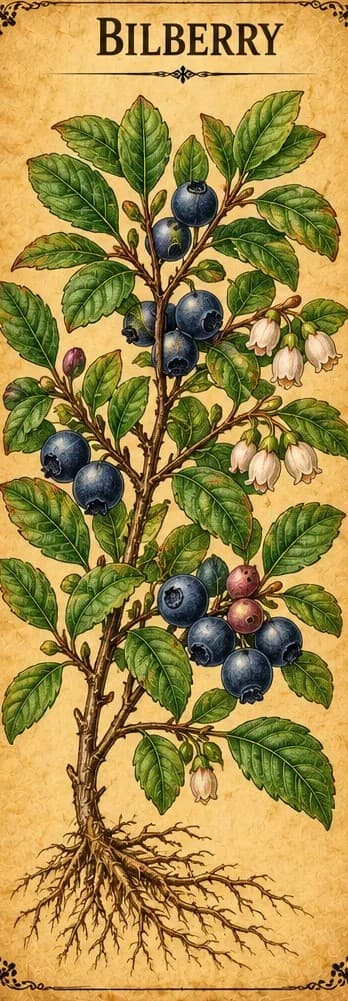
Bilberry
Vaccinium myrtillus
Dried bilberries are a traditional EU herbal medicine for mild diarrhea and mouth inflammation. Trials of supplements for blood sugar and heart health are small and inconclusive.
Safety at a glance
- Pregnancy1 note →
- BreastfeedingNothing recorded
- MedicinesNothing recorded
- Who should avoid itNothing recorded
- AllergiesNothing recorded
- ToxicityNothing recorded
Tap a box to read the safety notes below. “Nothing recorded” means our sources don't cover it, not that it's safe.
What is Bilberry?
- Plant family
- Ericaceae, the heather family
- Parts used
- The ripe berries, dried for medicine
- Genus
- Vaccinium
- Species
- myrtillus
Also called
European Blueberry, Whortleberry, Myrtilli fructus
Traditionally used for
- Mild diarrhea (traditional)
- Mouth inflammation (traditional)
- Blood sugar (studied)
Traditionally described as
- Antioxidant
Health topics
Where Bilberry appears in symptom search, and why. Being listed doesn't mean it's a proven treatment.
- Diarrhea
A traditional EU herbal medicine for mild diarrhea (as a tea of the dried berries). See a doctor if it lasts more than 3 days.
- High Blood Sugar
A review of small trials found a borderline drop in long-term blood sugar (HbA1c); evidence is weak.
- High Cholesterol
Small studies found bilberries improved blood fats, but a 2025 review of 11 trials found no clear change in cholesterol.
Traditions that use it
- European Folk Medicine
Dried bilberries are a traditional EU herbal medicine for mild diarrhea and for minor inflammation inside the mouth.
How it's prepared
Common ways Bilberry is prepared or sold. This isn't advice on how to take it; see Safety below.
- Decoction
The dried berries are simmered in water to make a liquid that's used in the mouth, for example as a rinse.[1]Health agency
- Tea / Infusion
The dried ripe berries are made into an herbal tea to drink.[1]Health agency
Safety
Side effects
No side effects or drug interactions are known for dried bilberries.[1]Health agency
Pregnancy
The European Medicines Agency says dried bilberries can be used during pregnancy and breastfeeding; no concerns about birth defects have arisen from eating them.[1]Health agency
What does the research say?
Traditional use
These are traditional uses, not proven treatments.
The European Medicines Agency recognises dried bilberries as a traditional herbal medicine, based on long use rather than trials, for:
- Mild diarrhea: a tea of 5 to 15 g of dried berries boiled in 250 ml of water, 3 to 4 times a day (15 to 60 g a day). See a doctor if it lasts more than 3 days.
- Minor inflammation inside the mouth: a mouth rinse of 20 g boiled in 200 ml of water, used several times a day. See a doctor if it lasts more than a week.
It isn't recommended for children under 12.[1]Health agency
Research in people
A 2025 review of 11 trials with 409 adults looked at bilberry supplements and heart and metabolic health. There was a borderline drop in long-term blood sugar (HbA1c), and triglycerides fell in short trials of 4 weeks or less. Bilberry didn't clearly change fasting blood sugar, cholesterol, blood pressure, weight or markers of inflammation. The authors say longer, high-quality trials are needed.[2]Review or trial
Technical detail: HbA1c WMD −1.63% (95% CI −3.36 to 0.11; p = 0.06); fasting glucose WMD −0.08 mmol/L (−0.22 to 0.07).
A 2022 review checked where bilberry's best-known health claims came from. For diabetes, eyesight and circulation, trial results are contradictory, with no clear benefit or dose. The eyesight and diabetes claims trace back to unproven or false claims repeated since the 20th century without checking. The night-vision story began with a claim that British pilots ate bilberry jam in World War II, which was never confirmed, and a 2004 review found bilberry extract doesn't improve night vision in healthy eyes.[3]Study
The same review found more promising results for blood fats and inflammation, mostly from small studies:
- 150 g of frozen bilberries 3 times a week for 6 weeks lowered total and LDL ("bad") cholesterol and triglycerides and raised HDL ("good") cholesterol
- After a heart attack, 40 g of bilberry powder a day added to the cholesterol-lowering effect of statins
- In people with metabolic syndrome, 400 g of fresh bilberries a day for 8 weeks lowered several markers of inflammation
- In an uncontrolled study of people with mild to moderate ulcerative colitis, a bilberry powder and juice preparation led to remission in 63%
Larger double-blind trials are still lacking.[3]Study
In short
Not for children under 12 as a medicine. See a doctor if diarrhea lasts more than 3 days.
Sources
- [1] European Union herbal monograph on Vaccinium myrtillus L., fructus siccus (EMA/HMPC/678995/2013) — European Medicines Agency, Committee on Herbal Medicinal Products (HMPC)Government health agency
- [2] Investigating the Effects of Vaccinium myrtillus Supplementation on Cardiometabolic Indices: A Systematic Review and Meta-Analysis · DOI: 10.1002/ptr.70054Review or clinical trial
- [3] Bilberries: Curative and Miraculous - A Review on Bioactive Constituents and Clinical Research · DOI: 10.3389/fphar.2022.909914Peer-reviewed study
This information is educational and traditional in nature, and is not a substitute for professional medical advice. Unfamiliar word? See what these words mean.