
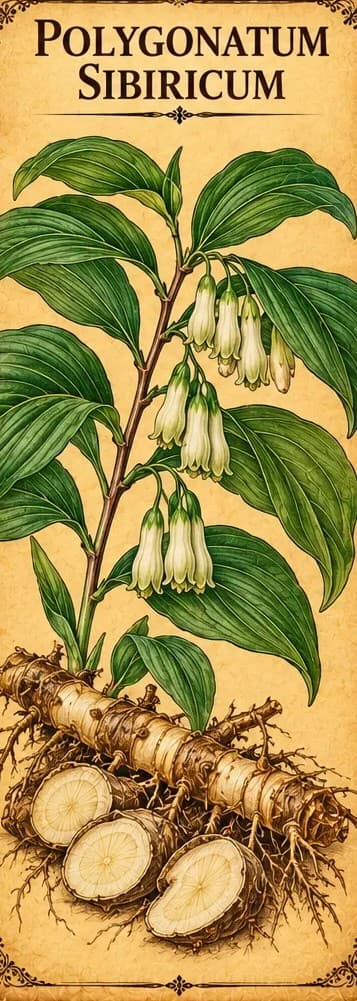
Polygonatum Sibiricum
Polygonatum sibiricum
Huang jing, a relative of Solomon's seal used in China for over 2,000 years as food and as a tonic for tiredness, weakness and slow-healing wounds. Research is in the lab.
Safety at a glance
- PregnancyNothing recorded
- BreastfeedingNothing recorded
- MedicinesNothing recorded
- Who should avoid itNothing recorded
- AllergiesNothing recorded
- ToxicityNothing recorded
Tap a box to read the safety notes below. “Nothing recorded” means our sources don't cover it, not that it's safe.
What is Polygonatum Sibiricum?
- Plant family
- Asparagaceae, the asparagus family
- Parts used
- The underground stem (rhizome)
- Genus
- Polygonatum
- Species
- sibiricum
Also called
Polygonati Rhizoma
Traditional names
Huang Jing, Huangjing
Traditionally used for
- Tonic for tiredness and weakness (traditional)
- Slow-healing wounds (traditional)
- Health foods
Traditionally described as
- Killed cancer cells (in lab studies)
Health topics
Where Polygonatum Sibiricum appears in symptom search, and why. Being listed doesn't mean it's a proven treatment.
- Fatigue
A traditional Chinese tonic for tiredness and weakness ("deficiency"). Not tested in trials.
- Sleep Problems (Insomnia)
In one trial, the root extract improved mild insomnia and total sleep time.
Traditions that use it
- Traditional Chinese Medicine
Called huang jing; used for over 2,000 years as a superior tonic for qi and yin and to strengthen the spleen, lungs and kidneys.
How it's prepared
Common ways Polygonatum Sibiricum is prepared or sold. This isn't advice on how to take it; see Safety below.
What does the research say?
Traditional use
These are traditional uses, not proven treatments.
Huang jing has been used in China for over 2,000 years as both food and medicine. It's ranked a superior tonic, used to "tonify qi and nourish yin" and to strengthen the spleen, lungs and kidneys. Classical texts recommend it for "deficiency" conditions, including:
- Tiredness and weight loss
- Night sweats
- A weak immune system
It was also used for sores, ulcers and slow-healing wounds.[2]Study
An early herbal, the Record of Famous Doctors, describes it as sweet, neutral and non-toxic. The Chinese Pharmacopoeia lists this and two related species as sources of huang jing. Today it's used in Chinese patent medicines, for example for memory problems and diabetes, and in drinks and health foods. It's a close relative of Solomon's seal (Polygonatum odoratum).[1]Study
Laboratory & animal research
Lab and animal results show what might be worth studying in people. They don't show that the herb has these effects in humans.
In lab studies, saponins from Polygonatum sibiricum killed several kinds of cancer cells, and other Polygonatum compounds boosted immune responses. These haven't been tested in people.[2]Study
Research in people
In a 2019 Korean trial, 80 people with mild insomnia took 500 mg a day of Polygonatum sibiricum root extract or a dummy pill for 4 weeks. The extract improved insomnia scores and increased total sleep time.[3]Study
Sources
- [1] Preparation, Structure, Function, and Application of Dietary Polysaccharides from Polygonatum sibiricum in the Food Industry: A Review · DOI: 10.3390/molecules30051098Peer-reviewed study
- [2] The antitumor potential of Polygonatum spp.: a narrative review of traditional uses, bioactive metabolites, and multi-targeted mechanisms · DOI: 10.3389/fphar.2025.1662839Peer-reviewed study
- [3] Efficacy of Polygonatum sibiricum on Mild Insomnia: A Randomized Placebo-Controlled Trial · DOI: 10.3390/nu11081719Peer-reviewed study
This information is educational and traditional in nature, and is not a substitute for professional medical advice. Unfamiliar word? See what these words mean.