
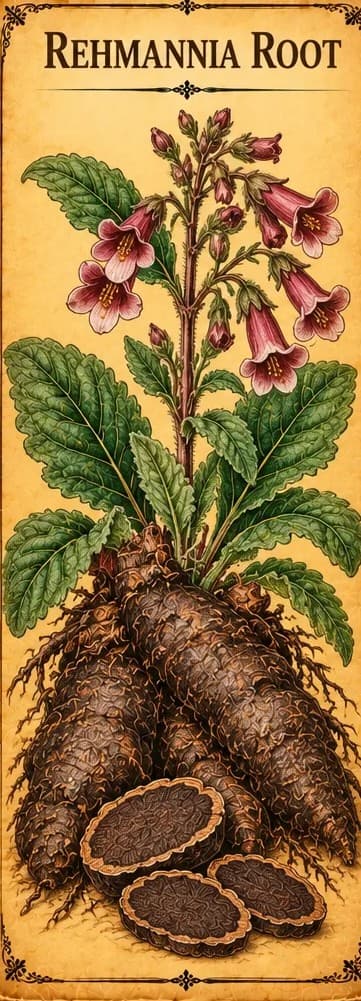
Rehmannia Root
Rehmannia glutinosa
Di huang, a Chinese medicine root used raw or steamed black, recorded in the Shennong Herbal Classic for injuries, joint pain and as a "kidney" tonic. Research is in the lab and in animals.
Safety at a glance
- PregnancyNothing recorded
- BreastfeedingNothing recorded
- MedicinesNothing recorded
- Who should avoid itNothing recorded
- AllergiesNothing recorded
- Toxicity1 note →
Tap a box to read the safety notes below. “Nothing recorded” means our sources don't cover it, not that it's safe.
What is Rehmannia Root?
- Plant family
- Orobanchaceae, the broomrape family
- Parts used
- The root, used raw (sheng di huang) or steamed until black (shu di huang)
- Genus
- Rehmannia
- Species
- glutinosa
Also called
Rehmanniae Radix, Rehmannia
Traditional names
Di Huang, Shu Di Huang, Sheng Di Huang
Traditionally used for
- Kidney tonic (traditional)
- Injuries and joint pain (traditional)
- Anti-ageing (traditional)
Traditionally described as
- Protected the kidneys (in animal studies)
Health topics
Where Rehmannia Root appears in symptom search, and why. Being listed doesn't mean it's a proven treatment.
- Acne
In a very small 8-week trial in 22 women, acne improved somewhat more with a rehmannia leaf extract taken by mouth than with a dummy capsule. It used the leaf, not the root.
- Menopause Symptoms
Formulas built around rehmannia eased menopause-like symptoms in women treated for breast cancer, in lower-quality trials.
Traditions that use it
- Traditional Chinese Medicine
Called di huang; recorded in the Shennong Herbal Classic and used for centuries to strengthen the "kidneys" and treat kidney diseases.
How it's prepared
Common ways Rehmannia Root is prepared or sold. This isn't advice on how to take it; see Safety below.
- Decoction
The dried roots and rhizomes are made into infusions or decoctions.[1]Health agency
Safety
Toxicity testing
Its long traditional use suggests it's safe, but full toxicity studies of its purified extracts are largely missing.[2]Study
What does the research say?
Traditional use
These are traditional uses, not proven treatments.
The Shennong Herbal Classic describes rehmannia as sweet, cold and non-toxic, and recommends it for:
- Broken bones and muscle injuries
- "Blood stasis"
- Building up bone marrow and muscle
- Aching joints
It says that taken long-term, it "lightens the body" and slows ageing. Chinese medicine has long used it to strengthen the "kidneys", a term that also covers growth, reproduction and fluid balance.[3]Study
The root is used raw (sheng di huang) or steamed (shu di huang), and steaming changes its chemistry and effects.[2]Study
Laboratory & animal research
Lab and animal results show what might be worth studying in people. They don't show that the herb has these effects in humans.
In lab and animal studies, compounds from rehmannia, such as catalpol, protected the kidneys and reduced kidney scarring. These haven't been confirmed in people.[3]Study
In lab and animal studies, rehmannia polysaccharides boosted the immune system and slowed some lung cancer cells. These haven't been tested in people.[2]Study
Research in people
Breast cancer treatment can bring on menopause-like symptoms. A 2025 review of 17 Chinese trials with 1,139 women found that herbal formulas with rehmannia as the main herb eased these symptoms more than standard Western medicines. The trials had design flaws and varied widely, and they tested formulas, not rehmannia alone.[4]Review or trial
In a very small trial, 22 women with moderate to severe acne took 100 mg a day of rehmannia leaf extract or a dummy capsule for 8 weeks. Acne improved somewhat more with the extract, along with some measures of skin quality. Note this used the leaf, not the root.[5]Study
In short
Full toxicity studies of its extracts are lacking.
Sources
- [1] WHO monographs on selected medicinal plants, Volume 3 — "Radix Rehmanniae" monograph — World Health OrganizationGovernment health agency
- [2] Rehmannia glutinosa polysaccharides: a review on structural features, pharmacological potential, and advanced delivery systems · DOI: 10.3389/fnut.2026.1772902Peer-reviewed study
- [3] Harnessing the multi-targeted potential of rehmanniae radix natural products against renal fibrosis: a mechanistic review · DOI: 10.3389/fphar.2025.1690036Peer-reviewed study
- [4] Rehmannia glutinosa for perimenopausal syndrome in patients with breast cancer: A systematic review and meta-analysis · DOI: 10.15537/smj.2025.46.7.20240572Review or clinical trial
- [5] Assessment of the Effect of Rehmannia glutinosa Leaf Extract in Maintaining Skin Health: A Proof-of-Concept, Double-Blind, Randomized, Placebo-Controlled Clinical Trial · DOI: 10.2147/CCID.S448928Peer-reviewed study
This information is educational and traditional in nature, and is not a substitute for professional medical advice. Unfamiliar word? See what these words mean.