
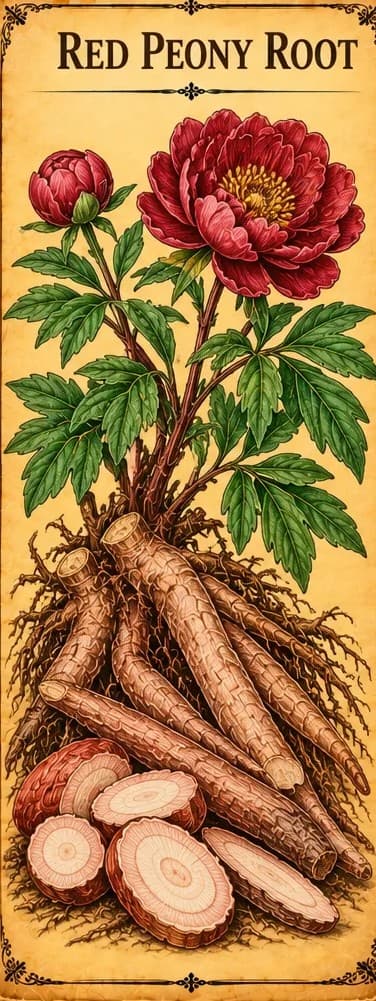
Red Peony Root
Paeonia lactiflora
Chi shao, a root from Paeonia lactiflora, used to "cool the blood" and relieve "blood stasis" and pain: for nosebleeds, sore eyes, period pain and injuries. Research is in animals.
Safety at a glance
- PregnancyNothing recorded
- BreastfeedingNothing recorded
- MedicinesNothing recorded
- Who should avoid itNothing recorded
- AllergiesNothing recorded
- ToxicityNothing recorded
Tap a box to read the safety notes below. “Nothing recorded” means our sources don't cover it, not that it's safe.
What is Red Peony Root?
- Plant family
- Paeoniaceae, the peony family
- Parts used
- The dried root
- Genus
- Paeonia
- Species
- lactiflora
Also called
Radix Paeoniae Rubra, Paeoniae Radix Rubra
Traditional names
Chi Shao, Chishao
Traditionally used for
- Period pain (traditional)
- Injuries and bruising (traditional)
- Nosebleeds and rashes (traditional)
- Sore eyes (traditional)
Traditionally described as
- Slowed blood clotting (in animal studies)
Health topics
Where Red Peony Root appears in symptom search, and why. Being listed doesn't mean it's a proven treatment.
- Menstrual Discomfort
A traditional Chinese herb for period pain. Not tested on its own in trials.
- Sprains and Bruises
Traditionally used for injuries and "blood stasis". Not tested on its own in trials.
Traditions that use it
- Traditional Chinese Medicine
Called chi shao; a "heat-clearing, blood-cooling" herb used to relieve "blood stasis" and pain, for nosebleeds, sore eyes, period pain and injuries.
How it's prepared
Common ways Red Peony Root is prepared or sold. This isn't advice on how to take it; see Safety below.
- Decoction
The root is boiled in water as a decoction.[1]Health agency
- Powder
The dried root is used crude or as a powder.[1]Health agency
What does the research say?
Traditional use
These are traditional uses, not proven treatments.
Red and white peony root come from the same plant, Paeonia lactiflora. Chinese physicians began treating them as separate medicines in the Northern Song Dynasty (960–1127 AD). Red peony root is described as slightly cold and bitter, and is used to "clear heat and cool the blood" and relieve "blood stasis" and pain, for:
- Rashes and nosebleeds from "blood heat"
- Painful, swollen eyes and cloudy vision
- Pain under the ribs
- Period pain
- Injuries
Laboratory & animal research
Lab and animal results show what might be worth studying in people. They don't show that the herb has these effects in humans.
In animal studies, red peony root protected the liver, improved blood flow in small vessels, widened blood vessels, protected the heart during reduced blood flow, thinned the blood and slowed clotting. Its main compound, paeoniflorin, is thought to be largely responsible. These haven't been confirmed in people.[2]Study
Sources
- [1] WHO monographs on selected medicinal plants, Volume 1 — "Radix Paeoniae" monograph — World Health OrganizationGovernment health agency
- [2] Efficacy, Chemical Constituents, and Pharmacological Actions of Radix Paeoniae Rubra and Radix Paeoniae Alba · DOI: 10.3389/fphar.2020.01054Peer-reviewed study
This information is educational and traditional in nature, and is not a substitute for professional medical advice. Unfamiliar word? See what these words mean.