
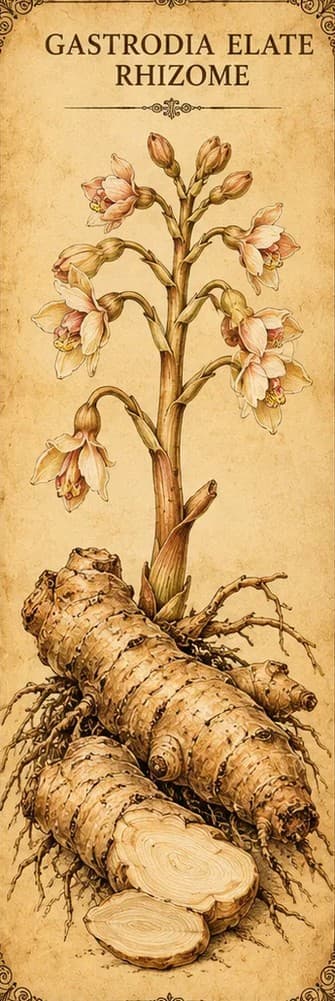
Gastrodia Elata Rhizome
Gastrodia elata
Tian ma, the tuber of an orchid recorded over 2,000 years ago and used in Chinese medicine for headache, dizziness, high blood pressure and stroke. Research is mostly in the lab and in animals.
Safety at a glance
- PregnancyNothing recorded
- BreastfeedingNothing recorded
- MedicinesNothing recorded
- Who should avoid itNothing recorded
- AllergiesNothing recorded
- ToxicityNothing recorded
Tap a box to read the safety notes below. “Nothing recorded” means our sources don't cover it, not that it's safe.
What is Gastrodia Elata Rhizome?
- Plant family
- Orchidaceae, the orchid family
- Parts used
- The dried tuber (rhizome) of an orchid
- Genus
- Gastrodia
- Species
- elata
Also called
Gastrodia, Rhizoma Gastrodiae, Gastrodia Elate Rhizome
Traditional names
Tian Ma, Tianma
Traditionally used for
- Headache and dizziness (traditional)
- High blood pressure (traditional)
- Stroke and numbness (traditional)
Traditionally described as
- Protected nerve cells (in animal studies)
Health topics
Where Gastrodia Elata Rhizome appears in symptom search, and why. Being listed doesn't mean it's a proven treatment.
- Headache
A review of 16 trials found gastrodin, its main compound, reduced migraine pain and frequency.
- High Blood Pressure
Traditionally used for high blood pressure; lowered it in animal studies. Not well tested in trials.
Traditions that use it
- Traditional Chinese Medicine
Called tian ma; recorded in the Shennong Herbal Classic over 2,000 years ago and used for headache, dizziness, high blood pressure, stroke and numbness.
How it's prepared
Common ways Gastrodia Elata Rhizome is prepared or sold. This isn't advice on how to take it; see Safety below.
- Decoction
It's usually taken as a decoction, often with other herbs such as chuanxiong.[1]Review or trial
What does the research say?
Traditional use
These are traditional uses, not proven treatments.
Tian ma is the dried tuber of an orchid, recorded in the Shennong Herbal Classic over 2,000 years ago. It's used in China, Korea, Japan and Russia, mainly for:
- Headache and dizziness
- High blood pressure
- Stroke, one-sided weakness and numbness in the limbs
- Arthritis
It's usually taken as a decoction, often with other herbs such as chuanxiong.[1]Review or trial
Laboratory & animal research
Lab and animal results show what might be worth studying in people. They don't show that the herb has these effects in humans.
In lab and animal studies, tian ma and its main compound gastrodin had calming and sleep-promoting effects, reduced seizures, protected nerve cells in models of Alzheimer's and Parkinson's disease, lowered blood pressure and protected the heart and blood vessels. Its compound gastrodin is used as a single-ingredient medicine in China, but clinical trials for newer uses are limited.[1]Review or trial
Research in people
Gastrodin is the main active compound of gastrodia (tianma). A 2022 review of 16 Chinese trials with 1,332 people found gastrodin helped migraine: more people improved, and attacks were less painful, less frequent and shorter, with no safety concerns reported.[2]Review or trial
Technical detail: response RR 1.21 (95% CI 1.17 to 1.27); pain MD −1.65 (−2.28 to −1.02).
In a 2025 Chinese trial, 155 adults having heart bypass surgery were given gastrodin by drip (600 mg twice a day) or a dummy drip for a week. Confusion after surgery (delirium) affected 19.5% of the gastrodin group versus 35.9% of the dummy group, and side effects were no more common.[3]Review or trial
Technical detail: relative risk 0.54 (95% CI 0.32 to 0.93).
Sources
- [1] From molecules to medicine: a systematic review of Gastrodia elata's bioactive metabolites and therapeutic potential · DOI: 10.3389/fphar.2025.1641443Review or clinical trial
- [2] Effectiveness of gastrodin for migraine: A meta-analysis · DOI: 10.3389/fneur.2022.939401Review or clinical trial
- [3] Efficacy and safety of gastrodin in preventing postoperative delirium following cardiac surgery: a randomized placebo controlled clinical trial · DOI: 10.1186/s13054-025-05331-9Review or clinical trial
This information is educational and traditional in nature, and is not a substitute for professional medical advice. Unfamiliar word? See what these words mean.