
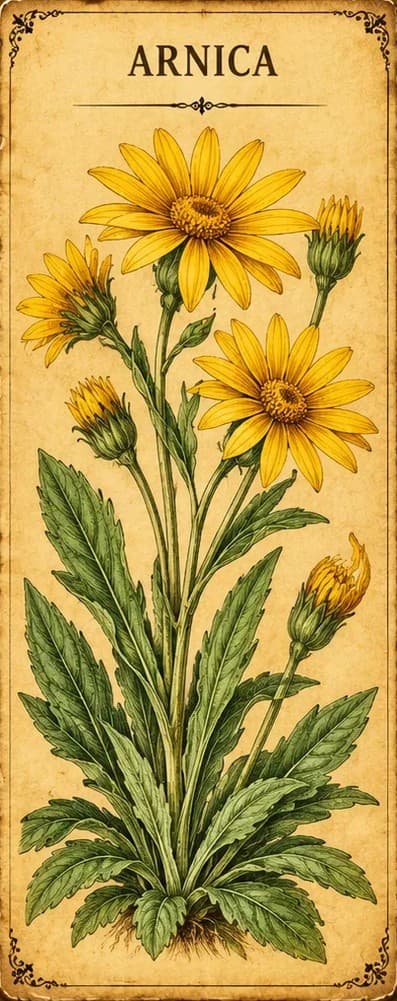
Arnica
Arnica montana
A yellow mountain daisy whose flowers are made into creams and gels, recognized in Europe as a traditional medicine for bruises, sprains and muscle pain. For use on unbroken skin only.
Safety at a glance
- Pregnancy1 note →
- BreastfeedingNothing recorded
- MedicinesNothing recorded
- Who should avoid it1 note →
- Allergies1 note →
- ToxicityNothing recorded
Tap a box to read the safety notes below. “Nothing recorded” means our sources don't cover it, not that it's safe.
What is Arnica?
- Plant family
- Asteraceae, the daisy family
- Parts used
- The flower heads, made into tinctures, creams, gels and dressings for the skin
- Genus
- Arnica
- Species
- montana
Also called
Arnica montana, Leopard's Bane, Mountain Arnica
Traditionally used for
- Bruises and sprains (traditional
- on the skin)
- Muscle pain (traditional
- on the skin)
Traditionally described as
Health topics
Where Arnica appears in symptom search, and why. Being listed doesn't mean it's a proven treatment.
- Sprains and Bruises
Recognized in Europe as a traditional medicine applied to the skin for bruises and sprains. For use on unbroken skin only.
Traditions that use it
- European Folk Medicine
Recognized in Europe as a traditional herbal medicine, used on the skin for bruises, sprains and muscle pain.
How it's prepared
Common ways Arnica is prepared or sold. This isn't advice on how to take it; see Safety below.
- Oil
An infused oil or liniment is applied with a clean cloth to unbroken skin only. It's for external use only.[1]General reference
- Salve
Creams, gels and ointments made with arnica flower extracts are applied to unbroken skin.[2]Health agency
- Tincture
Arnica flower tinctures and liquid extracts are recognized for use on the skin only, not by mouth.[2]Health agency
Safety
Who should avoid it
Not recommended for children under 12, because there isn't enough information on its use.[2]Health agency
Allergies
Arnica can cause allergic skin reactions such as itching, redness and eczema. Don't use it if you're allergic to arnica or other daisy-family plants.[2]Health agency
Pregnancy
Its safety in pregnancy and breastfeeding hasn't been established, and use in pregnancy isn't recommended.[2]Health agency
Depends on how it's prepared
Arnica medicines in Europe are only for use on the skin, as creams, gels, tinctures or soaked dressings. Don't use them on broken skin. See a doctor if symptoms last longer than 3 to 4 days or get worse.[2]Health agency
What does the research say?
Traditional use
These are traditional uses, not proven treatments.
Based on long-standing use, the European Medicines Agency recognizes arnica flower preparations applied to the skin as a traditional herbal medicine for bruises, sprains and localised muscle pain, in adults and children 12 and over. This rests on at least 30 years of safe use, not on proof from clinical trials.[3]Health agency
Research in people
The European Medicines Agency looked at clinical studies of arnica in people with bruises and soft tissue or joint pain. Some suggested it might reduce pain and bruising, but no firm conclusions could be drawn because the studies were small and many had no comparison group.[3]Health agency
In short
For use on unbroken skin only. Can cause skin allergy. Not for children under 12 or in pregnancy.
Sources
- [1] Arnica — Herban Herbalist materia medica — Herban Herbalist (herb shop)General reference
- [2] Community herbal monograph on Arnica montana L., flos (EMA/HMPC/198793/2012) — European Medicines Agency, Committee on Herbal Medicinal Products (HMPC)Government health agency
- [3] Arnica flower (Arnica montana L., flos): summary for the public (EMA/654173/2016) — European Medicines Agency, Committee on Herbal Medicinal Products (HMPC)Government health agency
This information is educational and traditional in nature, and is not a substitute for professional medical advice. Unfamiliar word? See what these words mean.