
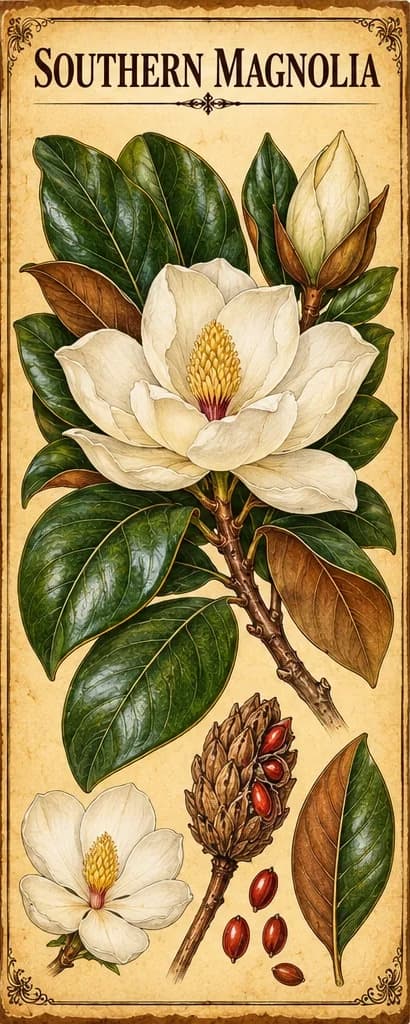
Southern Magnolia
Magnolia grandiflora
A large evergreen magnolia tree from the southeastern United States. The Choctaw and Koasati used its bark as a wash for heat rash and sores, and one small trial tested a bark mouthwash against tooth-decay bacteria.
Safety at a glance
- PregnancyNothing recorded
- BreastfeedingNothing recorded
- MedicinesNothing recorded
- Who should avoid itNothing recorded
- AllergiesNothing recorded
- ToxicityNothing recorded
Tap a box to read the safety notes below. “Nothing recorded” means our sources don't cover it, not that it's safe.
What is Southern Magnolia?
- Plant family
- Magnoliaceae, the magnolia family
- Parts used
- Mainly the bark
- Where it grows
- Coastal southeastern United States, from North Carolina to eastern Texas; widely planted elsewhere
- Genus
- Magnolia
- Species
- grandiflora
Traditionally used for
- Heat rash
- Sores
- Swelling
- Fevers
- Rheumatism (traditional)
Traditionally described as
- May cause sweating
- Stomach tonic
Health topics
Where Southern Magnolia appears in symptom search, and why. Being listed doesn't mean it's a proven treatment.
- Cuts, Wounds, Burns and Skin Ulcers
Traditional use only: the Koasati used a bark wash on sores. Not studied in people.
- Fever
Traditional use only: a review of historical records says Native peoples used magnolias such as this one for fevers. Not studied in people.
- Joint Discomfort
Traditional use only: a review of historical records says Native peoples used magnolias such as this one for rheumatism. Not studied in people.
- Skin Irritation, Rashes and Itching
Traditional use only: the Choctaw used a bark wash or a bath for the itching of prickly heat (heat rash). Not studied in people.
Traditions that use it
- Native American Ethnobotany
Choctaw and Koasati use of the bark as a wash for heat rash and sores, and in a steam bath for swelling.
How it's prepared
Common ways Southern Magnolia is prepared or sold. This isn't advice on how to take it; see Safety below.
- Decoction
The Choctaw and Koasati boiled the bark to make a wash for the skin.[1]Traditional text
- Extract
A mouthwash made with a 0.3% bark extract was tested in a small trial.[2]Study
What does the research say?
Traditional use
These are traditional uses, not proven treatments.
Southeastern peoples recorded these uses:
- Choctaw: a wash made by boiling the bark, used for the itching of prickly heat (heat rash). A bath made from the plant was also used for prickly heat.
- Choctaw: mashed bark steeped in water and used in a steam bath for dropsy, an old name for swelling caused by fluid build-up.
- Koasati: a wash made by boiling the bark, used on sores.
A 2024 review of historical records says Native peoples used magnolias, including Southern Magnolia, for rheumatism and fevers. Older writings described the dried bark as a stimulating tonic that may cause sweating and help the stomach. They also noted it was sometimes swapped for the weaker bark of the tulip tree.[3]Study
Technical detail: described as tonic, stimulant, diaphoretic and stomachic; substituted with Liriodendron bark.
Laboratory & animal research
Lab and animal results show what might be worth studying in people. They don't show that the herb has these effects in humans.
In lab tests, a seed extract and three compounds from it (magnolol, honokiol and 4-O-methylhonokiol) attached to cannabinoid receptors, the same receptors cannabis acts on, more strongly than to opioid receptors. They bound most strongly to the CB2 type.[4]Study
Technical detail: n-hexane seed extract; radioligand binding assays; CB2 Ki 0.29–1.94 μM vs CB1 Ki 3.85–17.82 μM for compounds 1–3.
In lab tests, compounds from a Southern Magnolia extract slowed the growth of the malaria parasite. Two of them were moderately active, and six were weak.[5]Study
Technical detail: methanol extract; Plasmodium falciparum; known neolignans 3 and 4 IC50 2.8 and 3.4 μM, others 16.5–114 μM.
In lab tests, the essential oil from the seeds kept yellow fever mosquitoes from biting about as well as DEET, a common insect repellent. Oils from the unripe and ripe fruit were highly toxic to the mosquitoes, while the leaf, flower and seed oils were much less so.[6]Study
Technical detail: Aedes aegypti; seed oil biting deterrence index 0.89; 1-decanol (3.3% of seed oil) was the most active compound, LC50 4.8 ppm.
In lab tests, some compounds from the fruit were toxic to five types of human cancer cells. Some also lowered nitric oxide, a signal of inflammation, in mouse immune cells.[7]Study
Technical detail: sesquiterpenoids; K562, A549, HepG2, MDA-MB-231 and SW480 cells, IC50 6.07–31.15 μM; LPS-induced NO release in RAW 264.7 macrophages, IC50 6.03–14.46 μM.
Research in people
In a small trial in Iran, 20 adults aged 18 to 35 were split into two groups. One group used a 0.3% Southern Magnolia bark mouthwash and the other a placebo mouthwash for a week. After a week off, they did the same again for another week.
While using the magnolia mouthwash, people had fewer Streptococcus mutans in their dental plaque than with the placebo or during the week off. This is a bacterium linked to tooth decay. The study was small and short, and the authors say larger studies are needed.[2]Study
Technical detail: randomized, single-blind, placebo-controlled; hydro-ethanol bark extract; S. mutans counted by culture; difference statistically significant (paired and independent t-tests).
In short
Barely studied in people, so its safety is unknown.
Sources
- [1] Native American Ethnobotany Database: Magnolia grandiflora — Botanical Research Institute of Texas (BRIT); compiled by Daniel E. MoermanTraditional text
- [2] The antibacterial effect of Magnolia mouthwash on the levels of salivary Streptococcus mutans in dental plaque: a randomized, single-blind, placebo-controlled trial · DOI: 10.18502/ijm.v13i1.5499Peer-reviewed study
- [3] Plants of the USA: recordings on native North American useful species by Alexander von Humboldt · DOI: 10.1186/s13002-024-00727-3Peer-reviewed study
- [4] In Vitro and In Silico Studies of Neolignans from Magnolia grandiflora L. Seeds against Human Cannabinoids and Opioid Receptors · DOI: 10.3390/molecules28031253Peer-reviewed study
- [5] Bioactive Neolignans and Other Compounds from Magnolia grandiflora L.: Isolation and Antiplasmodial Activity · DOI: 10.1002/cbdv.201700209Peer-reviewed study
- [6] Insecticidal and Biting Deterrent Activities of Magnolia grandiflora Essential Oils and Selected Pure Compounds against Aedes aegypti · DOI: 10.3390/molecules25061359Peer-reviewed study
- [7] Magnorolins A-L: sesquiterpenoids with diverse skeletons from the fruits of Magnolia grandiflora and their cytotoxic and anti-inflammatory activities · DOI: 10.1039/d6ra02737gPeer-reviewed study
This information is educational and traditional in nature, and is not a substitute for professional medical advice. Unfamiliar word? See what these words mean.