
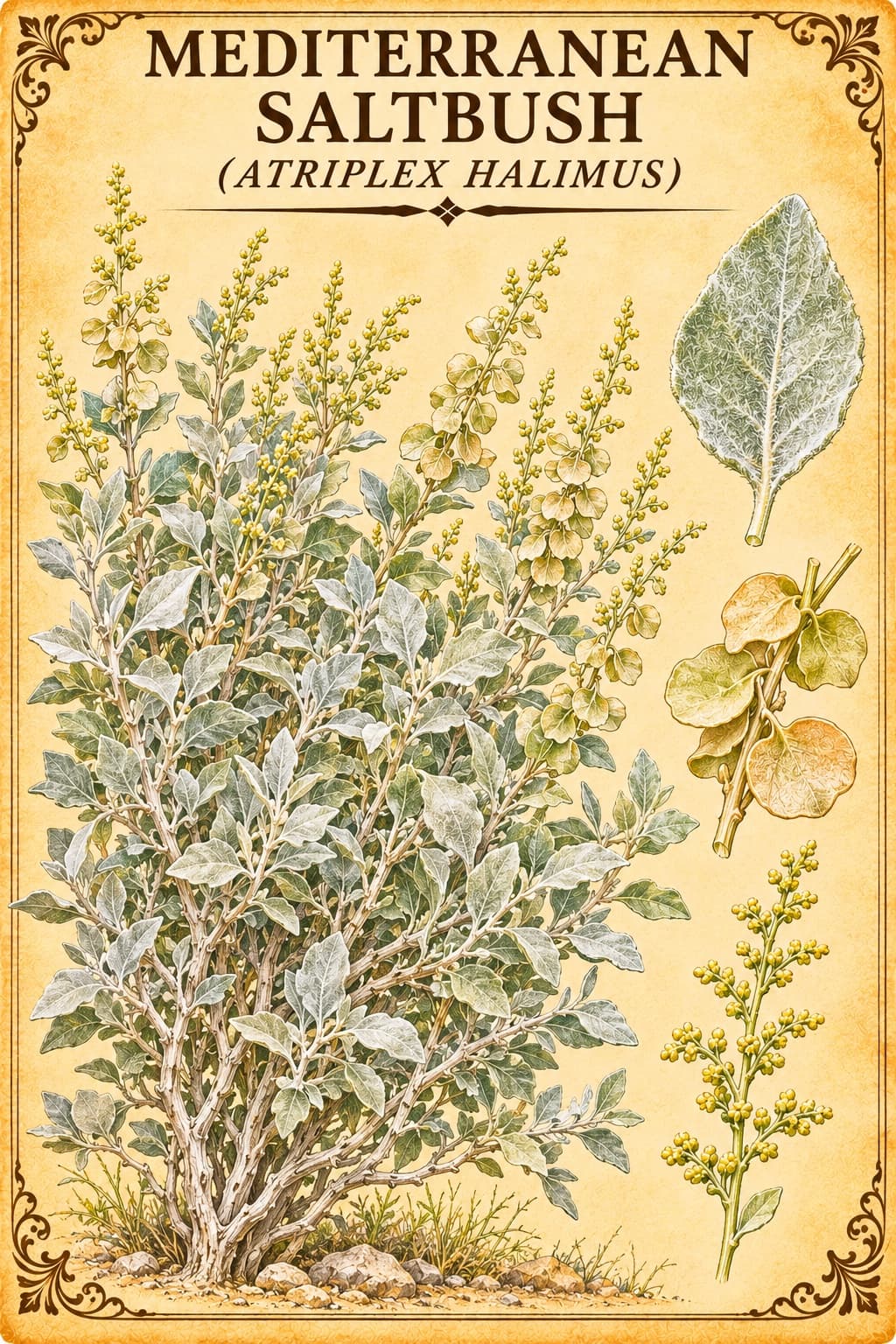
Mediterranean Saltbush
Atriplex halimus
A salty-leaved shrub of the Mediterranean and North Africa, eaten as a vegetable and drunk as a tea for diabetes. It lowered blood sugar in rats.
Safety at a glance
- PregnancyNothing recorded
- BreastfeedingNothing recorded
- MedicinesNothing recorded
- Who should avoid itNothing recorded
- AllergiesNothing recorded
- Toxicity2 notes →
Tap a box to read the safety notes below. “Nothing recorded” means our sources don't cover it, not that it's safe.
What is Mediterranean Saltbush?
- Plant family
- Amaranthaceae, the amaranth family
- Parts used
- The leaves
- Where it grows
- The Mediterranean and North Africa
- Genus
- Atriplex
- Species
- halimus
Also called
Saltbush
Traditionally used for
- Diabetes
- Stomach problems
- Arthritis (traditional)
- Food
Traditionally described as
- Leaves rich in fiber
- iron and flavonoids
Health topics
Where Mediterranean Saltbush appears in symptom search, and why. Being listed doesn't mean it's a proven treatment.
- High Blood Sugar
A traditional diabetes remedy. Lowered blood sugar in rats, and a small study of a four-herb tablet including it helped people with type 2 diabetes.
- Indigestion
A leaf tea is a traditional remedy for stomach and gut problems. Not studied in people.
- Joint Discomfort
Used traditionally for arthritis. A leaf extract reduced joint swelling in arthritic rats; not tested in people.
Traditions that use it
- Mediterranean Folk Medicine
Leaf decoctions and teas used across the Mediterranean and North Africa for diabetes, heart, gut and joint problems.
How it's prepared
Common ways Mediterranean Saltbush is prepared or sold. This isn't advice on how to take it; see Safety below.
- Culinary Preparation
Salty leaves eaten in salads and as a seasoning.[1]Study
- Decoction
Leaves boiled in water, the traditional way it's taken.[1]Study
Safety
Toxicity testing
Leaf extracts didn't damage DNA in a standard bacterial test (Ames test), and in lab tests they only harmed cells at high concentrations. No human safety studies were found.[1]Study
Like other plants in its family, saltbush is high in salts and in oxalates, compounds that bind calcium in the body.[2]Study
Contamination
The plant absorbs heavy metals from the soil and is used to clean up polluted land.[1]Study
What does the research say?
Traditional use
These are traditional uses, not proven treatments.
The salty leaves are eaten in salads and as a seasoning, and were eaten in times of famine. Since ancient times the shrub has also fed livestock.[1]Study
A decoction or tea of the leaves is a traditional remedy for heart disease, stomach and gut problems, diabetes and arthritis. The Sahrawi people living in refugee camps in Algeria still use it.[1]Study
In Pakistan a leaf decoction is taken to purify the blood and for fever, jaundice and liver disease, and in Algeria it's used for thyroid problems.[3]Study
It's one of the herbs strongly recommended in Greco-Arab and Islamic medicine to treat and prevent diabetes.[4]Study
Laboratory & animal research
Lab and animal results show what might be worth studying in people. They don't show that the herb has these effects in humans.
In lab tests, a leaf extract helped muscle cells move glucose transporters to their surface, one way the body takes up sugar.[4]Study
Extracts slowed alpha-amylase, an enzyme that breaks down starch into sugar, and reduced sugar damage to proteins in lab tests.[5]Study
In rats with arthritis, a water extract of the leaves taken for 21 days reduced paw swelling and joint damage and brought blood tests back toward normal.[6]Study
The leaves are high in fiber and iron and contain healthy omega fats. Most of the plant compounds in the traditional decoction survived a simulated digestion.[1]Study
A 2024 review found lab studies reporting antioxidant, antibacterial, blood-sugar-lowering and anti-parasite effects.[7]Study
Leaf juice and water extracts lowered blood sugar in diabetic rats.[3]Study
Saltbush is the favorite food of the fat sand rat, a North African desert gerbil, and is low in calories. When sand rats are kept in a lab and fed standard rodent food instead, they develop type 2 diabetes within 4 weeks, which makes them a common animal model for studying diabetes.[8]Study
Research in people
In a small 2008 study, 16 people with newly diagnosed type 2 diabetes took Glucolevel, a tablet combining saltbush with walnut, olive and nettle leaves, 3 times a day for 4 weeks. Average blood sugar fell from 290 to 210 mg/dl in the first week, HbA1c (long-term blood sugar) fell from 8.2 to 6.9 in the 6 people tested, and no side effects were reported. Because it was a mixture with no comparison group, saltbush's own effect isn't known.[9]Study
In short
No human safety studies were found; absorbs heavy metals from soil.
Sources
- [1] Investigating the Nutritional Properties, Chemical Composition (UPLC-HR-MS) and Safety (Ames Test) of Atriplex halimus L. Leaves and Their Potential Health Implications · DOI: 10.3390/plants14213350Peer-reviewed study
- [2] Oxalate, calcium and ash intake and excretion balances in fat sand rats (Psammomys obesus) feeding on two different diets · DOI: 10.1016/j.cbpb.2005.03.011Peer-reviewed study
- [3] The Therapeutic Properties, Ethno pharmacology and Phyto-chemistry of Atriplex Species: A review · DOI: 10.52700/pjbb.v2i1.38Peer-reviewed study
- [4] In Vitro Evaluations of Cytotoxicity of Eight Antidiabetic Medicinal Plants and Their Effect on GLUT4 Translocation · DOI: 10.1155/2013/549345Peer-reviewed study
- [5] Phytochemical Profiling, Antioxidant Capacity, and the Antidiabetic Potential of Atriplex halimus Extracts: UHPLC-MS/MS Analysis, In Vitro Enzyme Inhibition Assays, and Molecular Docking Studies · DOI: 10.1002/fsn3.70745Peer-reviewed study
- [6] Phytochemical Characterization and Evaluation of Antioxidant, Anti-Inflammatory, Cytotoxic, Genotoxic, and Anti-Arthritic Activities of Atriplex halimus Aqueous Leaf Extract · DOI: 10.3390/plants15142164Peer-reviewed study
- [7] Atriplex halimus: Phytochemical Insights, Traditional Applications, and Pharmacological Promises · DOI: 10.1002/cbdv.202402171Peer-reviewed study
- [8] Circadian rhythms-related disorders in diurnal fat sand rats under modern lifestyle conditions: A review · DOI: 10.3389/fphys.2022.963449Peer-reviewed study
- [9] Maintaining a physiological blood glucose level with 'glucolevel', a combination of four anti-diabetes plants used in the traditional Arab herbal medicine · DOI: 10.1093/ecam/nem047Peer-reviewed study
This information is educational and traditional in nature, and is not a substitute for professional medical advice. Unfamiliar word? See what these words mean.