
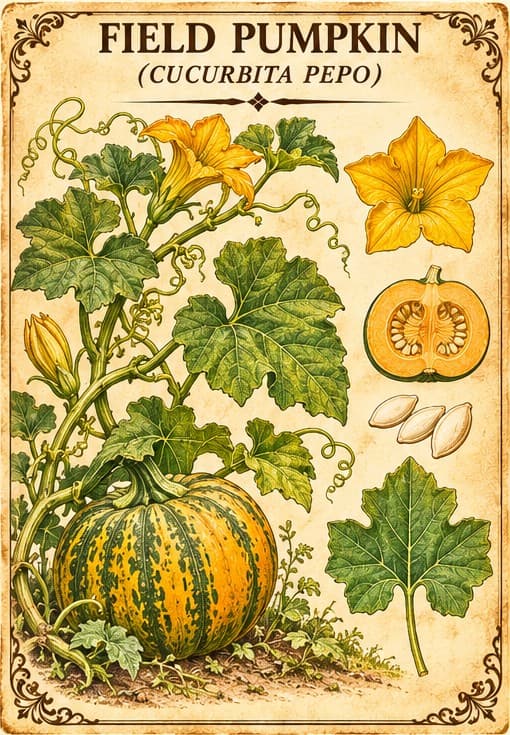
Field Pumpkin
Cucurbita pepo
The common pumpkin. Its seeds are an EU traditional medicine for urinary symptoms from an enlarged prostate or overactive bladder, and Native Americans used them for urinary problems and worms.
Safety at a glance
- Pregnancy1 note →
- BreastfeedingNothing recorded
- MedicinesNothing recorded
- Who should avoid it1 note →
- AllergiesNothing recorded
- ToxicityNothing recorded
Tap a box to read the safety notes below. “Nothing recorded” means our sources don't cover it, not that it's safe.
What is Field Pumpkin?
- Plant family
- Cucurbitaceae, the gourd and cucumber family
- Parts used
- The seeds, seed oil, flesh and flowers
- Where it grows
- North America
- Genus
- Cucurbita
- Species
- pepo
Also called
Pumpkin, Pumpkin Seed
Traditionally used for
- Enlarged prostate
- Overactive bladder
- Food
Traditionally described as
- Seeds rich in oil
- protein and plant sterols
Health topics
Where Field Pumpkin appears in symptom search, and why. Being listed doesn't mean it's a proven treatment.
- Enlarged Prostate (BPH)
An EU traditional herbal medicine for urinary symptoms from an enlarged prostate; human evidence depends on the preparation.
- SIBO and Intestinal Parasites
The Cherokee ate the seeds for worms. Not studied in people.
Traditions that use it
- Native American Ethnobotany
Seeds used by the Cherokee, Iroquois and Menominee for urinary problems and worms.
- European Folk Medicine
Pumpkin seed is an EU traditional herbal medicine for urinary symptoms.
How it's prepared
Common ways Field Pumpkin is prepared or sold. This isn't advice on how to take it; see Safety below.
- Oil
Seed oil, 1 to 1.2 g three times a day in the EU monograph.[1]Health agency
Safety
Who should avoid it
Not recommended for people under 18. See a doctor if urinary symptoms get worse or if fever, spasms, blood in the urine, painful urination or trouble passing urine occur.[1]Health agency
Side effects
Mild stomach upset is common, affecting about 4% of people. No interactions with medicines and no overdoses have been reported.[1]Health agency
Pregnancy
Pumpkin seed medicines aren't recommended during pregnancy or breastfeeding because their safety hasn't been established, though eating pumpkin seeds and oil as food hasn't raised concerns about birth defects.[1]Health agency
How much to use
EU monograph doses for adults: 2.5 to 7.5 g of seed twice a day, or 1 to 1.2 g of seed oil three times a day.[1]Health agency
What does the research say?
Traditional use
These are traditional uses, not proven treatments.
The European Medicines Agency recognizes pumpkin seed as a traditional herbal medicine to relieve urinary symptoms from an enlarged prostate or an overactive bladder, once a doctor has ruled out serious conditions. It can be used long term.[1]Health agency
The Menominee drank ground seeds in water to ease the passage of urine, the Iroquois gave a seed tea to children who weren't urinating enough, and the Cherokee ate browned seeds for bedwetting and the seeds for worms.[2]Traditional text
Native peoples ate the flesh fresh, roasted, dried in strips and baked into breads and puddings, and the Apache ate the blossoms. The Pima used a ground seed paste to clean and soften the skin.[2]Traditional text
Laboratory & animal research
Lab and animal results show what might be worth studying in people. They don't show that the herb has these effects in humans.
Seed extracts vary a lot between pumpkin varieties. The European Pharmacopoeia recommends the Styrian oil pumpkin (Cucurbita pepo var. styriaca), but several other varieties had similar compounds.[3]Study
Research in people
Human research on pumpkin products is strongest for urinary symptoms, and results depend on the exact preparation. Evidence for blood sugar and other effects is limited or inconsistent.[4]Study
In short
Seed medicines not recommended in pregnancy or under 18; may cause mild stomach upset.
Sources
- [1] Community herbal monograph on Cucurbita pepo L., semen (EMA/HMPC/136024/2010) — European Medicines Agency, Committee on Herbal Medicinal Products (HMPC)Government health agency
- [2] Native American Ethnobotany Database: Cucurbita pepo — Botanical Research Institute of Texas (BRIT); compiled by Daniel E. MoermanTraditional text
- [3] Profiling Hydrophilic Cucurbita pepo Seed Extracts: A Study of European Cultivar Variability · DOI: 10.3390/plants14152308Peer-reviewed study
- [4] Bioactive Compounds from Cucurbita spp. and Their Processing By-Products: A Critical Review · DOI: 10.3390/metabo16100754Peer-reviewed study
This information is educational and traditional in nature, and is not a substitute for professional medical advice. Unfamiliar word? See what these words mean.