
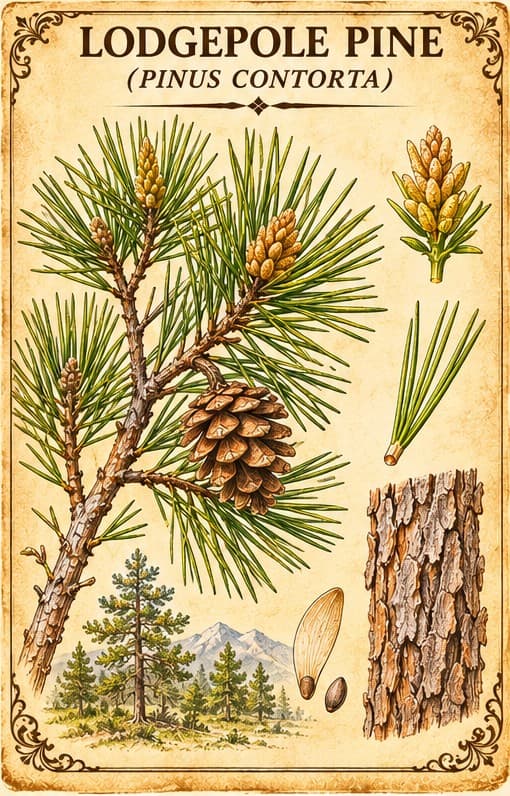
Lodgepole Pine
Pinus contorta
A western North American pine whose trunks were used as tipi poles. Its pitch was a favorite Native American remedy for colds, coughs, sore throats and sores.
Safety at a glance
- Pregnancy1 note →
- BreastfeedingNothing recorded
- MedicinesNothing recorded
- Who should avoid itNothing recorded
- AllergiesNothing recorded
- ToxicityNothing recorded
Tap a box to read the safety notes below. “Nothing recorded” means our sources don't cover it, not that it's safe.
What is Lodgepole Pine?
- Plant family
- Pinaceae, the pine family
- Parts used
- The pitch (sap), inner bark, needles and buds
- Where it grows
- Western North America
- Genus
- Pinus
- Species
- contorta
Traditionally used for
- Coughs
- Colds
- Sore throat
- Sores (traditional)
Traditionally described as
- Resinous pitch
Health topics
Where Lodgepole Pine appears in symptom search, and why. Being listed doesn't mean it's a proven treatment.
- Cough
Pitch and inner bark were traditional cough remedies across the West. Not studied in people.
- Cuts, Wounds, Burns and Skin Ulcers
Pitch was put on cuts, sores and burns. Not studied in people.
- Sore Throat
Pitch was chewed or sucked for sore throats. Not studied in people.
Traditions that use it
- Native American Ethnobotany
Used by the Thompson, Okanagan, Gitksan, Carrier, Blackfoot, Bella Coola, Kwakiutl and many other western peoples.
How it's prepared
Common ways Lodgepole Pine is prepared or sold. This isn't advice on how to take it; see Safety below.
- Salve
Pitch boiled with grease, rubbed on for colds, chest congestion and sore muscles.[1]Traditional text
Safety
Pregnancy
Lodgepole pine contains isocupressic acid, the chemical in ponderosa pine needles that causes miscarriage in pregnant cattle. Effects in people haven't been studied.[2]Health agency
What does the research say?
Traditional use
These are traditional uses, not proven treatments.
The pitch was the main medicine. The Thompson and Okanagan chewed the gum or boiled it with grease into a salve for colds, coughs, sore throats and chest congestion, and rubbed it on sore muscles and joints.[1]Traditional text
Pitch was put on cuts, sores, burns and boils by the Bella Coola, Quinault and Flathead, and mixed with fat as a skin cream. The Klamath and Carrier put it on sore or snow-blind eyes.[1]Traditional text
The Gitksan, Shuswap and Kutenai took the inner bark or a tea of it for tuberculosis and coughs, and the Okanagan-Colville ate the inner layer for stomach ulcers. The Thompson made a tea of the twigs and needles for flu.[1]Traditional text
The inner bark, seeds and sap were eaten, and the pitch was chewed like gum. The Blackfoot, Cheyenne and Dakota used the trunks as tipi poles.[1]Traditional text
In short
Contains a chemical that causes miscarriage in cattle; effects in people unknown.
Sources
- [1] Native American Ethnobotany Database: Pinus contorta — Botanical Research Institute of Texas (BRIT); compiled by Daniel E. MoermanTraditional text
- [2] Ponderosa Pine (Pinus ponderosa) — USDA Agricultural Research Service, Poisonous Plant Research LaboratoryGovernment health agency
This information is educational and traditional in nature, and is not a substitute for professional medical advice. Unfamiliar word? See what these words mean.