
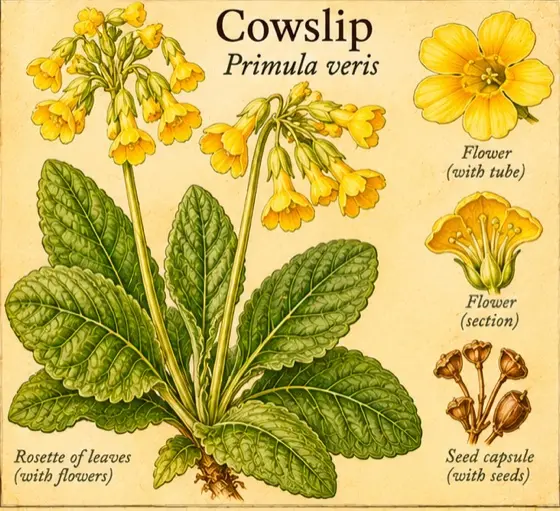
Cowslip
Primula veris
A yellow spring wildflower whose root and flowers are accepted in Europe as traditional remedies to loosen mucus in a cough with a cold.
Safety at a glance
- Pregnancy1 note →
- BreastfeedingNothing recorded
- MedicinesNothing recorded
- Who should avoid it1 note →
- Allergies1 note →
- ToxicityNothing recorded
Tap a box to read the safety notes below. “Nothing recorded” means our sources don't cover it, not that it's safe.
What is Cowslip?
- Plant family
- Primulaceae, the primrose family
- Parts used
- The root and rootstock, and the flowers
- Where it grows
- Europe and western Asia
- Genus
- Primula
- Species
- veris
Also called
Primula, Primrose Root, Oxlip
Traditional names
Primulae Radix, Primulae Flos
Older scientific names
Primula elatior
Traditionally used for
- Cough with a cold (traditional)
- Chest congestion (traditional)
Traditionally described as
- Root and flowers used to loosen mucus
Health topics
Where Cowslip appears in symptom search, and why. Being listed doesn't mean it's a proven treatment.
- Chest Congestion and Bronchitis
Traditionally used to help loosen and cough up mucus.
- Cough
Accepted in Europe as a traditional remedy to loosen mucus in a cough with a cold.
Traditions that use it
- European Folk Medicine
Cowslip root and flowers are traditional European remedies to loosen mucus in a cough with a cold.
How it's prepared
Common ways Cowslip is prepared or sold. This isn't advice on how to take it; see Safety below.
- Extract
Flower liquid extract: 1 to 3 mL up to 3 times a day, no more than 6 mL a day.[1]Health agency
- Tea / Infusion
Root: 0.2 to 0.5 g in 150 mL of boiling water, 3 times a day.[2]Health agency
- Tincture
Root tincture: 0.5 to 1 g, 3 times a day for adults.[2]Health agency
Safety
Who should avoid it
Use with caution if you have gastritis (an inflamed stomach lining) or a stomach ulcer. See a doctor if you get shortness of breath, a fever, or mucus that looks like pus.[2]Health agency
Allergies
Don't use cowslip if you're allergic to it or to other Primula plants, such as primroses.[1]Health agency
Pregnancy
Its safety in pregnancy and breastfeeding hasn't been established, so it isn't recommended at these times.[2]Health agency
How much to use
Too much cowslip root may cause an upset stomach, vomiting or diarrhea. No other side effects or medicine interactions are known.[2]Health agency
What does the research say?
Traditional use
These are traditional uses, not proven treatments.
Cowslip is a spring wildflower of European meadows, with clusters of nodding yellow flowers. Based on long-standing use, European regulators accept both its root and its flowers as traditional herbal medicines. They're used to help loosen mucus and make it easier to cough up when you have a cough with a cold.
This is based on long use, not on clinical trials.[2]Health agency
Technical detail: traditional use as an expectorant; covers Primula veris and/or Primula elatior (oxlip); separate monographs for radix and flos.
European guidance for the root, for adults and teenagers, is 0.2 to 0.5 g of cut root in 150 mL of boiling water as a tea, 3 times a day. Tinctures and extracts are also used. Most root preparations aren't recommended for children under 12, but a few liquid extracts and tinctures have doses for children from age 4. See a doctor if the cough lasts more than 1 week.[2]Health agency
European guidance for the flowers, for adults and teenagers, is 1 g of cut flowers in 150 mL of boiling water as a tea, 3 times a day. A liquid extract can be taken at 1 to 3 mL up to 3 times a day, but no more than 6 mL a day. Flower preparations aren't recommended for children under 12.[1]Health agency
In short
Use with caution with gastritis or stomach ulcers. Not recommended in pregnancy or for young children.
Sources
- [1] Community herbal monograph on Primula veris L. and/or Primula elatior (L.) Hill, flos (EMA/HMPC/136582/2012) — European Medicines Agency, Committee on Herbal Medicinal Products (HMPC)Government health agency
- [2] Community herbal monograph on Primula veris L. and/or Primula elatior (L.) Hill, radix (EMA/HMPC/104095/2012) — European Medicines Agency, Committee on Herbal Medicinal Products (HMPC)Government health agency
This information is educational and traditional in nature, and is not a substitute for professional medical advice. Unfamiliar word? See what these words mean.