
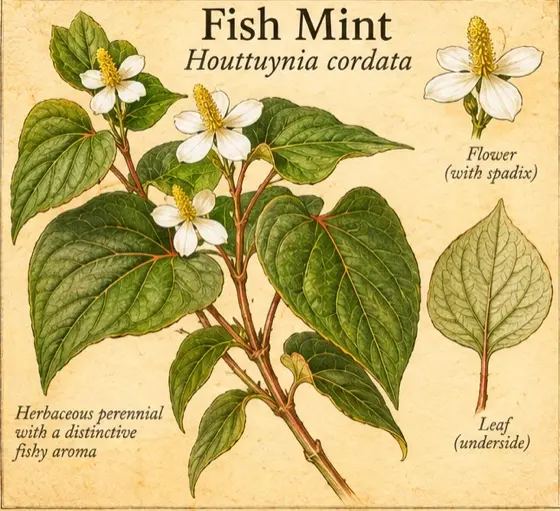
Fish Mint
Houttuynia cordata
An edible Asian plant named for its fishy smell, used in Chinese medicine (yu xing cao) for pneumonia, coughs, colds and fever. In lab studies it reduced inflammation and acted against germs.
Safety at a glance
- PregnancyNothing recorded
- BreastfeedingNothing recorded
- MedicinesNothing recorded
- Who should avoid itNothing recorded
- AllergiesNothing recorded
- Toxicity1 note →
Tap a box to read the safety notes below. “Nothing recorded” means our sources don't cover it, not that it's safe.
What is Fish Mint?
- Plant family
- Saururaceae, the lizard's-tail family
- Parts used
- The leaves and stems (eaten fresh or used as medicine)
- Where it grows
- East and Southeast Asia
- Genus
- Houttuynia
- Species
- cordata
Also called
Fish Leaf, Chameleon Plant
Regional names
Diếp Cá
Traditional names
Yu Xing Cao
Traditionally used for
- Food
- Pneumonia and cough (traditional Chinese)
- Colds and fever (traditional)
Traditionally described as
- Rich in essential oils and flavonoids
Health topics
Where Fish Mint appears in symptom search, and why. Being listed doesn't mean it's a proven treatment.
- Colds and Nasal Congestion
Used with other herbs in Chinese medicine for colds and fever.
- Cough
A traditional Chinese remedy for pneumonia, lung abscess and cough.
- Fever
A traditional Chinese remedy for fever, usually combined with other herbs.
Traditions that use it
- Traditional Chinese Medicine
Known as yu xing cao. Used for pneumonia and lung abscess, and with other herbs for dysentery, colds, fever and mumps.
Safety
Toxicity testing
Fish mint contains alkaloids related to aristolochic acid. A 2023 review says these compounds limit its development and use as a medicine, and discusses its safety as a food and medicine.[1]Study
Technical detail: aristolochic acid-type alkaloids.
What does the research say?
Traditional use
These are traditional uses, not proven treatments.
Fish mint is a leafy plant that's also eaten as food. In China the stems and leaves have a long history as medicine for pneumonia and lung abscess. With other herbs, they're used for:
- Dysentery
- Colds and fever
- Mumps
It's used against colds, cough, fever, pneumonia, mumps and tumors, and plays a role in traditional health care.[3]Study
Laboratory & animal research
Lab and animal results show what might be worth studying in people. They don't show that the herb has these effects in humans.
Fish mint contains essential oils, flavonoids, alkaloids and phenolic acids. In lab and animal studies, it reduced lung injury and inflammation, acted against bacteria and viruses, strengthened protective barriers in the vagina, mouth and gut, and slowed several types of tumors.[2]Study
In lab and animal studies, its essential oils, carbohydrates and flavonoids eased inflammatory bowel disease by changing the gut environment.[1]Study
Technical detail: mechanisms involve the intestinal microbiota and barrier; related formulas include Xiezhuo Jiedu Formula.
In short
Contains alkaloids related to aristolochic acid, which limit its use as a medicine.
Sources
- [1] Houttuynia cordata thunb. alleviates inflammatory bowel disease by modulating intestinal microenvironment: a research review · DOI: 10.3389/fimmu.2023.1306375Peer-reviewed study
- [2] Houttuynia cordata Thunb: An Ethnopharmacological Review · DOI: 10.3389/fphar.2021.714694Peer-reviewed study
- [3] Pharmacological Effects of Houttuynia cordata Thunb (H. cordata): A Comprehensive Review · DOI: 10.3390/ph15091079Peer-reviewed study
This information is educational and traditional in nature, and is not a substitute for professional medical advice. Unfamiliar word? See what these words mean.