
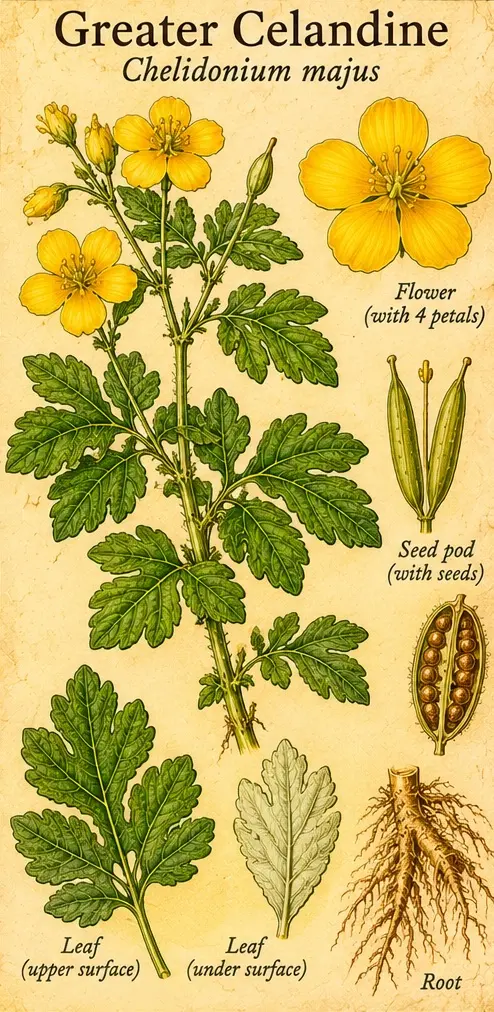
Greater Celandine
Chelidonium majus
A yellow-flowered poppy-family plant long used for stomach and bile complaints. European regulators concluded that taking it by mouth is too risky because it can cause hepatitis.
Safety at a glance
- PregnancyNothing recorded
- BreastfeedingNothing recorded
- MedicinesNothing recorded
- Who should avoid itNothing recorded
- AllergiesNothing recorded
- Toxicity4 notes →
Tap a box to read the safety notes below. “Nothing recorded” means our sources don't cover it, not that it's safe.
What is Greater Celandine?
- Plant family
- Papaveraceae, the poppy family
- Parts used
- The flowering aerial parts (herb); its orange sap has been used on the skin
- Where it grows
- Europe and western and central Asia; naturalized in North America
- Genus
- Chelidonium
- Species
- majus
Also called
Celandine, Swallowwort, Tetterwort
Traditional names
Bai Qu Cai, Chelidonii Herba
Traditionally used for
- Stomach and bile complaints (traditional; no longer recommended)
- Cough and spasms (traditional Chinese)
Traditionally described as
- Orange sap rich in alkaloids such as sanguinarine and chelerythrine
Health topics
Where Greater Celandine appears in symptom search, and why. Being listed doesn't mean it's a proven treatment.
- Gallbladder, Gallstones and Bile Flow
Traditionally used for gallbladder and bile complaints, but no longer recommended because of liver injury.
- Liver Safety Warnings
Taken by mouth, it has caused many cases of hepatitis; European regulators judged its risks to outweigh its benefits.
- Poisonous Plants
Contains alkaloids that can injure the liver when taken by mouth.
Traditions that use it
- Traditional Chinese Medicine
Known as bai qu cai, it's used to relieve coughs, asthma, spasms and pain.
- European Folk Medicine
Used for centuries in Europe for stomach, gallbladder and bile complaints, taken as a tea or tincture; also applied to the skin.
Natural compounds
How it's prepared
Common ways Greater Celandine is prepared or sold. This isn't advice on how to take it; see Safety below.
- Tea / Infusion
Traditionally taken as a tea; liver injury has been reported after tea use.[1]Health agency
- Tincture
Traditionally taken as a tincture; not recommended by mouth because of liver injury.[1]Health agency
Safety
Toxicity testing
Greater celandine taken by mouth can cause hepatitis (liver inflammation). In one series, 10 people developed acute hepatitis over 2 years, probably caused by greater celandine, and 5 had marked blockage of bile flow. All recovered quickly after stopping it, with liver tests back to normal within 2 to 6 months.[1]Health agency
Technical detail: other causes (viral, autoimmune, hereditary, alcohol) were excluded; liver biopsies were consistent with drug-induced damage. In probable cases, liver injury occurred within 90 days and the daily alkaloid dose exceeded 9 mg.
A 72-year-old man in the United States developed acute hepatitis after taking a greater celandine supplement for nausea. Most earlier cases of liver injury were reported in Europe. Doctors seeing liver injury should ask about herbal supplements, especially those taken for common stomach symptoms.[2]Study
A 60-year-old woman developed jaundice (yellow skin and eyes), nausea, loss of appetite and tiredness soon after starting a greater celandine preparation. Tests showed acute hepatitis, and other causes were ruled out. She gradually improved after stopping it.[3]Study
Technical detail: raised AST, ALT, bilirubin and INR; biopsy showed portal inflammation, centrilobular necrosis and giant-cell transformation.
Sanguinarine, one of its alkaloids, damaged DNA in mouse bone marrow cells and in some lab tests.[1]Health agency
Technical detail: genotoxicity; DNA adducts with sanguinarine and chelerythrine in the presence of rat liver microsomes.
What does the research say?
Traditional use
These are traditional uses, not proven treatments.
Greater celandine is a poppy-family wildflower with yellow four-petaled flowers and an orange sap. For centuries, its leaf preparations have been used as a natural remedy for stomach and gut symptoms, and often for gallbladder and bile problems.[2]Study
In China, where it's called bai qu cai, it's used to relieve coughs, asthma, spasms and pain. Scientists have found 94 alkaloids in the plant. In lab studies, they acted against germs, inflammation, viruses and tumors.[4]Study
Technical detail: benzophenanthridine, protoberberine, aporphine and protopine alkaloids.
Research in people
European regulators reviewed greater celandine in 2011. They found that evidence it works is lacking. They also found that its traditional use by mouth is outweighed by many reports of liver and bile-duct harm, and by products being withdrawn in several European countries for safety reasons. They concluded that the risks of taking it by mouth outweigh the benefits, and that safer herbal medicines are available.[1]Health agency
Technical detail: benefit-risk of oral use considered negative; no EU herbal monograph was issued; cutaneous use not sufficiently supported by market data on single-herb products.
In short
Can cause hepatitis when taken by mouth. European regulators judged its risks to outweigh its benefits.
Sources
- [1] Assessment report on Chelidonium majus L., herba (EMA/HMPC/369801/2009) — European Medicines Agency, Committee on Herbal Medicinal Products (HMPC)Government health agency
- [2] A Yellow Flower With Jaundice Power: Liver Injury Attributed to Greater Celandine · DOI: 10.14309/crj.0000000000001347Peer-reviewed study
- [3] Chelidonium majus-Induced Hepatitis: A Case Report of Herb-Induced Liver Injury · DOI: 10.7759/cureus.109572Peer-reviewed study
- [4] Alkaloids in Chelidonium majus L: a review of its phytochemistry, pharmacology and toxicology · DOI: 10.3389/fphar.2024.1440979Peer-reviewed study
This information is educational and traditional in nature, and is not a substitute for professional medical advice. Unfamiliar word? See what these words mean.