
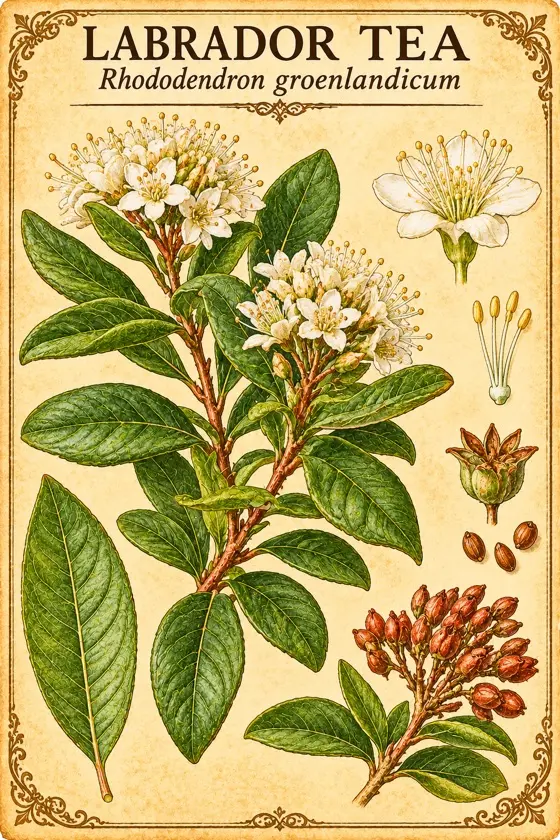
Labrador Tea
Rhododendron groenlandicum
An evergreen bog shrub drunk as a tea by the Cree of northern Quebec, who use it for diabetes symptoms. In obese mice, it lowered blood sugar, insulin and liver fat.
Safety at a glance
- Pregnancy1 note →
- BreastfeedingNothing recorded
- MedicinesNothing recorded
- Who should avoid itNothing recorded
- AllergiesNothing recorded
- Toxicity2 notes →
Tap a box to read the safety notes below. “Nothing recorded” means our sources don't cover it, not that it's safe.
What is Labrador Tea?
- Plant family
- Ericaceae, the heather family
- Parts used
- The leaves
- Where it grows
- Bogs and boreal forests of northern North America and Greenland
- Genus
- Rhododendron
- Species
- groenlandicum
Also called
Bog Labrador Tea, Hudson's Bay Tea, Muskeg Tea
Older scientific names
Ledum groenlandicum
Traditionally used for
- Diabetes symptoms (Cree traditional and animal research)
- Liver
- kidney and lung inflammation (traditional)
Traditionally described as
- Leaves rich in flavonoids such as catechin and quercetin
Health topics
Where Labrador Tea appears in symptom search, and why. Being listed doesn't mean it's a proven treatment.
- Fatty Liver (NAFLD)
Reduced liver fat by 42% in mice on a high-fat diet.
- High Blood Sugar
A Cree remedy for diabetes symptoms; lowered blood sugar and insulin in obese mice.
- Poisonous Plants
Related species contain toxic ledol, and rhododendrons can contain grayanotoxins.
Traditions that use it
- Native American Ethnobotany
A beverage and medicinal tea of the Cree Nations of northern Quebec, used for diabetes symptoms and for inflammation of the liver, kidneys, lungs and digestive system.
Natural compounds
How it's prepared
Common ways Labrador Tea is prepared or sold. This isn't advice on how to take it; see Safety below.
- Tea / Infusion
The leaves are steeped as a beverage and medicinal tea.[1]Study
Safety
Pregnancy
In Russian folk medicine, the related marsh Labrador tea has been used to cause abortion. The safety of Labrador tea in pregnancy hasn't been studied.[2]Study
Toxicity testing
Some Labrador tea species contain ledol, a toxic compound in the leaf oil. This species (Rhododendron groenlandicum) contains much less ledol than its relative, marsh Labrador tea (R. tomentosum), so it's considered less toxic.[2]Study
Rhododendron leaves can contain grayanotoxins. Poisoning causes dizziness, low blood pressure, vomiting, loss of coordination and, in severe cases, paralysis. Most grayanotoxin poisoning comes from "mad honey" made from rhododendron nectar. Whether Labrador tea itself contains grayanotoxins isn't well studied.[2]Study
Contamination
Labrador tea species share common names and can be mistaken for one another, so make sure you have the right plant.[2]Study
What does the research say?
Traditional use
These are traditional uses, not proven treatments.
Labrador tea is a small evergreen shrub of northern bogs and forests, in the heather family, with clusters of white flowers. The Cree Nations of northern Quebec drink it as an everyday beverage and as a medicinal tea. Working with Cree communities, researchers identified it as a traditional remedy for diabetes symptoms.[1]Study
In Canada, the Cree have long used Labrador tea for inflammation affecting the liver, kidneys, lungs and digestive system. "Labrador tea" covers 8 related shrubs across the cooler parts of the Northern Hemisphere. Their leaves are rich in flavonoids, phenolic acids and an aromatic essential oil. Lab studies report antioxidant, antimicrobial, blood-sugar-lowering and liver-protecting effects, which line up with traditional uses. More research is needed to confirm them.[2]Study
Laboratory & animal research
Lab and animal results show what might be worth studying in people. They don't show that the herb has these effects in humans.
In obese, insulin-resistant mice on a high-fat diet, Labrador tea extract for 8 weeks lowered blood sugar by 13%, blood insulin by 65% and liver fat by 42%. It helped muscle and liver respond better to insulin. This is an animal study only.[1]Study
Technical detail: 125, 250 and 500 mg/kg in diet-induced obese C57BL/6 mice; oral glucose tolerance response −18.2%; Akt and AMPK activation; GLUT4 +53% in muscle.
In the same kind of obese mice, Labrador tea reduced kidney scarring and halved fat build-up in the kidneys. It also tended to reduce protein leaking into the urine, an early sign of kidney damage.[3]Study
Technical detail: 250 mg/kg/day for 8 weeks; renal fibrosis 4.85 → 3.27 AU; albumin-creatinine ratio 0.69 → 0.53 (trend).
Scientists traced part of Labrador tea's effect in fat cells to two related compounds working together: catechin and epicatechin, the same type of flavonoids found in green tea.[4]Study
Technical detail: bioassay-guided fractionation of an 80% ethanol extract; glitazone-like adipogenic activity in 3T3-L1 cells.
In short
Related species contain toxic ledol; rhododendrons can contain grayanotoxins. Safety in pregnancy unknown.
Sources
- [1] Labrador tea (Rhododendron groenlandicum) attenuates insulin resistance in a diet-induced obesity mouse model · DOI: 10.1007/s00394-015-0908-zPeer-reviewed study
- [2] Phytochemical Profiling and Biological Activities of Rhododendron Subsect. Ledum: Discovering the Medicinal Potential of Labrador Tea Species in the Northern Hemisphere · DOI: 10.3390/plants13060901Peer-reviewed study
- [3] Rhododendron groenlandicum (Labrador tea), an antidiabetic plant from the traditional pharmacopoeia of the Canadian Eastern James Bay Cree, improves renal integrity in the diet-induced obese mouse model · DOI: 10.3109/13880209.2015.1137953Peer-reviewed study
- [4] A combination of (+)-catechin and (-)-epicatechin underlies the in vitro adipogenic action of Labrador tea (Rhododendron groenlandicum), an antidiabetic medicinal plant of the Eastern James Bay Cree pharmacopeia · DOI: 10.1016/j.jep.2015.12.021Peer-reviewed study
This information is educational and traditional in nature, and is not a substitute for professional medical advice. Unfamiliar word? See what these words mean.